Who Was Abraham in the Bible? The Complete Story of the Father of Faith
Abraham is called the father of faith. Jews, Christians, and Muslims all trace their spiritual heritage back to him. But his story does not begin with a hero. It begins with a seventy-five-year-old man with no children, living in a comfortable city, who heard God tell him to leave everything and go somewhere he had never seen. He went. Over the next hundred years he made mistakes, waited decades for a promise, and faced the hardest test any parent could imagine.
If you have searched for who Abraham was in the Bible, or what his story teaches us today, this is a complete guide. We will walk through God’s call, his journey to Canaan, his separation from Lot, God’s covenant and the stars, Hagar and Ishmael, the visitors at Mamre, the birth of Isaac, the test on Mount Moriah, how the New Testament remembers him, and five practical life lessons his story still speaks into ours.
Who Was Abraham in the Bible?
Abraham, first called Abram, was the son of Terah, born in Ur of the Chaldeans in ancient Mesopotamia (Genesis 11:27-31). God called him to leave his homeland and promised to make him into a great nation through which all the peoples of the earth would be blessed. He became the father of Isaac, the grandfather of Jacob, and the ancestor of the people of Israel. His story is told in Genesis 11:26-25:11. The Bible calls him “God’s friend” (James 2:23).
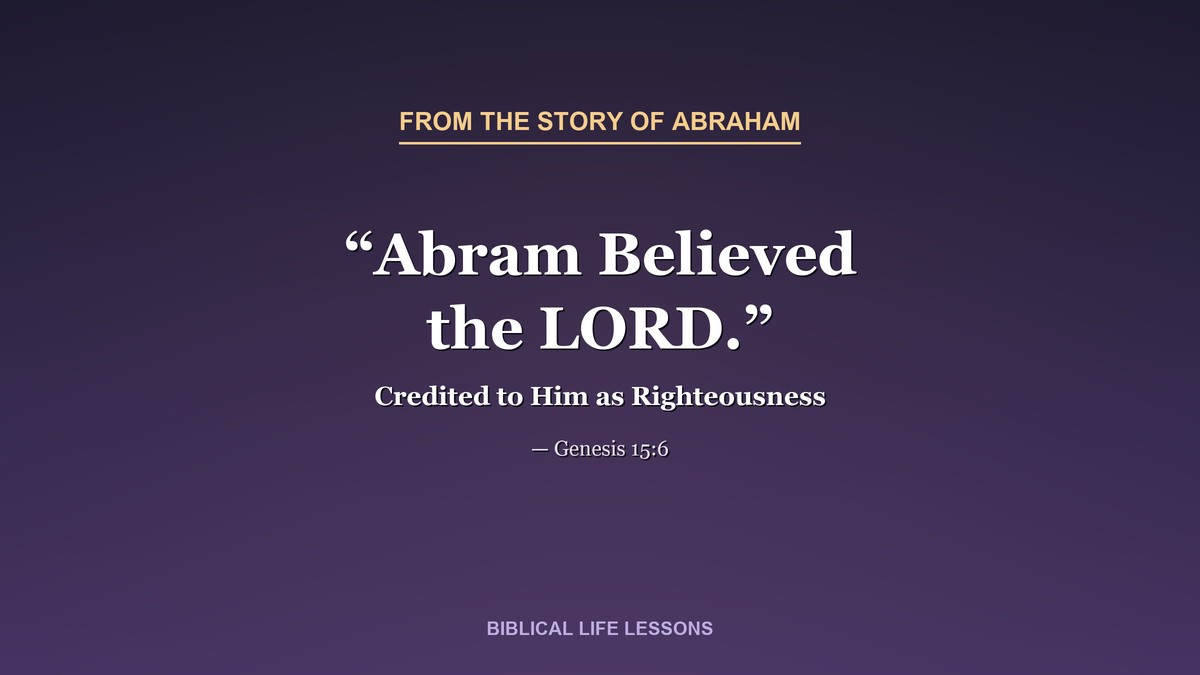
“Abram believed the LORD, and he credited it to him as righteousness.” (Genesis 15:6, NIV)
Three things stand out about him. He was obedient, leaving everything familiar when God called. He was patient, waiting twenty-five years for the son God promised. And he was imperfect, more than once taking matters into his own hands. Yet through it all, he kept returning to the God who kept His word.
The Call to Go (Genesis 12:1-9)
Abram’s father Terah had moved the family from Ur to Harran, in what is now southern Turkey. There, the LORD spoke to Abram:
“Go from your country, your people and your father’s household to the land I will show you. I will make you into a great nation, and I will bless you; I will make your name great, and you will be a blessing.” (Genesis 12:1-2, NIV)
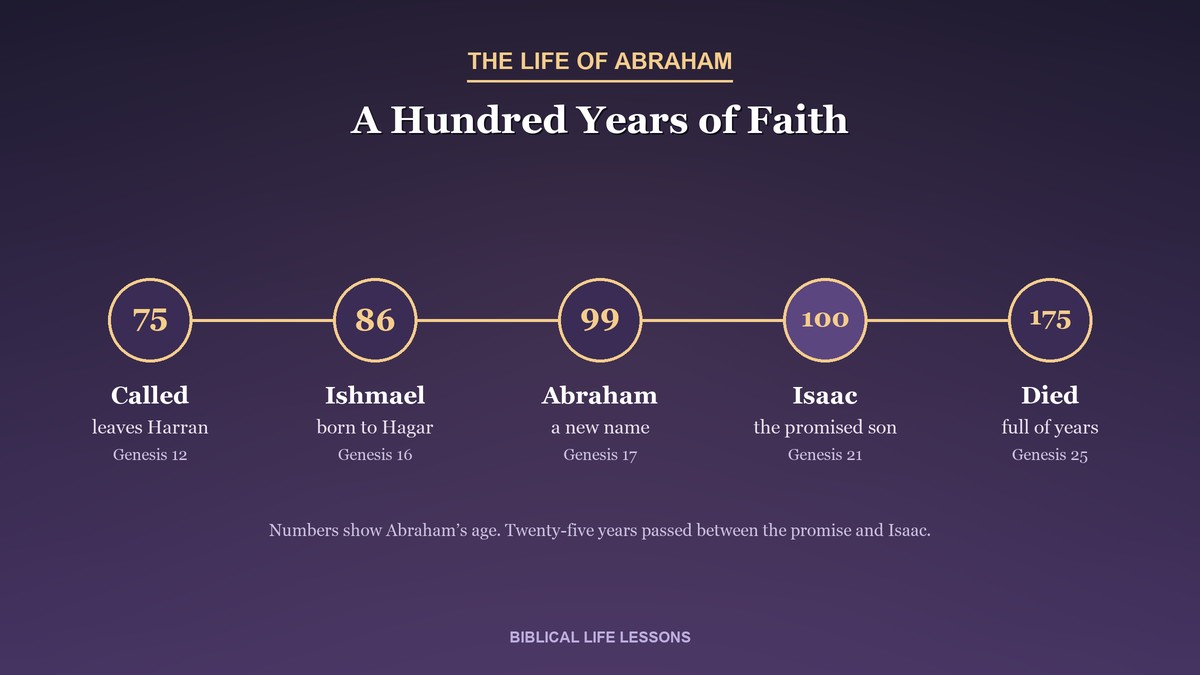
God did not give him a map, a timeline, or even the name of the place. He gave him a promise. “So Abram went, as the LORD had told him” (Genesis 12:4). He was seventy-five years old. He took his wife Sarai, his nephew Lot, and everything they owned, and traveled to the land of Canaan. When he arrived, God said, “To your offspring I will give this land,” and Abram built an altar to the LORD (Genesis 12:7).
Centuries later, the book of Hebrews summed up that moment: “By faith Abraham, when called to go to a place he would later receive as his inheritance, obeyed and went, even though he did not know where he was going” (Hebrews 11:8).
Detour to Egypt (Genesis 12:10-20)
Not long after arriving, a famine struck and Abram went down to Egypt. Afraid the Egyptians would kill him to take his beautiful wife, he told Sarai to say she was his sister. Pharaoh took her into his palace, and God struck Pharaoh’s household with diseases until the truth came out. Pharaoh rebuked Abram and sent them away. The man of faith had just acted out of fear, and it would not be the last time (Genesis 20).
Abram and Lot (Genesis 13-14)
Abram and Lot both had so many flocks and herds that the land could not support them together, and their herders began to quarrel. Abram, the elder, could have claimed the best land for himself. Instead he said, “Let’s not have any quarreling between you and me … If you go to the left, I’ll go to the right; if you go to the right, I’ll go to the left” (Genesis 13:8-9).
Lot chose the well-watered plain of the Jordan, near the city of Sodom. Abram took what was left, and God reaffirmed His promise: all the land Abram could see would belong to his descendants. Later, when Lot was captured by invading kings, Abram gathered 318 trained men, rescued him, and then gave a tenth of everything to Melchizedek, the mysterious king of Salem and “priest of God Most High” (Genesis 14:18-20).
Count the Stars (Genesis 15)
Years had passed and Abram still had no child. God came to him in a vision: “Do not be afraid, Abram. I am your shield, your very great reward” (Genesis 15:1). Abram answered honestly that a servant in his house would be his heir.
God took him outside and said, “Look up at the sky and count the stars—if indeed you can count them. … So shall your offspring be” (Genesis 15:5). And then comes one of the most important verses in the Bible: “Abram believed the LORD, and he credited it to him as righteousness” (Genesis 15:6). The apostle Paul would later build his teaching on faith around this very verse (Romans 4:3).
That night, God confirmed His promise with a covenant ceremony. A smoking firepot and a blazing torch passed between the pieces of the animals Abram had prepared, a sign that God Himself was binding Himself to keep His word.
Hagar and Ishmael (Genesis 16)
Ten years after arriving in Canaan, Sarai was still childless. She suggested that Abram have a child with her Egyptian servant, Hagar, a common custom at the time. Abram agreed, Hagar became pregnant, and tension filled the household. Hagar fled into the desert, where the angel of the LORD found her by a spring and promised that her son would also become a great people. She called God “the One who sees me” (Genesis 16:13). Abram was eighty-six when Ishmael was born.
It was an attempt to help God keep His promise, and it brought lasting pain. Yet even in that mistake, God showed compassion to everyone involved.
A New Name (Genesis 17)
When Abram was ninety-nine, God appeared to him again: “I am God Almighty; walk before me faithfully and be blameless” (Genesis 17:1). He changed Abram’s name, meaning “exalted father,” to Abraham, “father of many nations.” He changed Sarai’s name to Sarah and promised that she would have a son within a year. He gave circumcision as the sign of the covenant.
Abraham’s reaction was painfully human: he fell facedown and laughed. A son, at a hundred years old? God’s answer was clear: the son would be named Isaac, which means “he laughs.”
Visitors at Mamre and the Plea for Sodom (Genesis 18-19)
One hot afternoon, three visitors appeared near Abraham’s tent by the great trees of Mamre. Abraham ran to welcome them and prepared a feast. One of them was the LORD Himself, who repeated the promise of a son. Sarah, listening inside the tent, laughed to herself. The LORD asked, “Is anything too hard for the LORD?” (Genesis 18:14).
Then the LORD revealed that He was going to judge the wicked city of Sodom, where Lot lived. Abraham stepped forward and began to plead: “Will not the Judge of all the earth do right?” (Genesis 18:25). Would God spare the city for fifty righteous people? For forty-five? Forty? Thirty? Twenty? Ten? Each time God agreed. In the end, not even ten could be found. But God rescued Lot and his daughters before the city was destroyed.
Isaac Is Born (Genesis 21)
“Now the LORD was gracious to Sarah as he had said” (Genesis 21:1). Twenty-five years after God first called him, Abraham held his son Isaac. He was a hundred years old. Sarah said, “God has brought me laughter, and everyone who hears about this will laugh with me” (Genesis 21:6).
The joy also brought sorrow. When Ishmael mocked the young Isaac, Sarah insisted that Hagar and her son be sent away. Abraham was deeply distressed, but God promised to care for Ishmael too, and He did, meeting Hagar and the boy in the desert with water and a promise.
The Test on Mount Moriah (Genesis 22)
Then came the hardest moment of Abraham’s life. “Some time later God tested Abraham” (Genesis 22:1). God told him, “Take your son, your only son, whom you love—Isaac—and go to the region of Moriah. Sacrifice him there as a burnt offering on a mountain I will show you” (Genesis 22:2).
Early the next morning, Abraham set out. On the third day, as father and son climbed the mountain, Isaac asked, “The fire and wood are here, but where is the lamb for the burnt offering?” Abraham answered, “God himself will provide the lamb for the burnt offering, my son” (Genesis 22:7-8).
Abraham built the altar, bound Isaac, and took the knife. At that moment the angel of the LORD called out, “Do not lay a hand on the boy. … Now I know that you fear God, because you have not withheld from me your son, your only son” (Genesis 22:12). Abraham looked up and saw a ram caught by its horns in a thicket, and offered it instead.
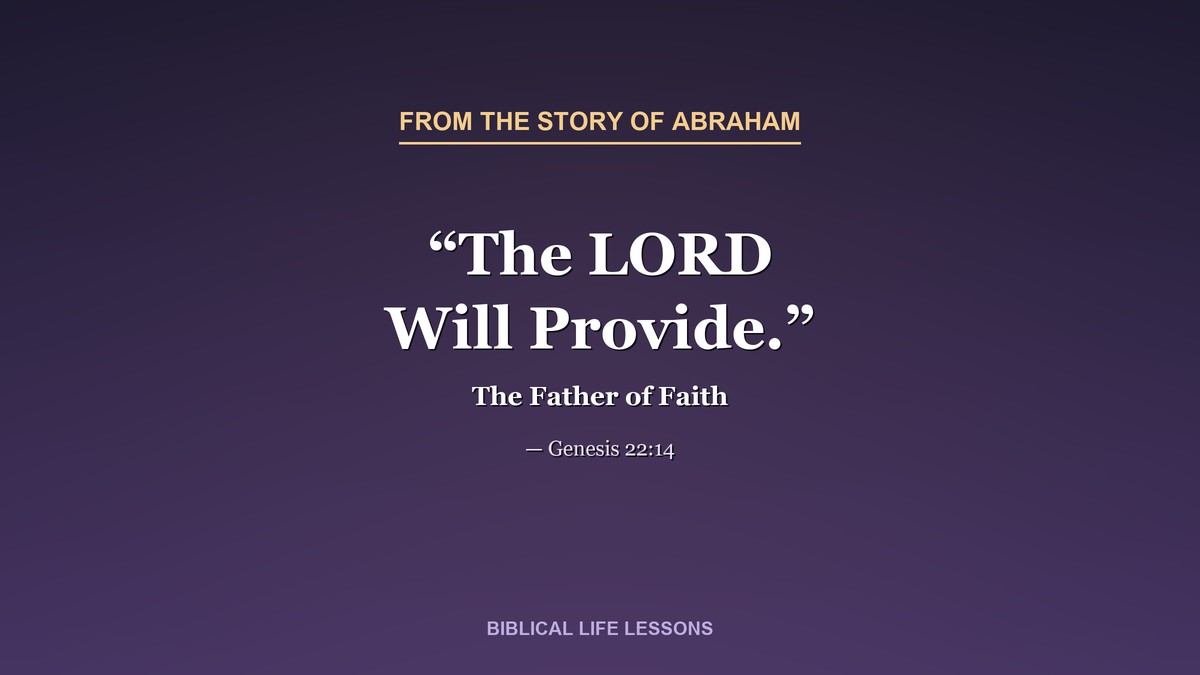
“So Abraham called that place The LORD Will Provide.” (Genesis 22:14, NIV)
Hebrews tells us what Abraham was thinking on that mountain: “Abraham reasoned that God could even raise the dead” (Hebrews 11:19). He did not understand the command, but he trusted the God who had promised that Isaac would carry his line.
Abraham’s Final Years (Genesis 23-25)
Sarah died at 127, and Abraham bought a cave at Machpelah to bury her, the first piece of the promised land he ever owned. He sent his servant back to his homeland to find a wife for Isaac, and God led the servant to Rebekah (Genesis 24). Abraham died at 175, “at a good old age, an old man and full of years,” and his sons Isaac and Ishmael buried him beside Sarah (Genesis 25:8-9).
Abraham in the New Testament
The New Testament mentions Abraham more than seventy times. Paul uses him as the great example of being made right with God by faith rather than by works: “Understand, then, that those who have faith are children of Abraham” (Galatians 3:7). James points to Moriah as proof that real faith shows itself in action (James 2:21-23). And Jesus said something astonishing about him: “Before Abraham was born, I am!” (John 8:58). The blessing promised to Abraham for “all peoples on earth” finds its fulfillment in Jesus, Abraham’s descendant, through whom people from every nation are welcomed into God’s family.
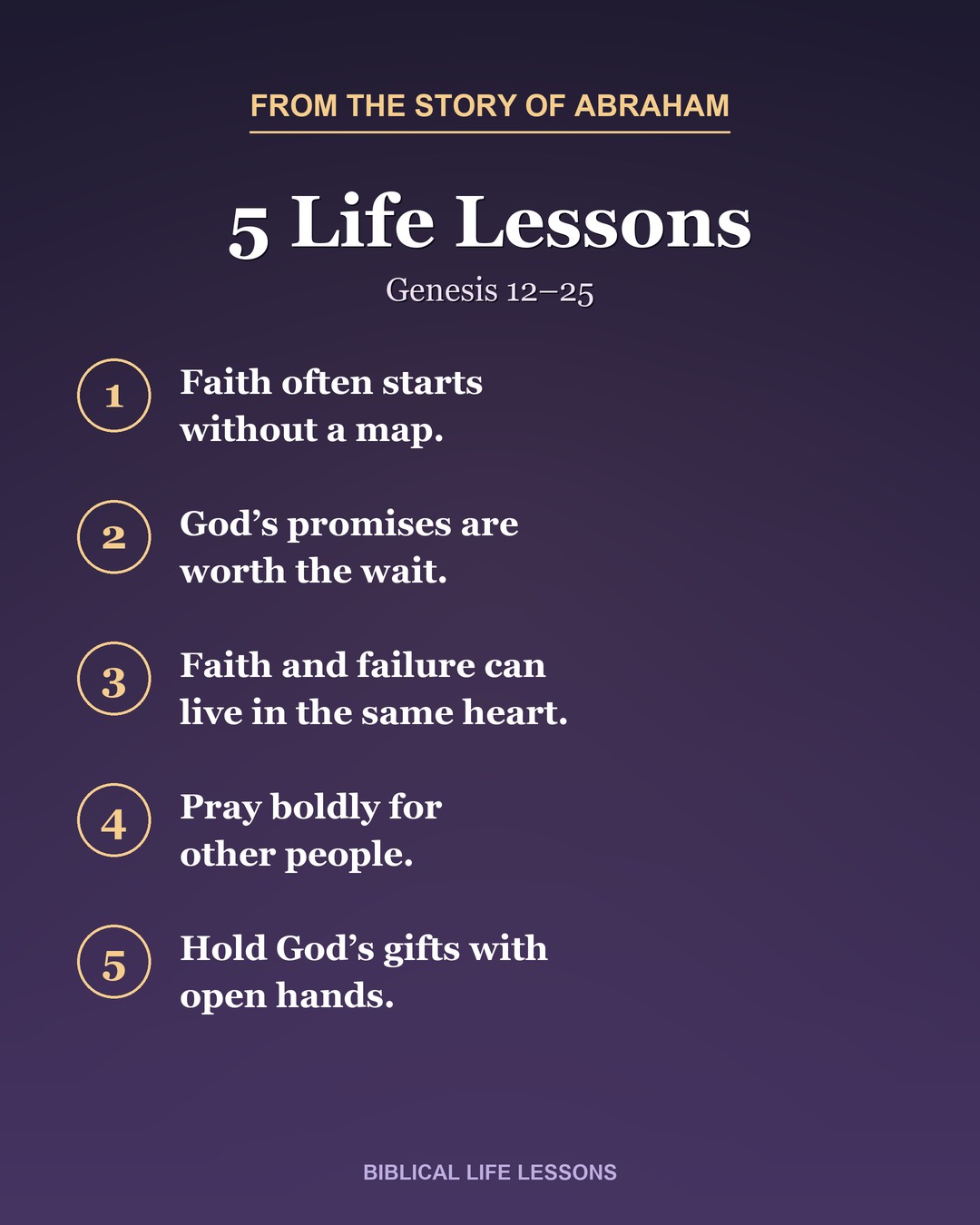
Five Life Lessons from Abraham’s Story
1. Faith often starts without a map.
God told Abraham to go “to the land I will show you,” not the land He had already shown him. Faith rarely gets the full plan up front. It takes the next step because it trusts the One who knows the destination.
2. God’s promises are worth the wait.
Twenty-five years passed between the promise and Isaac’s birth. Long delays are not denials. If you are waiting on God, keep looking up at the stars He showed you.
3. Faith and failure can live in the same heart.
The father of faith lied about his wife twice and tried to fulfill God’s promise through Hagar. His story is honest about it, and so is God’s grace. Your mistakes do not cancel God’s faithfulness; they show how much you need it.
4. Pray boldly for other people.
Abraham stood before God and pleaded for a city that was not his own, six times over. God welcomed his persistence. Bring the people and places on your heart to God, and do not be afraid to keep asking.
5. Hold God’s gifts with open hands.
Isaac was the miracle Abraham had waited his whole life for, and God asked him to offer him back. Abraham’s willingness showed that he loved the Giver more than the gift. God provided, as He always does. What blessing might God be asking you to trust Him with?
Frequently Asked Questions About Abraham
How old was Abraham when Isaac was born?
Abraham was 100 years old when Isaac was born (Genesis 21:5), and Sarah was about 90.
Why did God change Abram’s name to Abraham?
“Abram” means “exalted father.” God changed it to “Abraham,” meaning “father of many nations,” as a sign of His covenant promise (Genesis 17:5).
Where was Abraham from?
Abraham was born in Ur of the Chaldeans, in southern Mesopotamia (modern-day Iraq). His family later settled in Harran before God called him to Canaan (Genesis 11:31-12:5).
Why did God ask Abraham to sacrifice Isaac?
Genesis 22:1 says God was testing Abraham. God never intended for Isaac to die, and He stopped Abraham and provided a ram. The story showed the depth of Abraham’s trust, and it pointed ahead to the day God would provide His own Son as a sacrifice.
How many sons did Abraham have?
Abraham’s best-known sons are Ishmael, born to Hagar, and Isaac, born to Sarah. After Sarah’s death, he married Keturah and had six more sons (Genesis 25:1-2).
How old was Abraham when he died?
Abraham died at 175 years old and was buried in the cave of Machpelah beside Sarah (Genesis 25:7-10).
Why is Abraham called the father of faith?
Because he believed God’s promise when it seemed impossible, and God credited his faith as righteousness (Genesis 15:6). The New Testament says everyone who has faith in God is a spiritual child of Abraham (Galatians 3:7; Romans 4:16).
Related Reading
For a short devotional on Abraham’s first step of faith, read What Abraham Teaches Us About Saying Yes When You Don’t Know Where You’re Going. For the woman who waited beside him, see Who Was Sarah in the Bible? For the bride God led to his son, read Who Was Rebekah in the Bible? and for his grandson, see Who Was Jacob in the Bible? For the parting of ways with his nephew, read Abraham and Lot: Navigating Worldly Temptations. For his first son, see Life Lessons from Ishmael. For a wider guide to the men and women of Scripture, visit our Characters of the Bible pillar.
A Closing Prayer
Father, thank You for Abraham, and for calling an ordinary man into an extraordinary promise. Give me the faith to take the next step even when I cannot see the road ahead. Help me to keep trusting during the long years of waiting. When I fail, remind me that Your faithfulness is greater than my mistakes. Teach me to pray boldly for others, and to hold every gift You give me with open hands. Thank You that You are the LORD who provides, and that You provided Your own Son for me. In Jesus’ name, Amen.
Subscribe for Daily Email Devotionals
MEET FAITH FRIEND AI
Faith Friend is your friendly AI chatbot on BiblicalLifeLessons.com, here to help you explore the Bible, answer your faith-related questions, and guide you through life lessons based on God’s Word. Whether you’re seeking encouragement, understanding Scripture, or deepening your faith, Faith Friend is always ready to chat.