Who Was Elijah in the Bible? The Complete Story of the Prophet of Fire
Elijah is one of the most dramatic figures in the Bible. He stopped the rain with a word, was fed by ravens, raised a widow’s son, and called down fire from heaven in front of hundreds of false prophets. Then, a day later, he ran for his life and asked God to let him die. He never tasted death at all; he was taken up to heaven in a whirlwind. Centuries later, he appeared on a mountain talking with Jesus.
If you have searched for who Elijah was in the Bible, or what his story teaches us today, this is a complete guide. We will walk through the drought, the ravens, the widow of Zarephath, the showdown on Mount Carmel, his collapse under the broom bush, the gentle whisper at Mount Horeb, his calling of Elisha, the chariot of fire, how he connects to John the Baptist and Jesus, and five practical life lessons his story still speaks into ours.
Who Was Elijah in the Bible?
Elijah was a prophet of Israel who served during the reign of King Ahab in the 9th century BC. He is called “Elijah the Tishbite, from Tishbe in Gilead” (1 Kings 17:1). His name means “My God is the LORD,” which sums up his whole life’s message. His story is told in 1 Kings 17-2 Kings 2. In some older English translations of the New Testament, he is called Elias.
“Elijah was a human being, even as we are. He prayed earnestly that it would not rain, and it did not rain on the land for three and a half years.” (James 5:17, NIV)
Three things stand out about him. He was bold, standing alone against a king, a queen, and hundreds of false prophets. He was a man of prayer, whose prayers shut and opened the sky. And he was deeply human, as capable of fear and exhaustion as any of us. James’s point is exactly that: Elijah was an ordinary person who trusted an extraordinary God.
Israel Under Ahab and Jezebel
Elijah appeared at one of the darkest moments in Israel’s history. King Ahab “did more evil in the eyes of the LORD than any of those before him” (1 Kings 16:30). He married Jezebel, a princess from Sidon, and together they promoted the worship of Baal, a Canaanite god believed to control the rain and storms. Ahab built a temple and an altar for Baal in his capital, Samaria. Jezebel would later try to wipe out the LORD’s prophets.
Into that world, God sent a single prophet with a message aimed straight at Baal’s supposed power.
The Drought and the Ravens (1 Kings 17:1-7)
Elijah walked into Ahab’s court and announced: “As the LORD, the God of Israel, lives, whom I serve, there will be neither dew nor rain in the next few years except at my word” (1 Kings 17:1). If Baal really controlled the rain, he was about to be exposed.
Then God sent Elijah into hiding by the Kerith Ravine, east of the Jordan. “The ravens brought him bread and meat in the morning and bread and meat in the evening, and he drank from the brook” (1 Kings 17:6). God fed His prophet through birds known for scavenging, one day at a time. Then the brook dried up.
The Widow of Zarephath (1 Kings 17:8-24)
God sent Elijah to Zarephath, a town in Sidon, the very region Jezebel came from. There he met a widow gathering sticks. When he asked her for bread, she told him the truth: she had only a handful of flour and a little oil, and she was preparing a last meal for herself and her son before they died.
Elijah asked her to make him a small loaf first, and gave her God’s promise: “The jar of flour will not be used up and the jug of oil will not run dry until the day the LORD sends rain on the land” (1 Kings 17:14). She trusted the word, and day after day, the flour and oil did not run out.
Later her son became ill and stopped breathing. Elijah carried him upstairs, stretched himself out over the boy three times, and cried out to God. The LORD heard him, and the boy lived. The widow said, “Now I know that you are a man of God and that the word of the LORD from your mouth is the truth” (1 Kings 17:24). Jesus Himself later mentioned this widow as a sign of God’s grace reaching beyond Israel (Luke 4:25-26).
Fire on Mount Carmel (1 Kings 18)
In the third year of the drought, God sent Elijah back to Ahab. The king greeted him with an accusation: “Is that you, you troubler of Israel?” Elijah answered that the real trouble was Ahab’s abandonment of the LORD (1 Kings 18:17-18). Then he issued a challenge: gather all Israel, along with the 450 prophets of Baal and the 400 prophets of Asherah, on Mount Carmel.
Elijah confronted the people first:
“How long will you waver between two opinions? If the LORD is God, follow him; but if Baal is God, follow him.” (1 Kings 18:21, NIV)
The test was simple. Each side would prepare a bull on an altar but light no fire. “The god who answers by fire, he is God.” The prophets of Baal called on their god from morning until noon and beyond. They danced, shouted, and cut themselves. Elijah mocked them: “Shout louder! Surely he is a god! Perhaps he is deep in thought, or busy, or traveling. Maybe he is sleeping and must be awakened” (1 Kings 18:27). But “there was no response, no one answered, no one paid attention.”
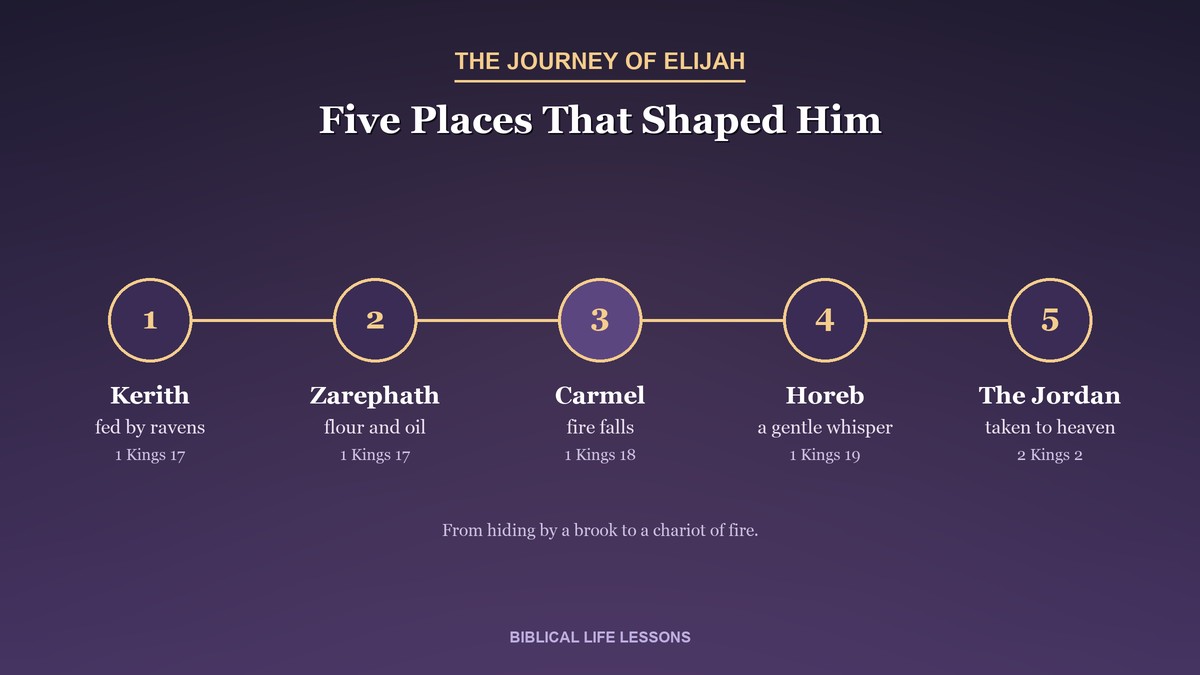
Then Elijah rebuilt the broken altar of the LORD with twelve stones, one for each tribe of Israel. He dug a trench around it and had the sacrifice drenched with water three times, until the trench overflowed. He prayed a short, simple prayer: “Answer me, LORD, answer me, so these people will know that you, LORD, are God” (1 Kings 18:37).
“Then the fire of the LORD fell and burned up the sacrifice, the wood, the stones and the soil, and also licked up the water in the trench” (1 Kings 18:38). The people fell on their faces and cried, “The LORD—he is God! The LORD—he is God!” (1 Kings 18:39).
Afterward, Elijah climbed to the top of Carmel, bent down to the ground, and prayed for rain. Six times his servant looked toward the sea and saw nothing. The seventh time he reported, “A cloud as small as a man’s hand is rising from the sea” (1 Kings 18:44). Soon the sky grew black and heavy rain fell. With God’s power on him, Elijah ran ahead of Ahab’s chariot all the way to Jezreel.
Under the Broom Bush (1 Kings 19:1-8)
You might expect Israel to turn back to God and Elijah to celebrate. Instead, Jezebel sent him a message promising to kill him within a day. “Elijah was afraid and ran for his life” (1 Kings 19:3). He went a day’s journey into the wilderness, sat down under a broom bush, and prayed to die: “I have had enough, LORD. Take my life; I am no better than my ancestors” (1 Kings 19:4).
God’s response is one of the tenderest moments in Scripture. He did not scold Elijah. He let him sleep. Then an angel touched him and said, “Get up and eat.” There was bread baked over hot coals and a jar of water. Elijah ate, drank, and slept again. The angel came back a second time: “Get up and eat, for the journey is too much for you” (1 Kings 19:7). Strengthened by that food, Elijah traveled forty days and forty nights to Horeb, the mountain of God.
The Gentle Whisper (1 Kings 19:9-18)
At Horeb, Elijah went into a cave. God asked him, “What are you doing here, Elijah?” Elijah poured out his heart: he had been zealous for the LORD, Israel had rejected God and killed His prophets, “I am the only one left, and now they are trying to kill me too” (1 Kings 19:10).
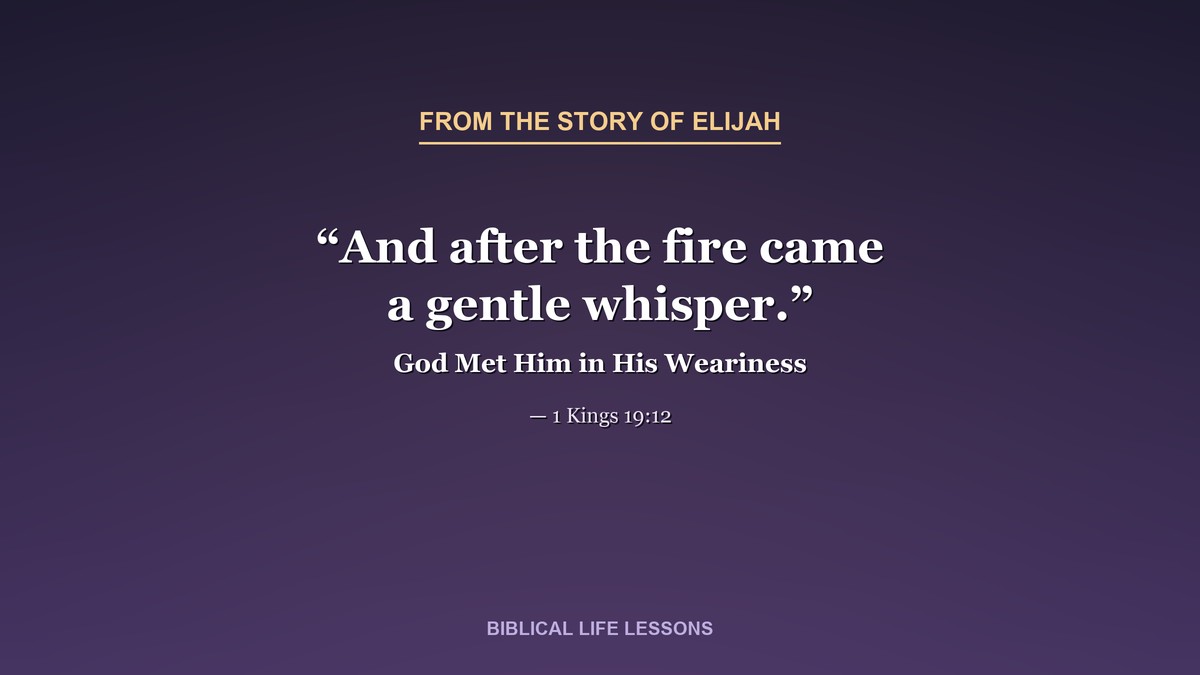
God told him to stand on the mountain. A powerful wind tore the mountains apart, but the LORD was not in the wind. Then an earthquake, but the LORD was not in the earthquake. Then a fire, but the LORD was not in the fire.
“And after the fire came a gentle whisper.” (1 Kings 19:12, NIV)
Elijah wrapped his face in his cloak and went out to meet God. The LORD gave him new work to do: anoint new kings, and anoint Elisha as the prophet who would follow him. And He corrected Elijah’s loneliest belief: “Yet I reserve seven thousand in Israel—all whose knees have not bowed down to Baal” (1 Kings 19:18). Elijah was never as alone as he felt.
Elijah Calls Elisha (1 Kings 19:19-21)
Elijah found Elisha plowing a field with twelve pairs of oxen. He walked up and threw his cloak around him, a sign that Elisha was being called to follow him. Elisha said goodbye to his family, slaughtered his oxen, burned his plowing equipment to cook them, fed the people, and set out to serve Elijah. From that day on, Elijah no longer ministered alone.
Confronting Ahab Again (1 Kings 21)
Ahab wanted a vineyard next to his palace, but its owner, Naboth, refused to sell his family’s inheritance. Jezebel arranged false witnesses, had Naboth stoned to death, and gave Ahab the vineyard. God sent Elijah to meet Ahab right there. “So you have found me, my enemy!” the king said (1 Kings 21:20). Elijah pronounced God’s judgment on Ahab’s house. Surprisingly, Ahab humbled himself, and God showed him a measure of mercy, delaying the disaster (1 Kings 21:27-29).
The Chariot of Fire (2 Kings 2:1-12)
When the time came for God to take Elijah, Elisha refused to leave his side. At the Jordan River, Elijah rolled up his cloak and struck the water, and the river divided so the two of them crossed on dry ground. Elijah asked what he could do for Elisha before he was taken. Elisha answered, “Let me inherit a double portion of your spirit” (2 Kings 2:9).
As they walked along talking, “suddenly a chariot of fire and horses of fire appeared and separated the two of them, and Elijah went up to heaven in a whirlwind” (2 Kings 2:11). Elisha cried out, “My father! My father! The chariots and horsemen of Israel!” He picked up the cloak that had fallen from Elijah and carried on his work.
Elijah, John the Baptist, and Jesus
The very last book of the Old Testament ends with a promise: “See, I will send the prophet Elijah to you before that great and dreadful day of the LORD comes” (Malachi 4:5). In the New Testament, an angel said John the Baptist would go before the Lord “in the spirit and power of Elijah” (Luke 1:17), and Jesus said of John, “he is the Elijah who was to come” (Matthew 11:14).
Then, on the Mount of Transfiguration, Elijah himself appeared with Moses, talking with Jesus (Matthew 17:3). The prophet who once stood alone on Carmel stood beside the One every prophet had pointed to.
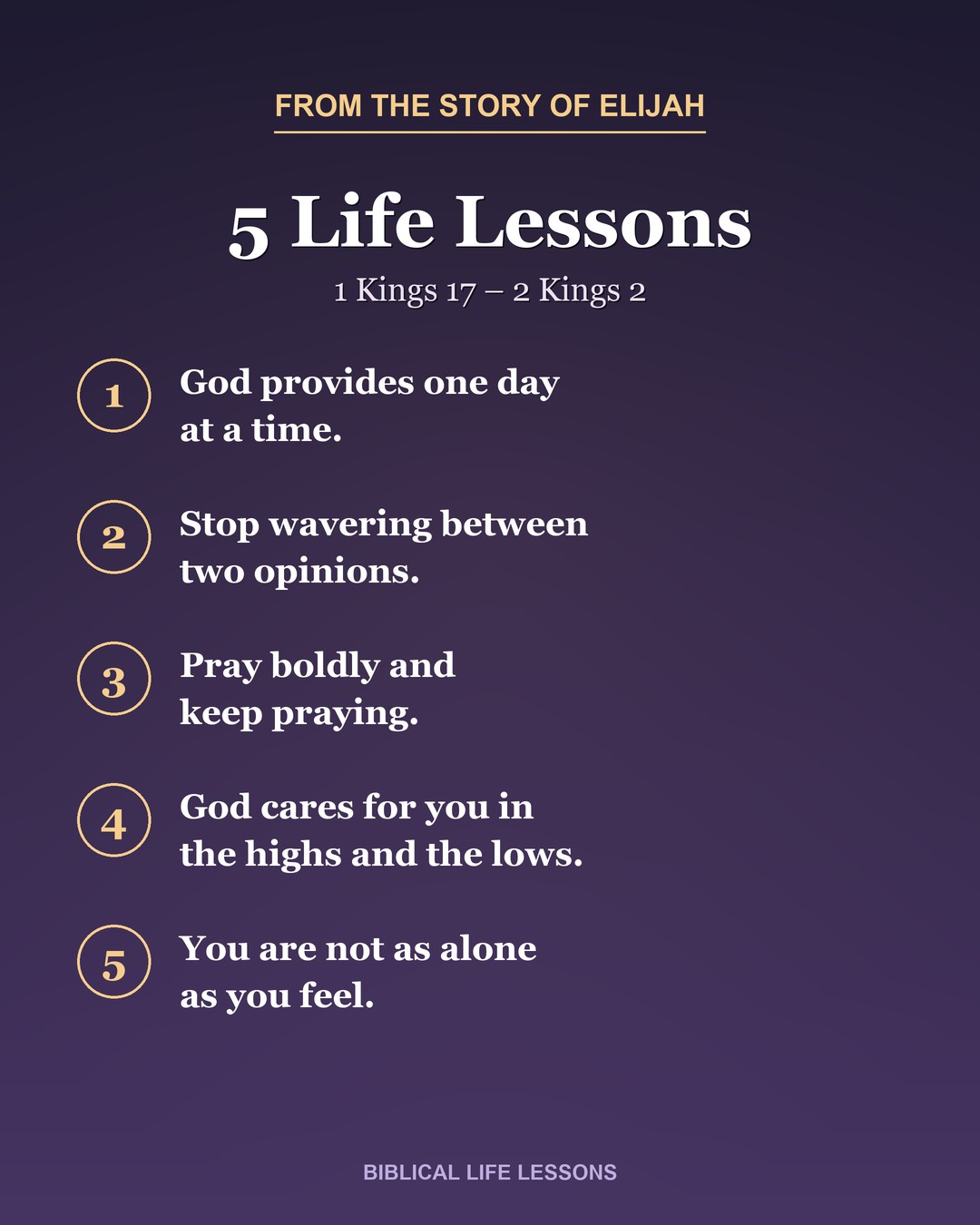
Five Life Lessons from Elijah’s Story
1. God provides one day at a time.
Bread from ravens, morning and evening. Flour that never ran out, but never piled up either. God rarely gave Elijah more than he needed for today. If you are living with little margin, God’s daily faithfulness is still enough.
2. Stop wavering between two opinions.
Elijah’s question on Carmel is still a question for us: “How long will you waver?” Trying to keep one foot in faith and one foot in something else leaves us unsettled. Decide who you will follow, and follow Him.
3. Pray boldly and keep praying.
Elijah prayed for fire, and it fell at once. He prayed for rain, and nothing happened six times. He kept praying until a cloud the size of a hand appeared. James uses Elijah to remind us that “the prayer of a righteous person is powerful and effective” (James 5:16). Don’t stop at the sixth time.
4. Great highs can be followed by deep lows, and God cares for both.
Elijah went from fire on Carmel to despair under a bush in a single day. God’s first answer to his exhaustion was not a lecture but sleep, food, and a gentle touch. If you are burned out, rest and care for your body are not a lack of faith. They may be exactly what God is giving you.
5. You are not as alone as you feel.
“I am the only one left,” Elijah said. God answered with seven thousand faithful people and a companion named Elisha. Discouragement tells us we are on our own. God’s word says otherwise. Ask Him to show you the people He has already placed around you.
Frequently Asked Questions About Elijah
Did Elijah die?
No. The Bible says Elijah was taken up to heaven in a whirlwind, separated from Elisha by a chariot and horses of fire (2 Kings 2:11). Enoch is the only other person in Scripture described as being taken by God without dying (Genesis 5:24).
Is Elias the same as Elijah?
Yes. Elias is the Greek form of the name Elijah. The King James Version uses “Elias” in the New Testament, while modern translations such as the NIV use “Elijah.”
How long was the drought in Elijah’s time?
Three and a half years, according to James 5:17 and Luke 4:25. First Kings 18:1 says the word of the LORD came to Elijah about the rain “in the third year.”
What does the name Elijah mean?
The name Elijah means “My God is the LORD” or “The LORD is my God.”
What was the “still small voice”?
“Still small voice” is the King James wording of 1 Kings 19:12. The NIV translates it as “a gentle whisper.” After a wind, an earthquake, and a fire, God spoke to Elijah quietly.
Who was Elijah’s successor?
Elisha, whom Elijah called while he was plowing (1 Kings 19:19-21). Elisha asked for a double portion of Elijah’s spirit and continued his ministry after Elijah was taken up to heaven.
Is John the Baptist Elijah?
John was not Elijah come back to life; when asked, he said he was not (John 1:21). But he came “in the spirit and power of Elijah” (Luke 1:17), and Jesus said John fulfilled the promise of Elijah’s coming (Matthew 11:14).
Related Reading
For Elijah’s lowest moment and how God met him, read What Elijah Teaches Us About Hearing God When You’re Burned Out. For more on the gentle whisper, see What Elijah Teaches Us About Finding God in the Quiet. For the widow who trusted God with her last meal, read Elijah and the Widow: A Lesson in Divine Provision. For the prophet who carried on his work, see What Elisha’s Life Teaches Us About Trusting God Fully. For the other prophet who stood with Elijah and Jesus on the mountain, read Who Was Moses in the Bible? For another prophet who ran and was met by God’s mercy, see Who Was Jonah in the Bible? For a wider guide to the men and women of Scripture, visit our Characters of the Bible pillar.
A Closing Prayer
Lord, You are God, and there is no other. Thank You for Elijah, an ordinary person who trusted You in extraordinary ways. Give me the courage to stop wavering and follow You with my whole heart. Teach me to pray boldly and to keep praying when the sky is still empty. When I am exhausted and afraid, meet me the way You met Elijah, with rest, with bread, and with a gentle whisper. Remind me that I am not alone. Provide for me today, as You always have. In Jesus’ name, Amen.
Subscribe for Daily Email Devotionals
MEET FAITH FRIEND AI
Faith Friend is your friendly AI chatbot on BiblicalLifeLessons.com, here to help you explore the Bible, answer your faith-related questions, and guide you through life lessons based on God’s Word. Whether you’re seeking encouragement, understanding Scripture, or deepening your faith, Faith Friend is always ready to chat.