Who Was Jonah in the Bible? The Complete Story of the Prophet Who Ran from God
Jonah is one of the most famous — and most surprising — prophets in the Bible. Most people know him as the man swallowed by a great fish. But the fish is only part of the story. Jonah is a prophet who ran from God, prayed from the bottom of the sea, preached to his nation’s worst enemies, and then sulked when God showed them mercy. His short book ends not with a happy resolution, but with a question God asks every one of us.
If you have searched for who Jonah was in the Bible, or what his story teaches us today, this is a complete guide. We will walk through his background, God’s call to Nineveh, his flight toward Tarshish, the storm at sea, his prayer from inside the fish, his second chance, Nineveh’s repentance, his anger at God’s mercy, what Jesus said about “the sign of Jonah,” and five practical life lessons his story still speaks into ours.
Who Was Jonah in the Bible?
Jonah was a Hebrew prophet, “son of Amittai” (Jonah 1:1), from the town of Gath Hepher in Galilee. He prophesied during the reign of King Jeroboam II of Israel, in the 8th century BC (2 Kings 14:25). God sent him to warn the city of Nineveh, the capital of the Assyrian Empire. The book of Jonah, one of the twelve Minor Prophets, tells his story in four short chapters.
“The word of the LORD came to Jonah son of Amittai: ‘Go to the great city of Nineveh and preach against it, because its wickedness has come up before me.'” (Jonah 1:1-2, NIV)
Three things stand out about him. He was reluctant — the only prophet in Scripture who ran in the opposite direction from his assignment. He was honest — his prayers and complaints are some of the rawest in the Bible. And he was pursued — God would not let him go, chasing him through a storm, a fish, and a second calling.
Who Were the Ninevites?
To understand Jonah, you have to understand Nineveh. Nineveh was the capital of Assyria, the most feared empire of its day, located on the Tigris River near the modern city of Mosul in Iraq. The Assyrians were known for their brutal warfare, and within a few decades of Jonah’s time, they would conquer the northern kingdom of Israel and carry its people into exile (2 Kings 17).
So when God told Jonah to go to Nineveh, He was sending an Israelite prophet to the enemy’s capital. Jonah did not run because he was afraid the Ninevites would hurt him. As he later admitted, he ran because he was afraid God would forgive them (Jonah 4:2).
Running from God (Jonah 1:1-3)
God told Jonah to go east to Nineveh. Instead, “Jonah ran away from the LORD and headed for Tarshish” (Jonah 1:3). Tarshish was in the opposite direction — far to the west across the Mediterranean, likely in what is now southern Spain. Jonah went down to the port of Joppa, found a ship heading there, paid the fare, and climbed aboard “to flee from the LORD.”
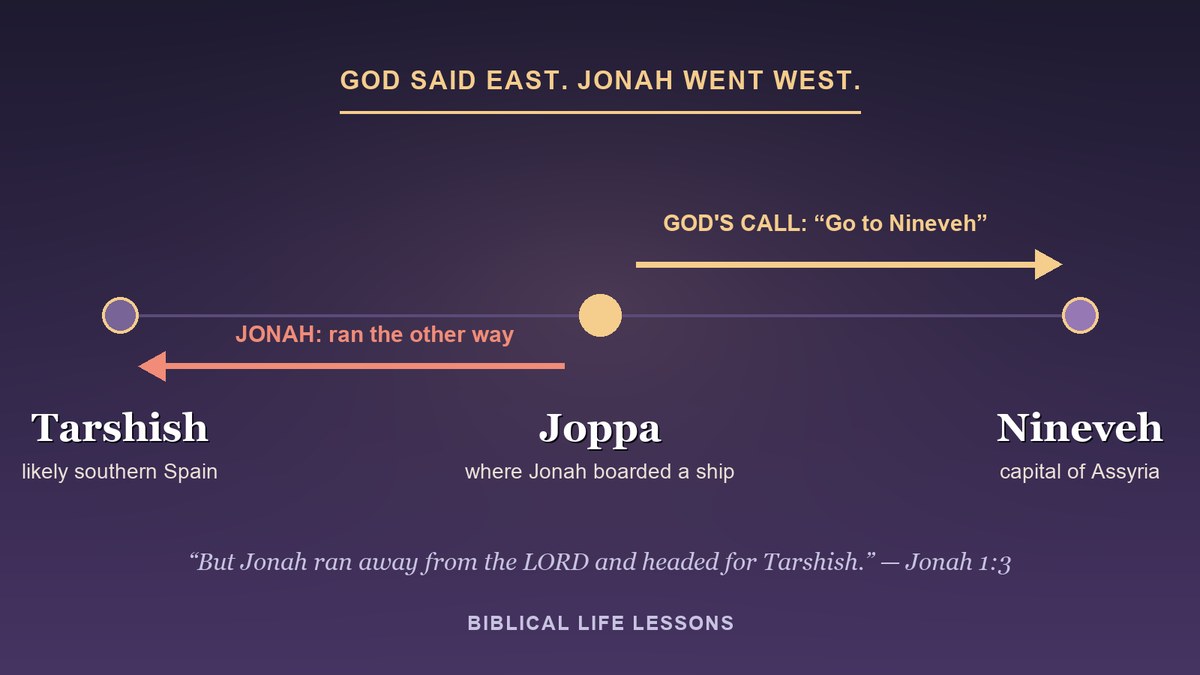
Notice how often the story uses the word “down.” Jonah went down to Joppa, down into the ship, down into the lowest part of the vessel, and soon would go down into the sea. Running from God is always a downward journey.
The Storm at Sea (Jonah 1:4-16)
“Then the LORD sent a great wind on the sea, and such a violent storm arose that the ship threatened to break up” (Jonah 1:4). The pagan sailors were terrified. Each one cried out to his own god, and they threw cargo overboard to lighten the ship. Meanwhile, Jonah was fast asleep below deck.
The captain woke him: “How can you sleep? Get up and call on your god!” The sailors cast lots to find out who was responsible for the disaster, and the lot fell on Jonah (Jonah 1:6-7). When they questioned him, he answered: “I am a Hebrew and I worship the LORD, the God of heaven, who made the sea and the dry land” (Jonah 1:9).
Jonah knew the storm was because of him. “Pick me up and throw me into the sea,” he told them, “and it will become calm” (Jonah 1:12). The sailors tried desperately to row back to land instead, but the storm only grew worse. Finally, praying for God’s mercy, they threw Jonah overboard — and the sea grew calm. The sailors “greatly feared the LORD,” offered a sacrifice, and made vows to Him (Jonah 1:15-16). Even while Jonah was running, God was using him to bring others to faith.
Inside the Great Fish (Jonah 1:17-2:10)
“Now the LORD provided a huge fish to swallow Jonah, and Jonah was in the belly of the fish three days and three nights.” (Jonah 1:17, NIV)
The fish was not a punishment — it was a rescue. Jonah should have drowned. Instead, God “provided” a way to save him. (The Hebrew simply says “a great fish”; the popular image of a whale comes from later translations of the Greek word in Matthew 12:40, which means a large sea creature.)
From inside the fish, Jonah prayed. His prayer in chapter 2 is a psalm of desperation and thanksgiving, full of echoes of the Psalms: “In my distress I called to the LORD, and he answered me. From deep in the realm of the dead I called for help, and you listened to my cry” (Jonah 2:2). He describes sinking to the roots of the mountains, seaweed wrapped around his head — and then God bringing his life up from the pit (Jonah 2:5-6).
His prayer ends with a short, powerful declaration: “Salvation comes from the LORD” (Jonah 2:9). Then “the LORD commanded the fish, and it vomited Jonah onto dry land” (Jonah 2:10).
A Second Chance (Jonah 3:1-4)
Some of the most hopeful words in the book are found in Jonah 3:1: “Then the word of the LORD came to Jonah a second time.” God did not replace His runaway prophet. He gave him the same assignment again.
This time, Jonah obeyed. Nineveh was “a very large city; it took three days to go through it” (Jonah 3:3). Jonah walked a day’s journey into the city and delivered the shortest sermon in the Bible — just five words in Hebrew: “Forty more days and Nineveh will be overthrown” (Jonah 3:4).
Nineveh Repents (Jonah 3:5-10)
What happened next was astonishing. “The Ninevites believed God” (Jonah 3:5). They declared a fast, and everyone from the greatest to the least put on sackcloth. When the news reached the king, he rose from his throne, took off his royal robes, covered himself with sackcloth, and sat down in the dust. He issued a decree calling everyone to “call urgently on God” and give up their evil ways and violence: “Who knows? God may yet relent and with compassion turn from his fierce anger so that we will not perish” (Jonah 3:9).
“When God saw what they did and how they turned from their evil ways, he relented and did not bring on them the destruction he had threatened.” (Jonah 3:10, NIV)
One of the most wicked cities in the ancient world turned to God through a reluctant prophet’s five-word sermon. It is one of the greatest revivals recorded in Scripture.
Jonah’s Anger and the Leafy Plant (Jonah 4)
You would expect Jonah to celebrate. Instead, “to Jonah this seemed very wrong, and he became angry” (Jonah 4:1). Then he finally admitted why he had run in the first place:
“I knew that you are a gracious and compassionate God, slow to anger and abounding in love, a God who relents from sending calamity.” (Jonah 4:2, NIV)
Jonah did not want his enemies to receive mercy. He was so upset that he asked God to take his life. God answered with a gentle question: “Is it right for you to be angry?” (Jonah 4:4).
Jonah went outside the city, built a shelter, and sat down to see what would happen. God provided a leafy plant to grow up and shade him, and Jonah was very happy about it. But the next day God provided a worm that chewed the plant until it withered, and then a scorching east wind. Jonah grew faint and again wished to die (Jonah 4:6-8).
Then God made His point. Jonah cared deeply about a plant he had not planted or tended — a plant that “sprang up overnight and died overnight.” The book ends with God’s question:
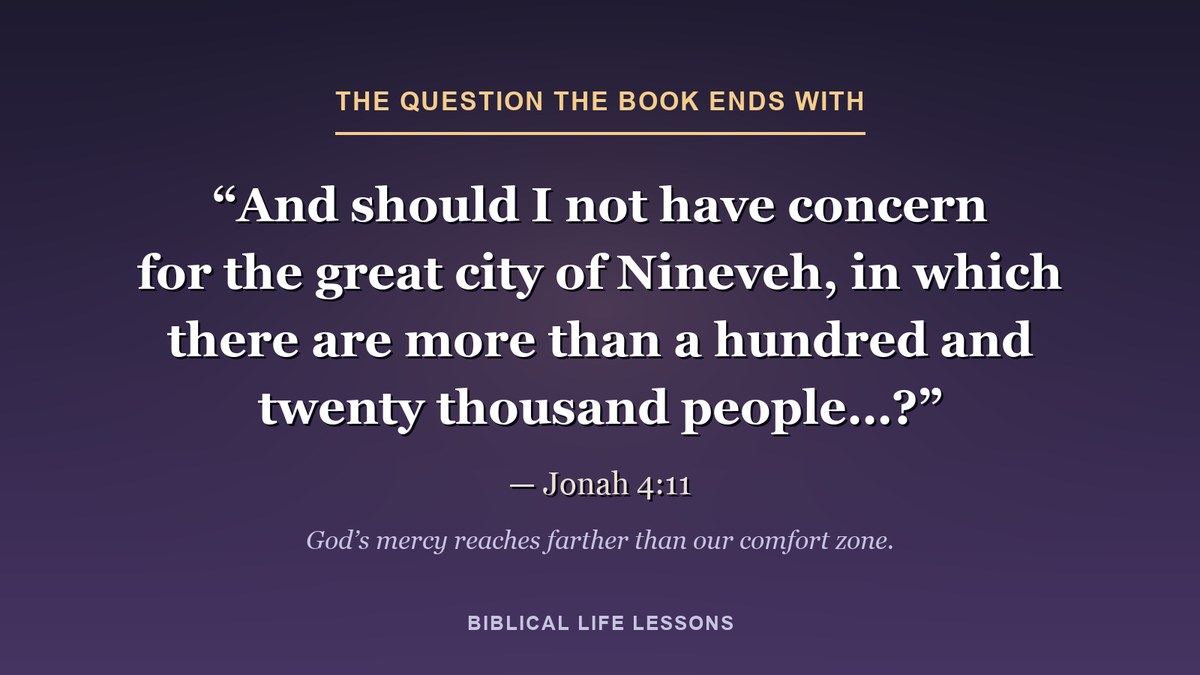
“And should I not have concern for the great city of Nineveh, in which there are more than a hundred and twenty thousand people who cannot tell their right hand from their left — and also many animals?” (Jonah 4:11, NIV)
We never hear Jonah’s answer. The question is left hanging — for Jonah, and for every reader.
Jesus and “the Sign of Jonah”
Centuries later, when religious leaders demanded a miraculous sign from Jesus, He pointed them to Jonah: “For as Jonah was three days and three nights in the belly of a huge fish, so the Son of Man will be three days and three nights in the heart of the earth” (Matthew 12:40). Jonah’s rescue from the depths became a picture of Jesus’ death, burial, and resurrection.
Jesus added a warning: “The men of Nineveh will stand up at the judgment with this generation and condemn it; for they repented at the preaching of Jonah, and now something greater than Jonah is here” (Matthew 12:41). Nineveh repented after hearing a reluctant prophet. How much more should we respond to Jesus Himself?
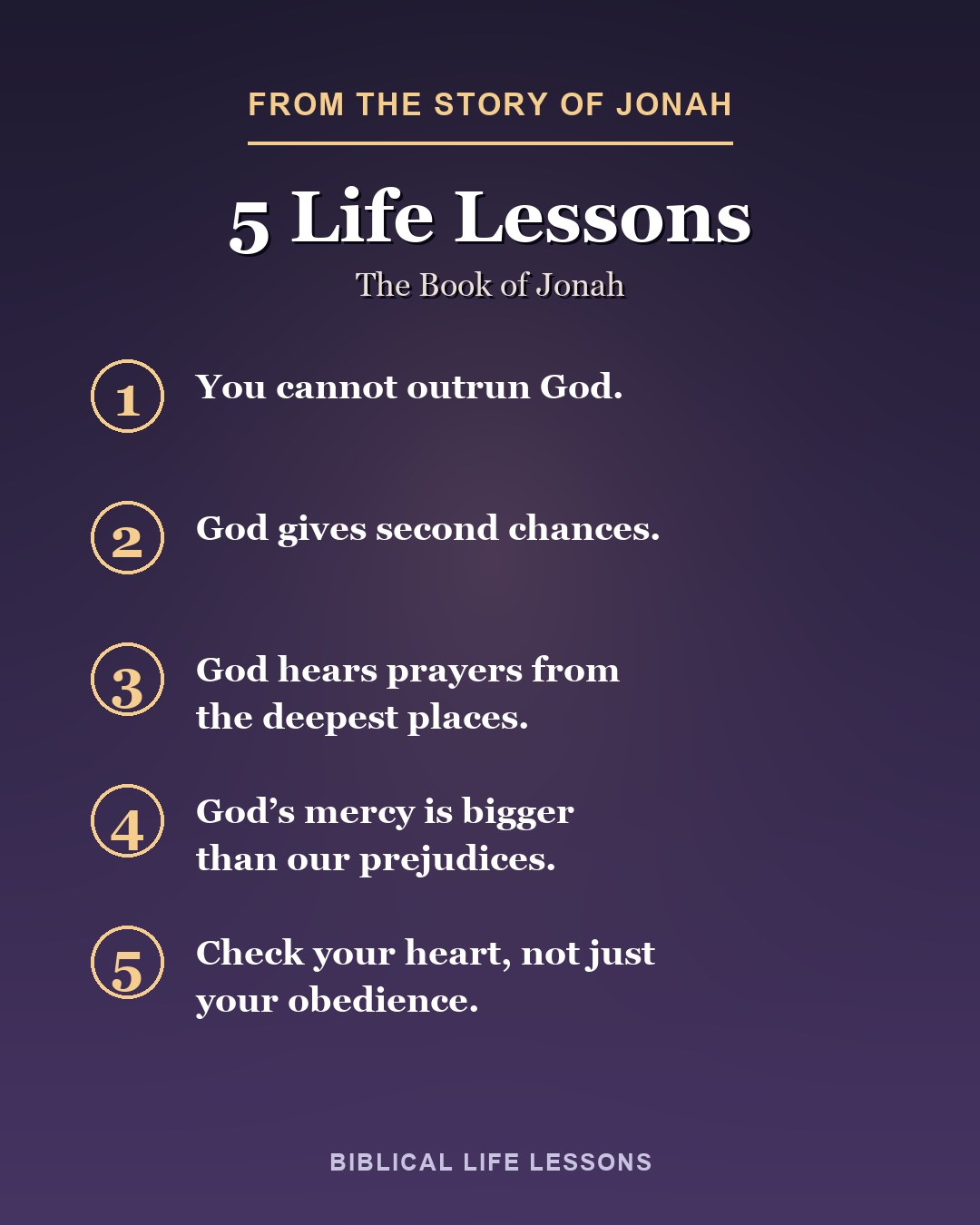
Five Life Lessons from Jonah’s Story
1. You cannot outrun God.
Jonah bought a ticket to the far side of the known world, and God met him in the middle of the sea. Psalm 139 asks, “Where can I flee from your presence?” Jonah learned the answer the hard way: nowhere. If you are running from something God has asked of you, His pursuit is not a threat — it is love that refuses to let you go.
2. God gives second chances.
“The word of the LORD came to Jonah a second time.” God did not give up on His prophet after he ran. He rescued him and gave him the same calling again. Whatever you have run from, it is not too late to turn around. God’s calling on your life does not expire because you failed once.
3. God hears prayers from the deepest places.
Jonah prayed from inside a fish, at the bottom of the sea, after running from God. And God heard him. There is no place too dark, and no failure too great, to call out to God. “In my distress I called to the LORD, and he answered me.”
4. God’s mercy is bigger than our prejudices.
Jonah wanted God’s mercy for himself but not for his enemies. God showed compassion to Nineveh — and even cared about its animals. Is there a person or group you secretly hope God will not forgive? Jonah’s story challenges us to let God’s mercy reach farther than our comfort zone.
5. Check your heart, not just your obedience.
Jonah eventually obeyed, but his heart did not change. He did the right thing with the wrong attitude, and the book ends with him still angry. God cares not only about what we do but about why we do it. He invites us to share His heart for people — not just His instructions.
Frequently Asked Questions About Jonah
Why did Jonah run from God?
Jonah ran because he did not want Nineveh — the capital of Israel’s brutal enemy, Assyria — to be spared. He later admitted, “I knew that you are a gracious and compassionate God… a God who relents from sending calamity” (Jonah 4:2). He feared that if he warned them, they would repent and God would forgive them.
Was Jonah swallowed by a whale?
The book of Jonah says God “provided a huge fish” (Jonah 1:17). The Hebrew word simply means a great fish. In Matthew 12:40, the Greek word means a large sea creature, which older translations rendered as “whale.” The Bible does not identify the exact kind of creature.
How long was Jonah in the fish?
Jonah was in the belly of the fish “three days and three nights” (Jonah 1:17). Jesus referred to this as “the sign of Jonah,” pointing to His own three days in the tomb before His resurrection (Matthew 12:40).
Where was Nineveh?
Nineveh was the capital of the Assyrian Empire, located on the eastern bank of the Tigris River, across from the modern city of Mosul in northern Iraq. Its ruins can still be seen today.
Where was Tarshish?
Tarshish was a distant port to the west, across the Mediterranean Sea. Many scholars identify it with Tartessus in southern Spain. For Jonah, it was about as far in the opposite direction from Nineveh as he could go.
What does the name Jonah mean?
The Hebrew name Jonah (Yonah) means “dove.”
Where is Jonah’s story in the Bible?
Jonah’s story is told in the book of Jonah, one of the Minor Prophets, between Obadiah and Micah. He is also mentioned in 2 Kings 14:25, and Jesus refers to him in Matthew 12:39-41, Matthew 16:4, and Luke 11:29-32.
Related Reading
For a short devotional on Jonah’s prayer from the depths, see What Jonah Teaches Us About Praying From Rock Bottom. For more on God’s pursuit of those who run, read A Heart That Runs, A God Who Pursues. For a comparison of two very different responses to God’s warning, see A Tale of Two Cities: Sodom and Gomorrah vs. Nineveh. For finding peace when life feels like a storm, read Calm in the Storm. For another reluctant servant God refused to give up on, see Who Was Gideon in the Bible? And for a prophet who also reached the end of himself, read What Elijah Teaches Us About Hearing God When You’re Burned Out. For a wider guide to the men and women of Scripture, visit our Characters of the Bible pillar.
A Closing Prayer
Father, thank You for Jonah, and thank You that You never stopped pursuing him. Where I am running from You, turn me around. Thank You that You hear my prayers even from the deepest places, and that You give second chances. Soften my heart toward the people I find hardest to love, and let Your mercy reach farther than my comfort. Change not only what I do, but why I do it, until my heart looks like Yours. Thank You for Jesus, the One greater than Jonah, who rose from the depths for me. In His name, Amen.
Subscribe for Daily Email Devotionals
MEET FAITH FRIEND AI
Faith Friend is your friendly AI chatbot on BiblicalLifeLessons.com, here to help you explore the Bible, answer your faith-related questions, and guide you through life lessons based on God’s Word. Whether you’re seeking encouragement, understanding Scripture, or deepening your faith, Faith Friend is always ready to chat.