Who Was Sarah in the Bible? The Complete Story of Abraham’s Wife (Genesis 11-23)
Sarah is the first matriarch of Israel — the woman God promised would become “the mother of nations.” She is Abraham’s wife, Isaac’s mother, and one of only two women named in the great “hall of faith” in Hebrews 11. Yet she is also the woman who laughed when God said she would have a son, who tried to fulfill God’s promise through her servant Hagar, and who waited twenty-five years for a child she had long stopped expecting.
If you have searched for who Sarah was in the Bible, or what her story teaches us today, this is a complete guide. We will walk through her family background, her journey from Ur to Canaan, the two times Abraham passed her off as his sister, the painful decision involving Hagar, her new name, the laughter at Mamre, the birth of Isaac, and five practical life lessons her story still speaks into ours.
Who Was Sarah in the Bible?
Sarah — first called Sarai — was the wife of Abraham and the mother of Isaac. Through Isaac came Jacob, the twelve tribes of Israel, and eventually Jesus Christ. She is the first of the four great matriarchs of Israel, followed by Rebekah, Rachel, and Leah. Her story runs from Genesis 11 to Genesis 23, and she is the only woman in the Bible whose age at death is recorded: 127 years (Genesis 23:1).
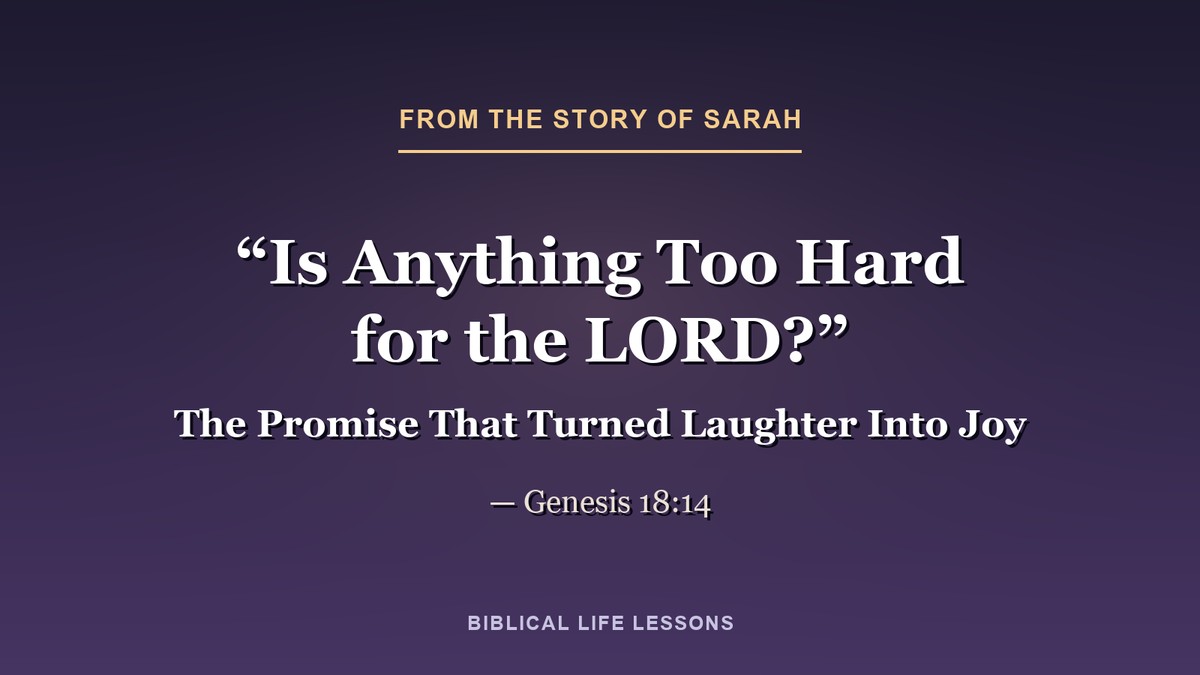
“Is anything too hard for the LORD? I will return to you at the appointed time next year, and Sarah will have a son.” (Genesis 18:14, NIV)
Three things stand out about her. She was beautiful — so beautiful that Abraham feared foreign kings would kill him to take her (Genesis 12:11-13). She was barren — Scripture introduces her with one heavy line: “Sarai was childless because she was not able to conceive” (Genesis 11:30). And she was chosen — God did not simply promise Abraham a son; He specifically promised that the son would come through Sarah (Genesis 17:16).
The Family Background: Where Did Sarah Come From?
Sarai grew up in Ur of the Chaldeans, an ancient city in southern Mesopotamia. She married Abram, the son of Terah, and Genesis later reveals that she was also his half-sister — “the daughter of my father though not of my mother” (Genesis 20:12). Marriages within the extended family were common in that era, long before the later laws of Moses.
Terah moved the family from Ur toward Canaan, but they settled in Haran instead (Genesis 11:31). It was there that God called Abram: “Go from your country, your people and your father’s household to the land I will show you” (Genesis 12:1). Abram was seventy-five years old when he left Haran (Genesis 12:4). Sarai, about ten years younger, went with him — leaving everything familiar to follow a promise she had not heard for herself.
The Sister Lie: Sarah in Egypt and Gerar
Not long after arriving in Canaan, a famine drove Abram and Sarai to Egypt. Afraid that the Egyptians would kill him to take his beautiful wife, Abram asked Sarai to say she was his sister (Genesis 12:11-13). She was taken into Pharaoh’s palace. God struck Pharaoh’s household with serious diseases, and Pharaoh sent them away, rebuking Abram for the deception (Genesis 12:17-20).
Years later, it happened again. In Gerar, Abraham told King Abimelech the same half-truth, and Abimelech took Sarah. This time God warned Abimelech in a dream, and Sarah was returned untouched (Genesis 20:1-7).
These scenes are hard to read. Twice, Sarah’s husband put her in danger to protect himself. Twice, God stepped in to protect her. The promise of a son through Sarah was not going to be lost to a husband’s fear or a foreign king’s palace. God guarded both the woman and the promise.
Hagar and Ishmael: Trying to Help God Along (Genesis 16)
Ten years after arriving in Canaan, Sarai was still childless. So she took matters into her own hands. Following a common custom of the time, she gave her Egyptian servant Hagar to Abram so that she could “build a family through her” (Genesis 16:2). Abram agreed.
Hagar conceived — and the household fractured almost immediately. Hagar began to despise Sarai. Sarai blamed Abram: “You are responsible for the wrong I am suffering” (Genesis 16:5). Then Sarai mistreated Hagar so harshly that she fled into the desert, where the angel of the LORD met her and sent her back (Genesis 16:6-9). Hagar gave birth to Ishmael when Abram was eighty-six (Genesis 16:16).
Sarai’s plan made sense by the standards of her culture. But it was her plan, not God’s. The tension between Sarah and Hagar, and later between Isaac and Ishmael, would run through the rest of Sarah’s life.
A New Name: From Sarai to Sarah (Genesis 17)
Thirteen years after Ishmael’s birth, God appeared to Abraham again. He changed Abram’s name to Abraham, and He changed Sarai’s name too:
“As for Sarai your wife, you are no longer to call her Sarai; her name will be Sarah. I will bless her and will surely give you a son by her. I will bless her so that she will be the mother of nations; kings of peoples will come from her.” (Genesis 17:15-16, NIV)
Both Sarai and Sarah are generally understood to mean “princess.” The change marked a new beginning: the promise was not just for Abraham, and it would not come through Hagar. Sarah herself — ninety years old — would be the mother of the promised son. God renamed her before she ever held the child. Her new identity came before the fulfillment.
The Laughter at Mamre (Genesis 18)
One hot afternoon, three visitors came to Abraham’s tent near the great trees of Mamre. Abraham hurried to serve them, and Sarah baked bread. Then one of the visitors — the LORD Himself — said, “I will surely return to you about this time next year, and Sarah your wife will have a son” (Genesis 18:10).
Sarah was listening at the entrance of the tent. And she laughed to herself: “After I am worn out and my lord is old, will I now have this pleasure?” (Genesis 18:12). The LORD asked Abraham why Sarah had laughed, and then asked the question at the center of her whole story: “Is anything too hard for the LORD?” (Genesis 18:14).
Sarah was afraid and denied it: “I did not laugh.” But He said, “Yes, you did laugh” (Genesis 18:15). It is one of the most human moments in Genesis. God did not cancel the promise because of Sarah’s doubt. He simply named it — and then kept His word anyway.
The Birth of Isaac: Laughter Redeemed (Genesis 21)
“Now the LORD was gracious to Sarah as he had said, and the LORD did for Sarah what he had promised. Sarah became pregnant and bore a son to Abraham in his old age, at the very time God had promised him.” (Genesis 21:1-2, NIV)
Abraham was one hundred years old; Sarah was ninety. They named their son Isaac, which means “he laughs.” The woman who once laughed in disbelief now laughed for joy: “God has brought me laughter, and everyone who hears about this will laugh with me” (Genesis 21:6). Twenty-five years after God first called Abraham out of Haran, the promised child was finally in her arms.
But the old tension had not gone away. At the feast celebrating Isaac’s weaning, Sarah saw Ishmael mocking, and she demanded that Abraham send Hagar and her son away (Genesis 21:9-10). Abraham was deeply distressed, but God told him to listen to Sarah, because Isaac was the son through whom the covenant line would continue — and God promised to make Ishmael into a nation too (Genesis 21:12-13).
Sarah’s Death and Legacy (Genesis 23)
Sarah died at the age of 127 in Kiriath Arba, also called Hebron. Abraham mourned and wept for her (Genesis 23:2). Then he bought the cave of Machpelah from Ephron the Hittite for four hundred shekels of silver and buried her there (Genesis 23:16-19). It was the first piece of the promised land Abraham ever owned — and it began as Sarah’s grave.
Sarah’s story does not end in Genesis. Isaiah calls Israel to “look to Abraham, your father, and to Sarah, who gave you birth” (Isaiah 51:2). Paul points to the deadness of Sarah’s womb as the backdrop for Abraham’s faith (Romans 4:19). Peter holds her up as an example to women who “do not give way to fear” (1 Peter 3:6). And Hebrews 11:11 names her among the heroes of faith: “And by faith even Sarah, who was past childbearing age, was enabled to bear children because she considered him faithful who had made the promise.”
Five Life Lessons from Sarah’s Story
1. God’s timing is rarely our timing — but it is never late.
Sarah waited twenty-five years between God’s first promise to Abraham and the birth of Isaac. By the end, the promise seemed not just delayed but impossible. Yet Genesis 21:2 says Isaac was born “at the very time God had promised.” If you are in a long season of waiting, the delay is not a sign that God has forgotten. He is working on a timeline you cannot yet see.
2. Do not try to manufacture what only God can give.
Sarai’s plan with Hagar was culturally acceptable and completely understandable. It also caused years of conflict and pain for everyone involved — including Hagar and Ishmael, who did nothing to deserve it. When God is slow, the temptation is to build a shortcut. But shortcuts we build in impatience often become burdens we carry for years. Wait for what God gives, not what you can arrange.
3. God can handle your doubt.
Sarah laughed at God’s promise. She even lied about it. God did not pretend He had not heard — “Yes, you did laugh” — but He also did not take the promise back. Hebrews 11 still calls her a woman of faith. If you have doubted God’s word, you are not disqualified. Bring your honest doubts to Him. He is faithful even when we are not sure.
4. Nothing is too hard for the Lord.
“Is anything too hard for the LORD?” is one of the great questions of Scripture, and Sarah’s story is its answer. A ninety-year-old woman who had never been able to conceive gave birth to a son. Whatever impossible situation you are facing today — a relationship, a diagnosis, a dream that died long ago — Genesis 18:14 still stands. God’s power is not limited by what seems possible to us.
5. God gives you a new identity before He gives you the outcome.
God renamed Sarai as Sarah — “mother of nations” — a full year before Isaac was born. She had to live into her new name while her arms were still empty. God often does the same with us: He calls us forgiven, chosen, and His own before our circumstances look like it. Let your identity rest in what God has said about you, not in what you can see yet.
Frequently Asked Questions About Sarah
Who was Sarah’s husband?
Sarah was married to Abraham (originally Abram), the man God called to leave his homeland and become the father of a great nation (Genesis 12:1-3). Abraham was about ten years older than Sarah (Genesis 17:17).
Was Sarah Abraham’s sister?
Sarah was Abraham’s half-sister. Abraham told King Abimelech, “She really is my sister, the daughter of my father though not of my mother; and she became my wife” (Genesis 20:12). Abraham used this half-truth twice to hide that she was his wife, in Egypt and in Gerar.
How old was Sarah when she had Isaac?
Sarah was ninety years old when Isaac was born, and Abraham was one hundred (Genesis 17:17; 21:5). Scripture emphasizes that she was well past the age of childbearing, which is why both she and Abraham laughed at the promise.
Why did Sarah laugh?
Sarah laughed because the promise seemed impossible. She was old, Abraham was old, and she had been unable to have children her whole life (Genesis 18:11-12). God responded with the question, “Is anything too hard for the LORD?” (Genesis 18:14). When Isaac was born, Sarah’s laughter of doubt turned into laughter of joy (Genesis 21:6).
Why did Sarah change her name?
Sarah did not change her name herself — God changed it from Sarai to Sarah in Genesis 17:15, at the same time He changed Abram’s name to Abraham. Both names are generally understood to mean “princess.” The new name marked God’s promise that she would be “the mother of nations” and that kings would come from her (Genesis 17:16).
How old was Sarah when she died, and where is she buried?
Sarah died at 127 years old in Hebron (Genesis 23:1-2). Abraham bought the cave of Machpelah from Ephron the Hittite and buried her there. Abraham, Isaac, Rebekah, Jacob, and Leah were later buried in the same cave (Genesis 49:31). The site is traditionally identified today as the Tomb of the Patriarchs in Hebron.
Where is Sarah’s story in the Bible?
Sarah’s story is told mainly in Genesis 11-23: her introduction (Genesis 11), the journey to Canaan and Egypt (Genesis 12), Hagar and Ishmael (Genesis 16), her new name (Genesis 17), the visitors at Mamre (Genesis 18), Gerar (Genesis 20), the birth of Isaac (Genesis 21), and her death (Genesis 23). She is also mentioned in Isaiah 51:2, Romans 4:19 and 9:9, Galatians 4, Hebrews 11:11, and 1 Peter 3:6.
Related Reading
For a short devotional on Sarah’s long wait, see What Sarah Teaches Us About the Promise You Almost Stopped Believing. To follow the story through the next generations, read Who Was Rebekah in the Bible? and Who Was Rachel in the Bible? For the other side of the Hagar story, see Hagar in the Bible: A Woman of Resilience. For Sarah’s husband, read What Abraham Teaches Us About Saying Yes When You Don’t Know Where You’re Going. And for a wider guide to the men and women of Scripture, visit our Characters of the Bible pillar.
A Closing Prayer
Father, thank You for Sarah. Thank You that You kept Your promise to her even when she laughed, even when she tried to take matters into her own hands, even when the waiting stretched on for years. Forgive me for the shortcuts I build when You feel slow. Help me believe that nothing is too hard for You. Teach me to live into the name You have given me before I see the outcome. And when You finally answer, fill my mouth with laughter. In Jesus’ name, Amen.
Subscribe for Daily Email Devotionals
MEET FAITH FRIEND AI
Faith Friend is your friendly AI chatbot on BiblicalLifeLessons.com, here to help you explore the Bible, answer your faith-related questions, and guide you through life lessons based on God’s Word. Whether you’re seeking encouragement, understanding Scripture, or deepening your faith, Faith Friend is always ready to chat.