Who Was Nicodemus in the Bible? The Complete Story of the Pharisee Who Came to Jesus at Night (John 3, 7, 19)
Nicodemus is one of the most intriguing people in the Gospels. He was a respected Pharisee and a member of the Jewish ruling council — and he came to Jesus at night, with questions he was not ready to ask in daylight. That conversation gave us some of the most famous words Jesus ever spoke: “You must be born again,” and “For God so loved the world.” Yet Nicodemus’ story does not end that night. He appears three times in John’s Gospel, and each time he steps a little further out of the shadows.
If you have searched for who Nicodemus was in the Bible, or what his story teaches us today, this is a complete guide. We will walk through who he was, his nighttime conversation with Jesus, what “born again” means, his quiet defense of Jesus before the council, his role in Jesus’ burial, and five practical life lessons his story still speaks into ours.
Who Was Nicodemus in the Bible?
Nicodemus was a Pharisee and “a member of the Jewish ruling council” (John 3:1) — the Sanhedrin, the highest Jewish court in Jerusalem. Jesus called him “Israel’s teacher” (John 3:10), suggesting he was a well-known and respected teacher of the Scriptures. He appears only in the Gospel of John, in three scenes: John 3, John 7, and John 19.
“Now there was a Pharisee, a man named Nicodemus who was a member of the Jewish ruling council. He came to Jesus at night and said, ‘Rabbi, we know that you are a teacher who has come from God. For no one could perform the signs you are doing if God were not with him.'” (John 3:1-2, NIV)
Three things stand out about him. He was powerful — a religious leader with status, education, and influence. He was curious — he had seen or heard about Jesus’ miracles and could not ignore them. And he was cautious — he came at night, when he was less likely to be seen. His story is the story of a man slowly moving from secret curiosity to public devotion.
A Pharisee and a Ruler: Nicodemus’ Background
The Pharisees were a group of Jewish teachers known for their strict devotion to God’s law and the traditions built around it. Many of them opposed Jesus because He challenged their interpretations and called out their hypocrisy. The Sanhedrin, the council Nicodemus belonged to, would later play a central role in condemning Jesus to death.
The name Nicodemus is Greek and is usually understood to mean “victor over the people” or “conqueror of the people.” Scripture tells us nothing about his family, age, or hometown. But we know enough to see the risk he was taking. For a man in his position, being seen seeking out Jesus could cost him his reputation, his seat on the council, and his standing in the community.
The Conversation at Night (John 3:1-21)
Nicodemus began politely, calling Jesus “Rabbi” and acknowledging that He had come from God. But Jesus went straight to the heart of the matter:
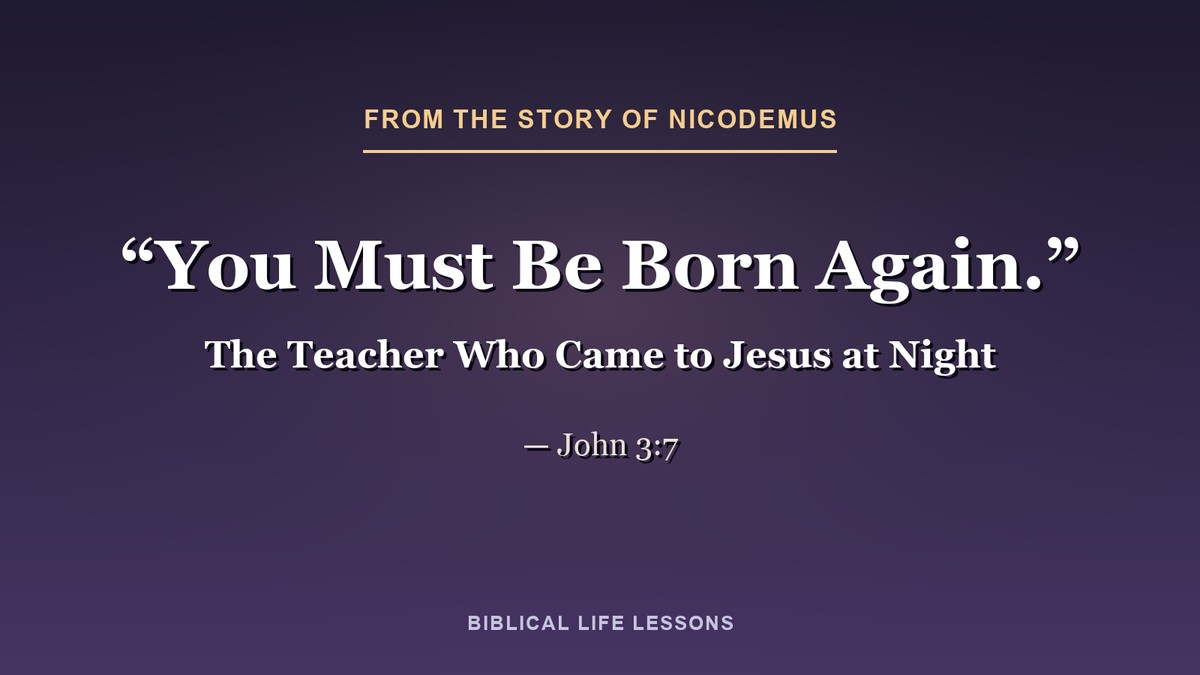
“Jesus replied, ‘Very truly I tell you, no one can see the kingdom of God unless they are born again.'” (John 3:3, NIV)
Nicodemus was confused. “How can someone be born when they are old?” he asked. “Surely they cannot enter a second time into their mother’s womb to be born!” (John 3:4). Jesus explained that He was not talking about physical birth, but spiritual birth: “No one can enter the kingdom of God unless they are born of water and the Spirit. Flesh gives birth to flesh, but the Spirit gives birth to spirit” (John 3:5-6).
Then Jesus used an image: “The wind blows wherever it pleases. You hear its sound, but you cannot tell where it comes from or where it is going. So it is with everyone born of the Spirit” (John 3:8). The Greek word for “wind” and “spirit” is the same — pneuma. New birth is not something we can control or manufacture. It is God’s work.
“How can this be?” Nicodemus asked (John 3:9). Jesus answered with a gentle rebuke: “You are Israel’s teacher, and do you not understand these things?” (John 3:10). The man who taught others about God was discovering that knowing about God and being born of God are not the same thing.
“For God So Loved the World” (John 3:14-21)
Jesus then pointed Nicodemus to a story he knew well. In Numbers 21, when the Israelites were bitten by venomous snakes in the wilderness, God told Moses to make a bronze snake and lift it up on a pole. Anyone who looked at it lived. Jesus said, “Just as Moses lifted up the snake in the wilderness, so the Son of Man must be lifted up, that everyone who believes may have eternal life in him” (John 3:14-15).
Nicodemus could not have known it yet, but Jesus was describing the cross. And in this same conversation — or in John’s reflection on it — come the most famous words in the Bible:
“For God so loved the world that he gave his one and only Son, that whoever believes in him shall not perish but have eternal life.” (John 3:16, NIV)
The passage ends with a striking image for a man who had come at night: “Light has come into the world, but people loved darkness instead of light… But whoever lives by the truth comes into the light” (John 3:19, 21). Scripture does not tell us how Nicodemus responded that night. He simply disappears from the scene. But the invitation into the light had been given.
Nicodemus Speaks Up for Jesus (John 7:45-52)
Nicodemus appears again several months later, during the Festival of Tabernacles. The chief priests and Pharisees had sent temple guards to arrest Jesus. The guards came back empty-handed, saying, “No one ever spoke the way this man does” (John 7:46).
The Pharisees were furious. “Has any of the rulers or of the Pharisees believed in him?” they demanded (John 7:48). In that room full of hostility, one voice spoke up:
“Nicodemus, who had gone to Jesus earlier and who was one of their own number, asked, ‘Does our law condemn a man without first hearing him to find out what he has been doing?'” (John 7:50-51, NIV)
It was not a bold declaration of faith. It was a careful question about fairness and the law. But it was more than anyone else on the council was willing to say. And it cost him: they mocked him immediately. “Are you from Galilee, too? Look into it, and you will find that a prophet does not come out of Galilee” (John 7:52). Nicodemus had stepped out of the shadows — just a little — and he felt the heat.
At the Cross: Burying Jesus (John 19:38-42)
Nicodemus’ final appearance is the most moving. Jesus had been crucified. Most of His disciples had scattered in fear. And two members of the very council that had condemned Him stepped forward.
Joseph of Arimathea, “a disciple of Jesus, but secretly because he feared the Jewish leaders,” asked Pilate for Jesus’ body (John 19:38). And John adds:
“He was accompanied by Nicodemus, the man who earlier had visited Jesus at night. Nicodemus brought a mixture of myrrh and aloes, about seventy-five pounds.” (John 19:39, NIV)
Seventy-five pounds of spices was an extraordinary amount — the kind of burial honor given to a king. Together, Joseph and Nicodemus wrapped Jesus’ body with the spices in strips of linen, following Jewish burial customs, and laid Him in a new tomb in a nearby garden (John 19:40-42).
The man who once came to Jesus in the dark now stood in broad daylight, publicly caring for the body of a crucified man. Handling a dead body would make him ceremonially unclean right before the Passover. Associating with Jesus now, after the council had condemned Him, could cost him everything. He did it anyway. Jesus had told him the Son of Man must be “lifted up.” Nicodemus had now seen it — and he did not walk away.
What Happened to Nicodemus?
The Bible does not mention Nicodemus again after John 19. Later Christian traditions claim he became a follower of Jesus and suffered for it, and an apocryphal writing called the “Gospel of Nicodemus” was attributed to him centuries later. But these are not part of Scripture, and we cannot know them for certain.
What we do know is the direction of his life. In John 3, he came at night. In John 7, he spoke up cautiously. In John 19, he stepped forward publicly. His faith grew — slowly, imperfectly, but truly.
Five Life Lessons from Nicodemus’ Story
1. Bring your questions to Jesus — even if it is “at night.”
Nicodemus came with uncertainty and fear, at a time when no one would see him. Jesus did not turn him away or shame him for coming in secret. He welcomed him and gave him the truth. If you have questions about faith that you are not ready to ask in front of others, Jesus is still willing to meet you wherever you are. Honest seeking is always welcome.
2. Religion is not the same as new birth.
Nicodemus was one of the most religious men in Israel. He knew the Scriptures, kept the law, and taught others. Yet Jesus told him, “You must be born again.” Knowledge, morality, and religious activity cannot replace a new life from God. Faith begins not with what we do for God, but with what God does in us.
3. Faith often grows step by step.
Nicodemus did not go from secret visitor to bold disciple overnight. His journey took years and three distinct steps. If your faith feels small or slow, take heart. God is patient with seekers, and He finishes the work He starts. What matters most is not how fast you are moving, but which direction you are going.
4. Small acts of courage matter.
In John 7, Nicodemus did not preach a sermon. He asked one question about fairness. It was a small step — but it was the only voice of reason in a hostile room, and it cost him ridicule. You may not be ready for big, bold moves. But do not underestimate one honest question, one word of fairness, or one quiet act of loyalty.
5. It is never too late to step into the light.
When Jesus died, Nicodemus could have stayed hidden. Instead, he chose that moment — when following Jesus looked most hopeless and most dangerous — to step forward publicly. Whatever has kept you hiding your faith, it is not too late to come into the light. The one who came at night ended up standing in the daylight beside the cross.
Frequently Asked Questions About Nicodemus
Why did Nicodemus come to Jesus at night?
John does not say exactly why. The most common explanation is that Nicodemus was afraid of being seen by other Pharisees and members of the council, many of whom opposed Jesus. Others suggest night was simply a quieter time for a long conversation. John’s repeated description of him as the man “who earlier had visited Jesus at night” (John 19:39) suggests the darkness was significant.
What does “born again” mean?
When Jesus told Nicodemus “no one can see the kingdom of God unless they are born again” (John 3:3), He meant a spiritual rebirth — a new life given by the Holy Spirit. The Greek phrase can also mean “born from above.” Jesus explained that it is a birth “of water and the Spirit” (John 3:5), something God does in a person rather than something a person achieves.
Was Nicodemus a believer in Jesus?
The Bible never records Nicodemus making a direct statement of faith. However, his defense of Jesus in John 7 and his public role in Jesus’ burial in John 19 strongly suggest that he became a follower. John pairs him with Joseph of Arimathea, whom he calls “a disciple of Jesus” (John 19:38).
Was John 3:16 spoken to Nicodemus?
John 3:16 appears within the account of Jesus’ conversation with Nicodemus. Bible scholars differ on whether Jesus’ words to Nicodemus continue through verse 21, or whether verses 16-21 are John’s own reflection on the conversation. Either way, John 3:16 is closely tied to what Jesus told Nicodemus about the Son of Man being lifted up.
How much spice did Nicodemus bring for Jesus’ burial?
Nicodemus brought “a mixture of myrrh and aloes, about seventy-five pounds” (John 19:39). This was an extraordinarily large amount, the kind of honor associated with royal burials.
What does the name Nicodemus mean?
Nicodemus is a Greek name usually understood to mean “victor over the people” or “conqueror of the people.”
Where is Nicodemus’ story in the Bible?
Nicodemus appears only in the Gospel of John: his nighttime conversation with Jesus (John 3:1-21), his defense of Jesus before the Pharisees (John 7:45-52), and his role in Jesus’ burial (John 19:38-42).
Related Reading
For a short devotional on Nicodemus, see What Nicodemus Teaches Us About Coming to Jesus When You Are Not Ready to Be Seen Doing It. For a closer look at the conversation in John 3, read Jesus and Nicodemus: A Nighttime Encounter of Faith. For the Old Testament story Jesus pointed him to, see The Serpent and the Cross: A Story of Redemption in Numbers 21. For another honest seeker, read What Thomas Teaches Us About Bringing Honest Doubt to Jesus. And for a wider guide to the men and women of Scripture, visit our Characters of the Bible pillar.
A Closing Prayer
Lord Jesus, thank You for Nicodemus. Thank You that You welcomed him when he came at night with his questions, and that You patiently drew him into the light. Thank You that You loved the world so much that You were lifted up for me. Give me the new birth that only Your Spirit can give. Where I am hiding, give me courage to step forward. Where my faith is small, help it grow. And let me stand with You in the daylight, no matter what it costs. In Your name, Amen.
Subscribe for Daily Email Devotionals
MEET FAITH FRIEND AI
Faith Friend is your friendly AI chatbot on BiblicalLifeLessons.com, here to help you explore the Bible, answer your faith-related questions, and guide you through life lessons based on God’s Word. Whether you’re seeking encouragement, understanding Scripture, or deepening your faith, Faith Friend is always ready to chat.