Who Was Noah in the Bible? The Complete Story of the Ark and the Flood
The story of Noah and the ark is one of the first Bible stories many of us ever heard, usually with smiling animals marching two by two. But the real story in Genesis is far more serious and far more hopeful. It is the story of a world so full of violence that God grieved He had made it, of one man who walked with God when no one else did, of a flood that wiped the earth clean, and of a rainbow that still carries God’s promise today.
If you have searched for who Noah was in the Bible, or what his story teaches us today, this is a complete guide. We will walk through the world before the flood, God’s instructions for the ark, the flood itself, the raven and the dove, Noah’s altar, God’s covenant and the rainbow, Noah’s failure after the flood, what the New Testament says about him, and five practical life lessons his story still speaks into ours.
Who Was Noah in the Bible?
Noah was the son of Lamech and a descendant of Adam through Seth, ten generations after creation (Genesis 5:28-32). He was the father of three sons, Shem, Ham, and Japheth. God chose him to build an ark that would save his family and the animals from a worldwide flood, and through his family the earth was filled again. His story is told in Genesis 5:28-9:29. His name sounds like the Hebrew word for “rest” or “comfort.”
“Noah was a righteous man, blameless among the people of his time, and he walked faithfully with God.” (Genesis 6:9, NIV)
Three things stand out about him. He was faithful in a world that was not. He was obedient, doing “everything just as God commanded him.” And he was human, as his story after the flood honestly shows. His life points less to his own greatness than to the grace of a God who saves.
A World Gone Wrong (Genesis 6:1-8)
In the generations after Adam and Eve, sin spread like a fire. By Noah’s day, the Bible describes the world in some of its darkest words:
“The LORD saw how great the wickedness of the human race had become on the earth, and that every inclination of the thoughts of the human heart was only evil all the time.” (Genesis 6:5, NIV)
The earth was “corrupt in God’s sight and was full of violence” (Genesis 6:11). The next verse shows the heart of God: “The LORD regretted that he had made human beings on the earth, and his heart was deeply troubled” (Genesis 6:6). God’s judgment was not cold. It came from a grieving heart.
Then comes one of the most hopeful sentences in Genesis: “But Noah found favor in the eyes of the LORD” (Genesis 6:8).
Building the Ark (Genesis 6:9-22)
God told Noah that He was going to bring floodwaters on the earth, and gave him detailed instructions: build an ark of cypress wood, coat it with pitch inside and out, and make it 300 cubits long, 50 cubits wide, and 30 cubits high, roughly 450 feet long, 75 feet wide, and 45 feet high. It would have three decks, a roof, and a door in the side.
God also made a promise: “But I will establish my covenant with you, and you will enter the ark—you and your sons and your wife and your sons’ wives with you” (Genesis 6:18). Noah was to bring two of every kind of animal, male and female, and seven pairs of every clean animal, along with food for them all.
Imagine building a massive boat on dry land, likely far from any sea, while everyone around you went on with life as usual. The Bible’s summary of Noah’s response is simple: “Noah did everything just as God commanded him” (Genesis 6:22). The New Testament adds that he was “a preacher of righteousness” (2 Peter 2:5), warning the people of his day even as he built.
The Flood (Genesis 7)
Noah was six hundred years old when the flood came. He, his wife, his three sons and their wives, and the animals went into the ark. Then comes a quiet detail that is easy to miss: “Then the LORD shut him in” (Genesis 7:16). God Himself closed the door.
“All the springs of the great deep burst forth, and the floodgates of the heavens were opened. And rain fell on the earth forty days and forty nights” (Genesis 7:11-12). The waters rose until they covered even the highest mountains. Every living thing on dry land died. “Only Noah was left, and those with him in the ark” (Genesis 7:23). The waters flooded the earth for a hundred and fifty days.
“But God Remembered Noah” (Genesis 8:1-19)
For months, Noah and his family floated on an endless sea. Then Genesis 8 opens with a turning point: “But God remembered Noah and all the wild animals and the livestock that were with him in the ark, and he sent a wind over the earth, and the waters receded” (Genesis 8:1). In the Bible, when God “remembers,” He acts on His promises.
The ark came to rest on the mountains of Ararat. Noah waited. He sent out a raven, and then a dove, which found nowhere to land and came back to him. A week later he sent the dove again, and in the evening it returned “with a freshly plucked olive leaf” in its beak (Genesis 8:11). A week after that, the dove did not return at all. The earth was drying out.
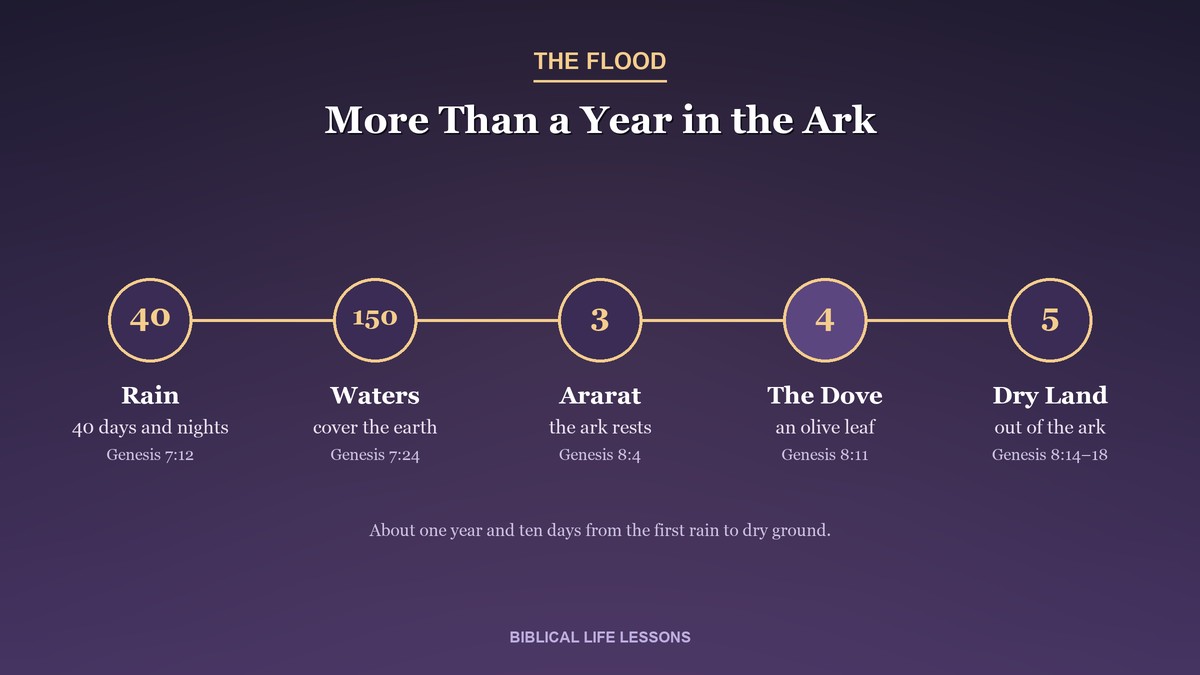
Still Noah waited for God’s word. Only when God told him to come out did he open the ark. He and his family had been inside for more than a year.
An Altar and a Promise (Genesis 8:20-22)
The first thing Noah did on dry ground was build an altar and offer sacrifices to the LORD. God was pleased, and He made a promise: “Never again will I curse the ground because of humans, even though every inclination of the human heart is evil from childhood. … As long as the earth endures, seedtime and harvest, cold and heat, summer and winter, day and night will never cease” (Genesis 8:21-22).
Notice the honesty of that promise. The human heart had not changed. The flood had not fixed sin. God’s promise rested not on human goodness but on His own mercy.
The Rainbow Covenant (Genesis 9:1-17)
God blessed Noah and his sons and told them to fill the earth again. Then He made a covenant, not only with Noah but with every living creature: never again would a flood destroy all life on the earth. And He gave a sign:
“I have set my rainbow in the clouds, and it will be the sign of the covenant between me and the earth.” (Genesis 9:13, NIV)
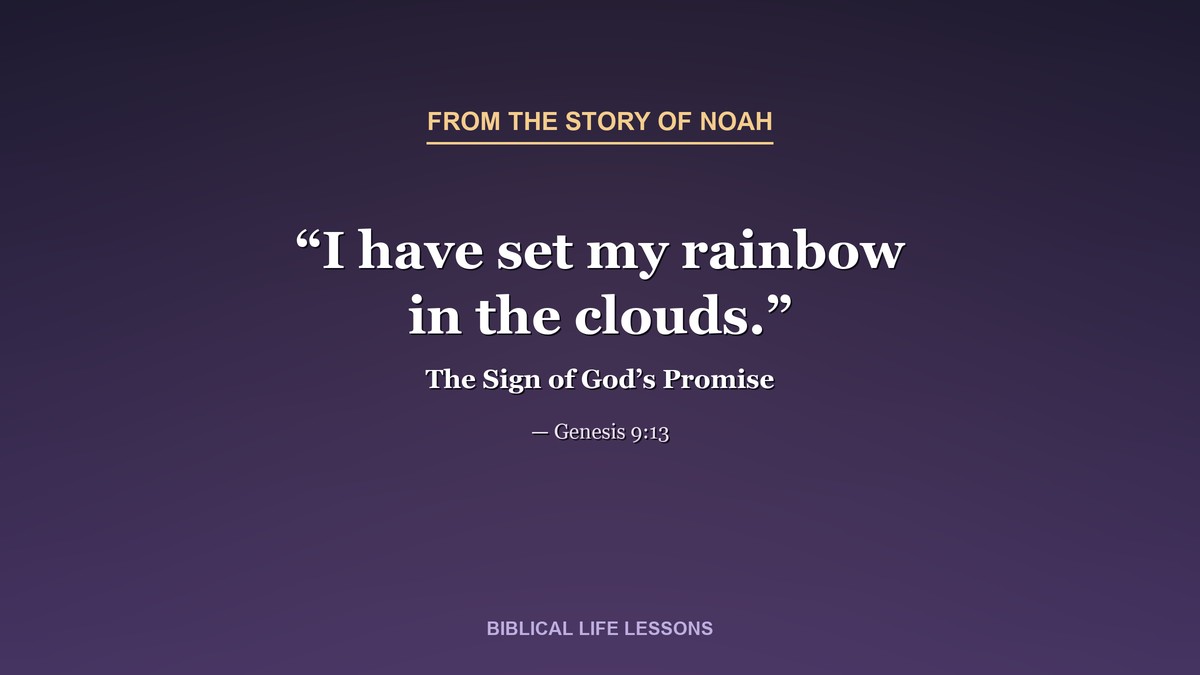
God said that whenever the rainbow appeared, He would remember His covenant. Every rainbow since is a reminder that God keeps His word.
Noah’s Failure (Genesis 9:18-29)
The story does not end with a hero on a mountaintop. Noah planted a vineyard, drank wine, became drunk, and lay uncovered inside his tent. His son Ham saw him and told his brothers. Shem and Japheth walked in backward with a garment and covered their father without looking. When Noah woke up, he pronounced a curse on Ham’s son Canaan and a blessing on Shem and Japheth.
The Bible does not hide the failures of its heroes. Even the man who walked with God in a corrupt generation was still a sinner who needed God’s grace. Noah lived 350 years after the flood and died at 950 (Genesis 9:29).
Noah in the New Testament
Hebrews holds Noah up as an example of faith: “By faith Noah, when warned about things not yet seen, in holy fear built an ark to save his family” (Hebrews 11:7). Jesus pointed to Noah’s day as a warning: “As it was in the days of Noah, so it will be at the coming of the Son of Man” (Matthew 24:37). People were eating, drinking, and marrying, unaware of what was coming until the flood swept them away. And Peter saw the ark as a picture of salvation through Christ, connecting the waters of the flood to the waters of baptism (1 Peter 3:20-21).
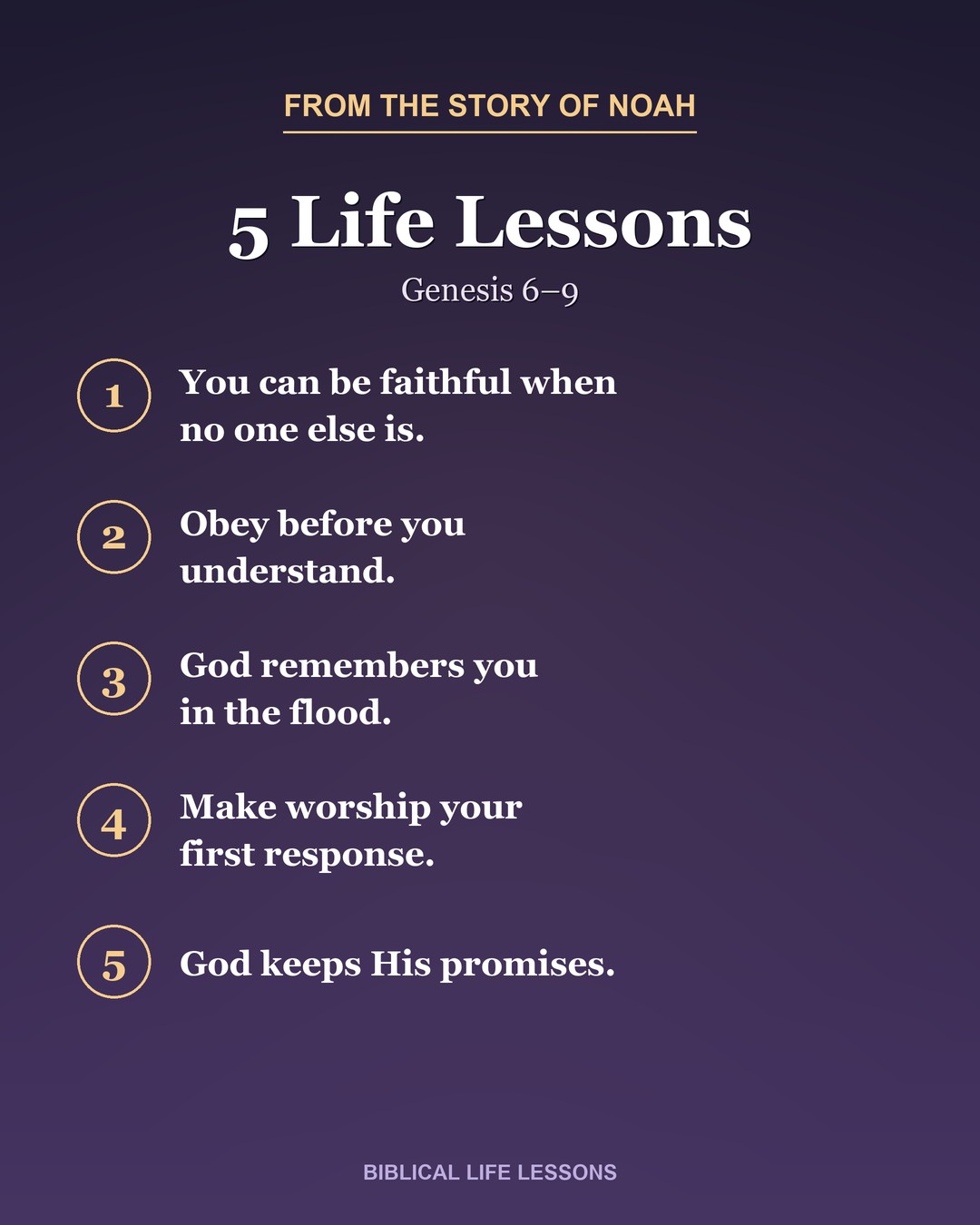
Five Life Lessons from Noah’s Story
1. You can be faithful when no one else is.
Noah walked with God while the world around him went the other way. Faithfulness does not depend on having a crowd. You can honor God in your home, your workplace, and your generation, even if you feel alone.
2. Obey before you understand.
Noah built for a flood he had never seen. He did “everything just as God commanded,” without knowing how or when it would all unfold. Obedience often comes before understanding.
3. God remembers you in the flood.
For months, Noah saw nothing but water. Then: “But God remembered Noah.” If you are in a long, dark season, God has not forgotten you. The wind will blow and the waters will go down.
4. Make worship your first response.
Before Noah built a house, planted a field, or rested, he built an altar. When God brings you through something hard, begin with thanksgiving.
5. God keeps His promises.
The rainbow is God’s signature on a promise He has kept for thousands of years. The same faithful God keeps every promise He has made to you in Christ.
Frequently Asked Questions About Noah
How long did it take Noah to build the ark?
The Bible does not say. Some people point to Genesis 6:3, which mentions 120 years, but that verse is not clearly about the time it took to build the ark. Noah’s three sons were born after he was 500 (Genesis 5:32), and they were married by the time the flood came when he was 600, so it may have taken decades.
How long was Noah in the ark?
About a year and ten days. The flood began in Noah’s 600th year, on the 17th day of the second month (Genesis 7:11), and the earth was completely dry on the 27th day of the second month the following year (Genesis 8:14).
How many people were on the ark?
Eight: Noah, his wife, his three sons (Shem, Ham, and Japheth), and their three wives (Genesis 7:13; 1 Peter 3:20).
How many animals did Noah take on the ark?
Two of every kind of unclean animal and seven pairs of every kind of clean animal and bird (Genesis 6:19-20; 7:2-3).
Where did Noah’s ark land?
The ark came to rest “on the mountains of Ararat” (Genesis 8:4), a mountainous region in the area of modern-day eastern Turkey and Armenia.
How old was Noah when he died?
Noah died at 950 years old, 350 years after the flood (Genesis 9:28-29).
What does the rainbow mean in the Bible?
The rainbow is the sign of God’s covenant with Noah and every living creature, His promise never again to destroy all life on earth with a flood (Genesis 9:12-17).
Related Reading
For more on the meaning of the ark, read The Significance of Noah’s Ark in Christian Symbolism. For the sign God gave after the flood, see The Rainbow Connection: Symbolism Beyond the Flood. For the man of faith who came generations after Noah, read Who Was Abraham in the Bible? For another man God called to obey before he understood, see Who Was Moses in the Bible? For hope in the middle of a long storm, read Calm in the Storm. For a wider guide to the men and women of Scripture, visit our Characters of the Bible pillar.
A Closing Prayer
Father, thank You for Noah, and for the grace You showed him in a dark and violent world. Help me to walk faithfully with You, even when the people around me go another way. Give me the courage to obey before I understand. When I am surrounded by floodwaters, remind me that You have not forgotten me. Let my first response to Your rescue always be worship. Thank You for every rainbow, and for every promise You have kept. Most of all, thank You for Jesus, the ark of my salvation. In His name, Amen.
Subscribe for Daily Email Devotionals
MEET FAITH FRIEND AI
Faith Friend is your friendly AI chatbot on BiblicalLifeLessons.com, here to help you explore the Bible, answer your faith-related questions, and guide you through life lessons based on God’s Word. Whether you’re seeking encouragement, understanding Scripture, or deepening your faith, Faith Friend is always ready to chat.