Who Was Paul in the Bible? The Complete Story from Persecutor to Apostle
No one in the early church looked less likely to become an apostle than Saul of Tarsus. He was a brilliant, zealous Pharisee who stood by approvingly while the first Christian martyr was stoned, and then went from house to house dragging believers off to prison. Then, on a road outside Damascus, the risen Jesus stopped him in a blinding light. The man who tried to destroy the church became its greatest missionary, planting churches across the Roman world and writing thirteen letters of the New Testament.
If you have searched for who Paul was in the Bible, or what his story teaches us today, this is a complete guide. We will walk through his background, his persecution of the church, his conversion on the Damascus road, his missionary journeys, his sufferings, his letters, his imprisonment in Rome, and five practical life lessons his story still speaks into ours.
Who Was Paul in the Bible?
Paul, also called Saul, was a Jewish Pharisee from the tribe of Benjamin, born in Tarsus in Cilicia (in modern-day Turkey) and a Roman citizen from birth (Acts 22:3, 28; Philippians 3:5). He studied in Jerusalem under the respected teacher Gamaliel and worked as a tentmaker (Acts 18:3). After meeting the risen Jesus, he became the apostle to the Gentiles, the non-Jewish nations. His story is told in Acts 7-28, and he wrote thirteen New Testament letters, from Romans to Philemon.
“Christ Jesus came into the world to save sinners—of whom I am the worst.” (1 Timothy 1:15, NIV)
Three things stand out about him. He was zealous, giving everything to whatever he believed in. He was transformed, a living proof that no one is beyond the reach of God’s grace. And he was tireless, enduring beatings, shipwrecks, and prison to carry the gospel to the ends of the known world.
Saul the Persecutor (Acts 7-8)
Saul first appears in the Bible at the stoning of Stephen, the church’s first martyr. “The witnesses laid their coats at the feet of a young man named Saul,” and “Saul approved of their killing him” (Acts 7:58; 8:1). That day a great persecution broke out against the church in Jerusalem.
Saul led it. “Saul began to destroy the church. Going from house to house, he dragged off both men and women and put them in prison” (Acts 8:3). He was convinced he was serving God. Later he would describe himself as having been “a blasphemer and a persecutor and a violent man” (1 Timothy 1:13).
The Road to Damascus (Acts 9:1-19)
Still “breathing out murderous threats against the Lord’s disciples,” Saul got letters from the high priest authorizing him to arrest any followers of Jesus in Damascus. As he neared the city, everything changed.
“Suddenly a light from heaven flashed around him. He fell to the ground and heard a voice say to him, ‘Saul, Saul, why do you persecute me?’ ‘Who are you, Lord?’ Saul asked. ‘I am Jesus, whom you are persecuting,’ he replied.” (Acts 9:3-5, NIV)
Saul got up blind, and his companions led him by the hand into Damascus. For three days he did not eat or drink. Meanwhile, the Lord spoke to a believer named Ananias and told him to go to Saul. Ananias was understandably afraid; he knew Saul’s reputation. But the Lord said, “This man is my chosen instrument to proclaim my name to the Gentiles and their kings and to the people of Israel” (Acts 9:15).
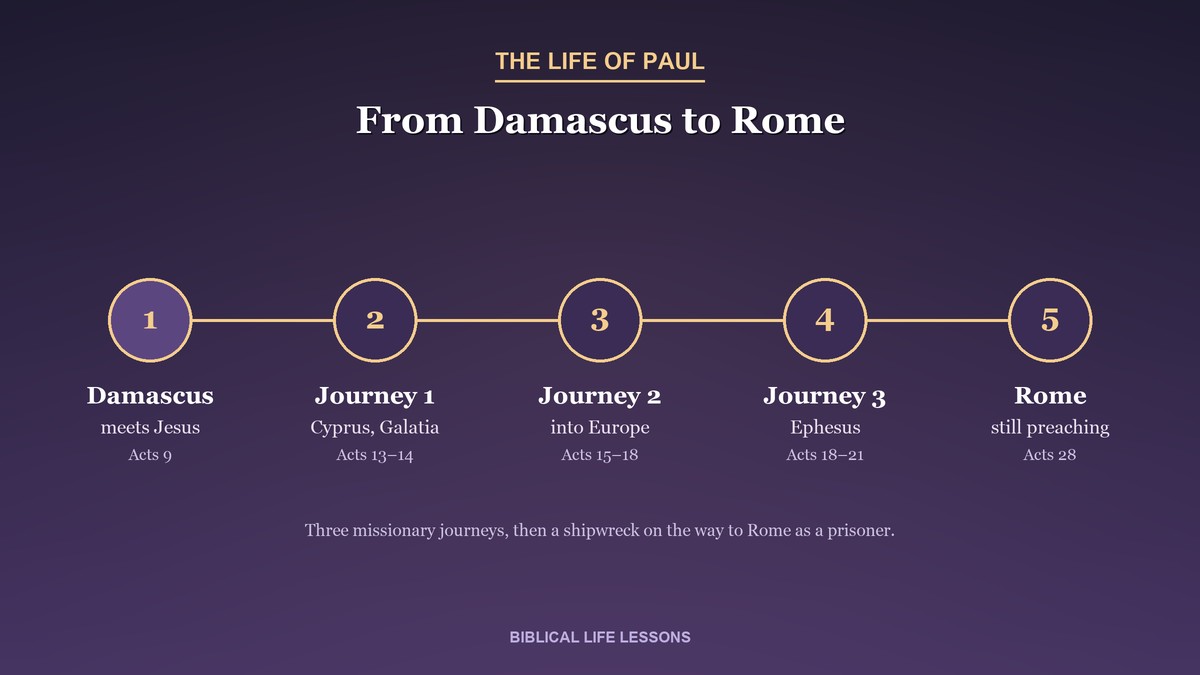
Ananias went, laid his hands on Saul, and called him “Brother Saul.” Immediately “something like scales fell from Saul’s eyes, and he could see again” (Acts 9:18). He was baptized, and at once began preaching in the synagogues that Jesus is the Son of God.
Years of Preparation (Acts 9:19-31; Galatians 1)
Saul’s new message made him new enemies. When some in Damascus plotted to kill him, his friends lowered him over the city wall in a basket at night (Acts 9:25). He spent time in Arabia and returned to Damascus (Galatians 1:17). When he came to Jerusalem, the disciples were afraid of him until Barnabas, “the son of encouragement,” took him in and vouched for him (Acts 9:27).
Then Saul went home to Tarsus, and for several years the Bible is almost silent about him. Later, Barnabas went looking for him and brought him to Antioch, where a growing church of both Jews and Gentiles had formed. “The disciples were called Christians first at Antioch” (Acts 11:26).
The Missionary Journeys (Acts 13-21)
While the church in Antioch was worshiping and fasting, the Holy Spirit said, “Set apart for me Barnabas and Saul for the work to which I have called them” (Acts 13:2). From this point on, Luke calls him by his Roman name, Paul (Acts 13:9).
The first journey took Paul and Barnabas to Cyprus and the cities of Galatia. In Lystra a crowd stoned Paul and dragged him outside the city, thinking he was dead. He got up and went back into the city (Acts 14:19-20).
The second journey, with Silas, carried the gospel into Europe after Paul saw a vision of a man begging, “Come over to Macedonia and help us” (Acts 16:9). In Philippi, a businesswoman named Lydia became the first convert in Europe. Paul and Silas were beaten and thrown into prison, but “about midnight Paul and Silas were praying and singing hymns to God” (Acts 16:25). An earthquake shook the prison open, and the terrified jailer asked, “Sirs, what must I do to be saved?” They answered, “Believe in the Lord Jesus, and you will be saved—you and your household” (Acts 16:30-31). Paul went on to Thessalonica, Berea, Athens, and Corinth, where he stayed eighteen months.
The third journey centered on Ephesus, where Paul taught for more than two years, until a riot broke out among the silversmiths whose idol business was suffering. On his way back to Jerusalem, he said goodbye to the Ephesian elders with tears, knowing hardship waited for him: “I consider my life worth nothing to me; my only aim is to finish the race and complete the task the Lord Jesus has given me—the task of testifying to the good news of God’s grace” (Acts 20:24).
What Paul Suffered
Paul’s ministry cost him dearly. In one of his letters, he listed some of it: “Five times I received from the Jews the forty lashes minus one. Three times I was beaten with rods, once I was pelted with stones, three times I was shipwrecked, I spent a night and a day in the open sea” (2 Corinthians 11:24-25). He went on to describe hunger, cold, sleepless nights, and the daily pressure of caring for all the churches.
He also wrote about a “thorn in my flesh,” some painful problem he begged God three times to take away. God’s answer became one of the most loved verses in the Bible:
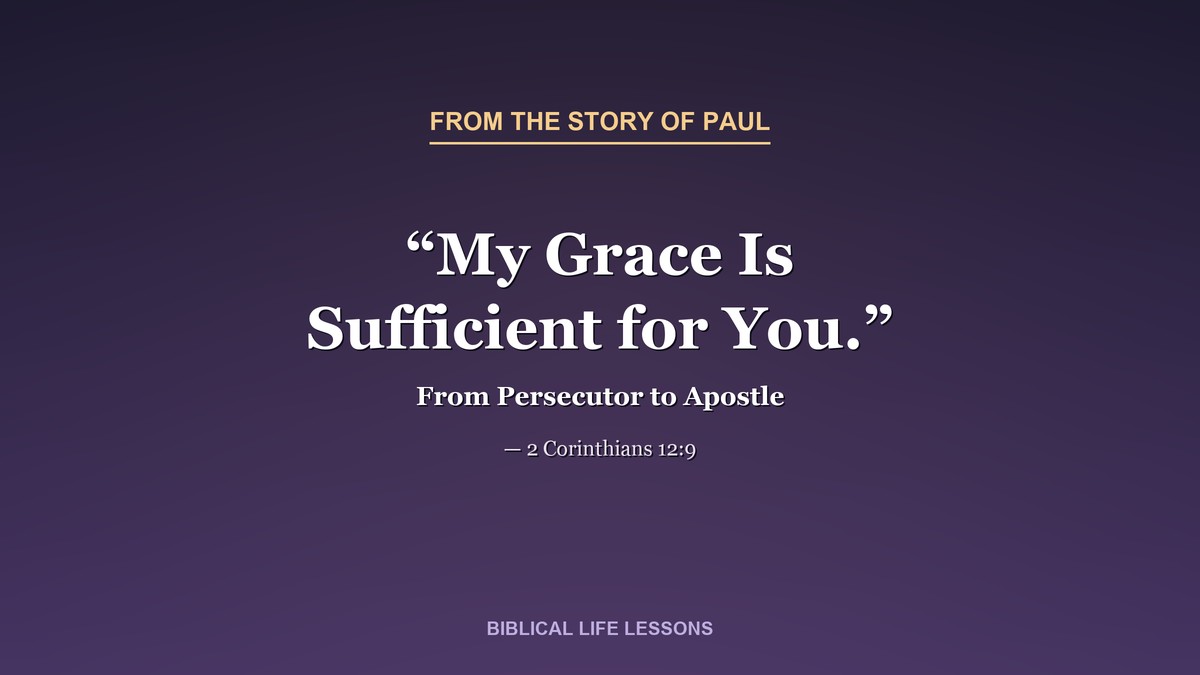
“My grace is sufficient for you, for my power is made perfect in weakness.” (2 Corinthians 12:9, NIV)
Paul’s response: “That is why, for Christ’s sake, I delight in weaknesses … For when I am weak, then I am strong” (2 Corinthians 12:10).
Arrest, Shipwreck, and Rome (Acts 21-28)
When Paul returned to Jerusalem, a mob seized him at the temple, and Roman soldiers had to rescue him. He spent two years in custody in Caesarea, defending himself before governors and King Agrippa. As a Roman citizen, he finally appealed to Caesar and was sent to Rome by ship.
The voyage ended in a violent storm and a shipwreck on the island of Malta, but just as God had promised Paul, all 276 people on board survived (Acts 27). When a viper fastened on Paul’s hand as he gathered firewood, he shook it off into the fire, unharmed (Acts 28:3-5).
In Rome, Paul lived under house arrest for two years. The book of Acts ends with him there, chained to a guard but still at work: “He proclaimed the kingdom of God and taught about the Lord Jesus Christ—with all boldness and without hindrance!” (Acts 28:31).
Paul’s Letters
Many of Paul’s letters were written to churches he had planted, and some from prison. Together they form much of the New Testament’s teaching about the gospel and the Christian life. A few of his best-known words:
- “I have been crucified with Christ and I no longer live, but Christ lives in me” (Galatians 2:20).
- “In all things God works for the good of those who love him” (Romans 8:28).
- “I have learned to be content whatever the circumstances. … I can do all this through him who gives me strength” (Philippians 4:11-13).
- “Love is patient, love is kind” (1 Corinthians 13:4).
Near the end of his life, waiting for execution, he wrote his last letter to his young friend Timothy:
“I have fought the good fight, I have finished the race, I have kept the faith.” (2 Timothy 4:7, NIV)

The Bible does not record Paul’s death. Early Christian tradition says he was beheaded in Rome under the emperor Nero, around AD 64-67.
Five Life Lessons from Paul’s Story
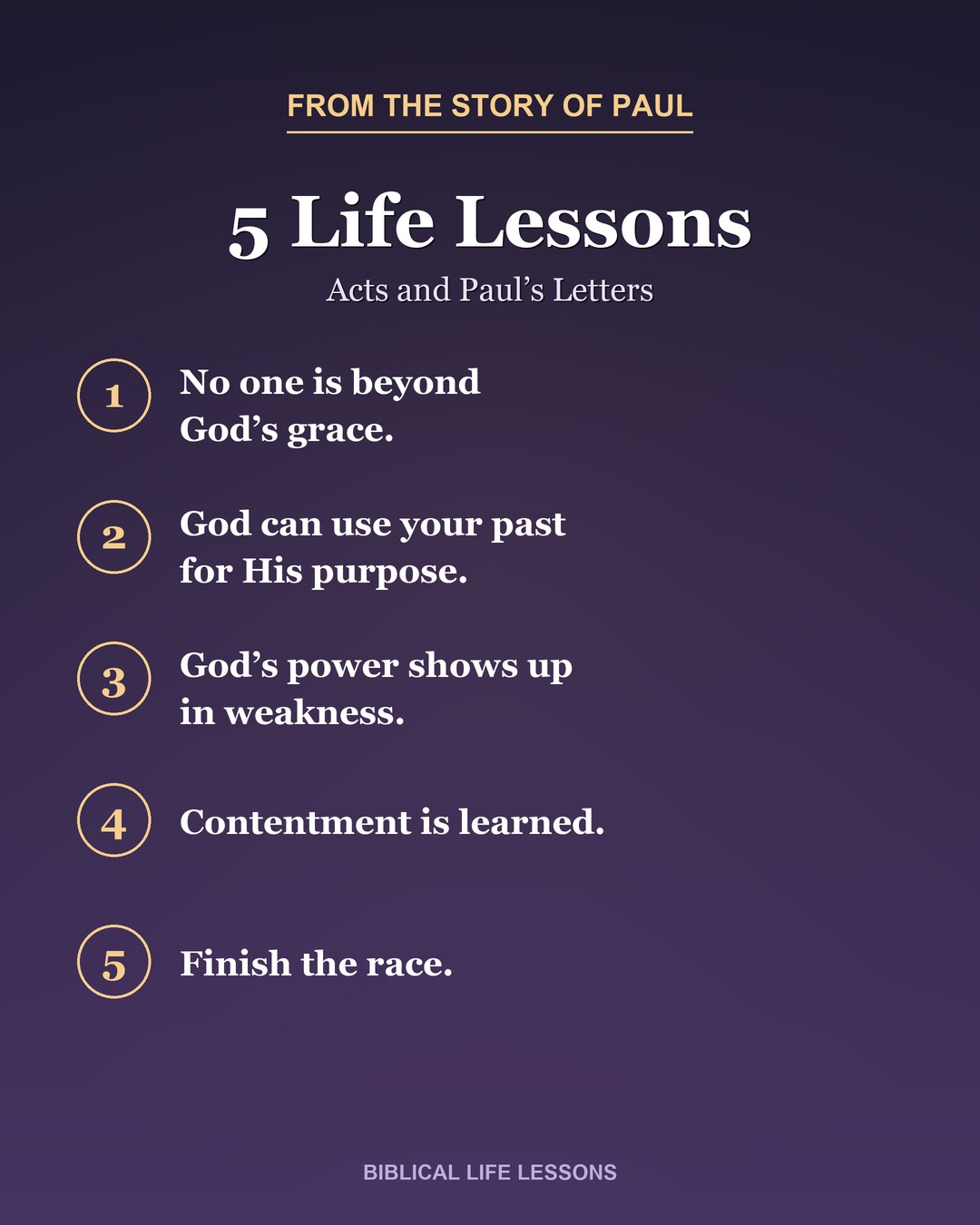
1. No one is beyond God’s grace.
If the man who hunted Christians could become an apostle, no one is too far gone. Paul called himself the worst of sinners so that we would know God’s patience has no limit. Keep praying for the person you think will never change.
2. God can use your past for His purpose.
Paul’s training, his zeal, his Roman citizenship, even his knowledge of the Scriptures he once used against Jesus, all became tools in God’s hands. Nothing in your story is wasted when you give it to Him.
3. God’s power shows up in weakness.
Paul begged God to remove his thorn, and God said no. Instead He gave grace that was enough. Your weakness is not a barrier to God working through you; it may be the very place He chooses to show His strength.
4. Contentment is learned.
Paul wrote about joy and contentment from a prison cell. He said he had “learned” the secret of being content, which means it did not come naturally. Contentment grows as we learn to rely on Christ in every circumstance.
5. Finish the race.
Paul did not just start well; he kept going through beatings, shipwrecks, and loneliness, all the way to the end. Whatever race God has given you, keep running. The goal is not a perfect start but a faithful finish.
Frequently Asked Questions About Paul
Did God change Saul’s name to Paul?
Not exactly. “Saul” was his Hebrew name and “Paul” was his Roman name. Acts 13:9 says he was “also called Paul,” and from then on, as he ministered among Gentiles, Luke uses his Roman name. The Bible does not describe a name change at his conversion.
How many books of the Bible did Paul write?
Thirteen New Testament letters carry Paul’s name: Romans, 1 and 2 Corinthians, Galatians, Ephesians, Philippians, Colossians, 1 and 2 Thessalonians, 1 and 2 Timothy, Titus, and Philemon.
Was Paul one of the twelve apostles?
No. Paul was not one of the original twelve disciples. He became an apostle after the risen Jesus appeared to him on the road to Damascus, and he described himself as one “abnormally born” (1 Corinthians 15:8).
What was Paul’s thorn in the flesh?
The Bible does not say. Suggestions include an eye problem, a chronic illness, or ongoing persecution. Paul’s point was not what it was, but that God’s grace was enough to carry him through it (2 Corinthians 12:7-9).
How many missionary journeys did Paul take?
The book of Acts describes three missionary journeys (Acts 13-14; 15:36-18:22; 18:23-21:16), followed by his voyage to Rome as a prisoner (Acts 27-28).
Was Paul married?
The Bible indicates Paul was unmarried during his ministry. In 1 Corinthians 7:7-8, he wishes others could be as he is and says it is good for the unmarried to stay as he is.
How did Paul die?
The Bible does not record his death. Early church tradition says he was beheaded in Rome during Nero’s persecution, around AD 64-67.
Related Reading
For the moment everything changed, read From Darkness to Light: Saul’s Road to Damascus. For his midnight song in the Philippian jail, see Resilience in Persecution: Paul and Silas Worship in Prison. For his thorn in the flesh, read What Paul Teaches Us About the Prayer God Does Not Answer the Way You Want and What Does It Mean That God’s Grace Is Sufficient? For the friend who believed in him first, see Barnabas in the Bible, and for the young man he mentored, read Timothy in the Bible. For the other great apostle of the early church, see Who Was Peter in the Bible? For a wider guide to the men and women of Scripture, visit our Characters of the Bible pillar.
A Closing Prayer
Lord Jesus, thank You for Paul, and for the grace that turned a persecutor into an apostle. Thank You that no one is beyond Your reach, including me. Take my past, my gifts, and my failures, and use them for Your purposes. When I am weak, let Your power rest on me, and teach me to be content in every circumstance. Give me the endurance to keep running the race You have set before me, so that at the end I can say I have kept the faith. In Your name, Amen.
Subscribe for Daily Email Devotionals
MEET FAITH FRIEND AI
Faith Friend is your friendly AI chatbot on BiblicalLifeLessons.com, here to help you explore the Bible, answer your faith-related questions, and guide you through life lessons based on God’s Word. Whether you’re seeking encouragement, understanding Scripture, or deepening your faith, Faith Friend is always ready to chat.