Who Was Peter in the Bible? The Complete Story from Fisherman to Apostle
Peter is the disciple most of us can relate to. He was impulsive, outspoken, and quick to promise more than he could deliver. He walked on water and then sank. He declared that Jesus was the Messiah and then, minutes later, tried to talk Him out of the cross. He swore he would die for Jesus and then denied Him three times before morning. Yet Jesus called him “the rock,” restored him beside a charcoal fire, and used him to preach the first great sermon of the church.
If you have searched for who Peter was in the Bible, or what his story teaches us today, this is a complete guide. We will walk through his calling, walking on the water, his great confession, the Transfiguration, his denial of Jesus, his restoration, Pentecost, his ministry in the early church, his letters, and five practical life lessons his story still speaks into ours.
Who Was Peter in the Bible?
Peter was one of the twelve apostles of Jesus and a leader of the early church. His birth name was Simon, son of John (or Jonah), and he was a fisherman from Bethsaida who lived in Capernaum on the Sea of Galilee with his brother Andrew (John 1:42-44; Mark 1:29). Jesus gave him the name Cephas in Aramaic, or Peter in Greek, both meaning “rock.” He was married (Mark 1:30), and he became part of Jesus’ inner circle along with James and John. His story is told in the four Gospels and the book of Acts, and he wrote the letters of 1 and 2 Peter.
“Simon son of John, do you love me?” He said, “Lord, you know all things; you know that I love you.” (John 21:17, NIV)
Three things stand out about him. He was eager, always the first to speak and the first to act. He was flawed, failing Jesus in the moment that mattered most. And he was restored, transformed by grace and the Holy Spirit into a bold leader who would one day give his life for Jesus.
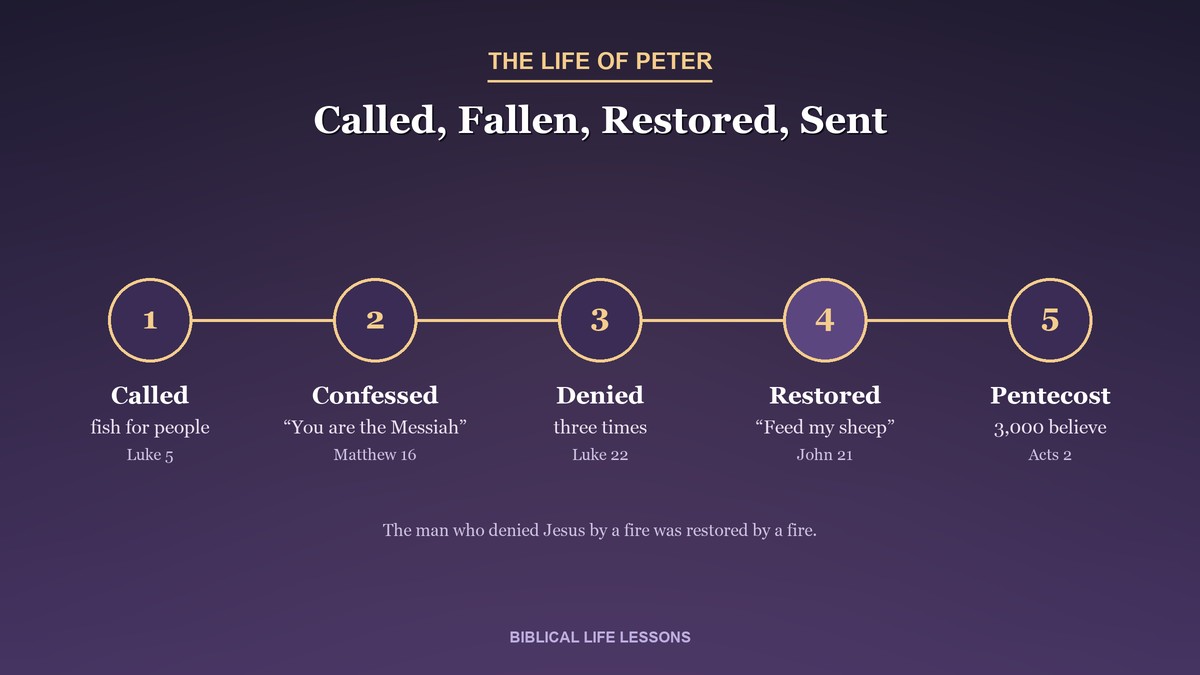
“Fish for People” (Luke 5:1-11)
Peter first met Jesus through his brother Andrew, who told him, “We have found the Messiah” (John 1:41). But the moment Peter left everything came on a morning by the lake. He and his partners had fished all night and caught nothing. Jesus borrowed his boat to teach the crowd, then told him to go out into deep water and let down the nets.
Peter answered, “Master, we’ve worked hard all night and haven’t caught anything. But because you say so, I will let down the nets” (Luke 5:5). The nets filled so full they began to break, and two boats nearly sank under the weight. Peter fell at Jesus’ knees: “Go away from me, Lord; I am a sinful man!” Jesus answered, “Don’t be afraid; from now on you will fish for people” (Luke 5:8-10). Peter pulled his boat to shore, left everything, and followed Him.
Walking on Water (Matthew 14:22-33)
One night the disciples were rowing across the lake against a strong wind when they saw Jesus walking toward them on the water. They were terrified, thinking He was a ghost. Jesus said, “Take courage! It is I. Don’t be afraid.”
Only Peter dared to answer: “Lord, if it’s you, tell me to come to you on the water.” Jesus said, “Come.” Peter stepped out of the boat and walked on the water toward Jesus. “But when he saw the wind, he was afraid and, beginning to sink, cried out, ‘Lord, save me!'” (Matthew 14:30).
“Immediately Jesus reached out his hand and caught him. ‘You of little faith,’ he said, ‘why did you doubt?'” (Matthew 14:31, NIV)
Peter sank, but he was also the only one who walked on water. And when he cried out, Jesus did not hesitate. He caught him immediately.
“You Are the Messiah” (Matthew 16:13-23)
Near Caesarea Philippi, Jesus asked His disciples, “Who do you say I am?” Peter answered for them all: “You are the Messiah, the Son of the living God” (Matthew 16:16). Jesus told him this had been revealed to him by the Father, and said, “You are Peter, and on this rock I will build my church” (Matthew 16:18).
But moments later, when Jesus began to explain that He must suffer, be killed, and rise again, Peter took Him aside and rebuked Him: “Never, Lord! This shall never happen to you!” Jesus turned and said, “Get behind me, Satan! You are a stumbling block to me; you do not have in mind the concerns of God, but merely human concerns” (Matthew 16:22-23). In a single conversation, Peter went from the clearest insight to the sharpest correction.
On the Mountain and in the Upper Room
Peter, James, and John went with Jesus up a high mountain, where Jesus was transfigured before them, His face shining like the sun, and Moses and Elijah appeared talking with Him. Peter, not knowing what else to say, offered to build three shelters (Matthew 17:1-4). A voice from the cloud answered: “This is my Son, whom I love … Listen to him!”
At the Last Supper, when Jesus knelt to wash the disciples’ feet, Peter refused: “You shall never wash my feet.” When Jesus said that unless He washed him, Peter had no part with Him, Peter swung to the other extreme: “Then, Lord, not just my feet but my hands and my head as well!” (John 13:8-9). That same night, he made a bold promise: “Even if all fall away on account of you, I never will” (Matthew 26:33).
Peter Denies Jesus (Luke 22:54-62)
Jesus told Peter that before the rooster crowed that very night, he would disown Him three times. In the garden of Gethsemane, Peter fell asleep while Jesus prayed. When the soldiers came, he drew a sword and cut off the ear of the high priest’s servant, Malchus, and Jesus healed it (John 18:10; Luke 22:51).
Peter followed at a distance as Jesus was led to the high priest’s house. He sat by a fire in the courtyard to keep warm. A servant girl looked at him and said, “This man was with him.” Peter denied it. A little later someone else said, “You also are one of them.” Again Peter denied it. An hour later another insisted, “Certainly this fellow was with him, for he is a Galilean.” Peter replied, “Man, I don’t know what you’re talking about!” Just as he was speaking, the rooster crowed.
“The Lord turned and looked straight at Peter. … And he went outside and wept bitterly.” (Luke 22:61-62, NIV)
Restored by the Sea (John 21)
On Easter morning, when the women reported the empty tomb, Peter ran to see it for himself. The angel had told them to tell “his disciples and Peter” (Mark 16:7), and the risen Jesus appeared to Peter personally (Luke 24:34; 1 Corinthians 15:5).
Later, back in Galilee, Peter went fishing again with some of the other disciples. They caught nothing all night. At dawn, a man on the shore told them to throw their net on the right side of the boat, and the net filled. John said, “It is the Lord!” Peter jumped into the water and swam to shore. Jesus had a charcoal fire burning, with fish and bread, and made them breakfast.
After the meal, Jesus asked Peter three times, “Simon son of John, do you love me?” Three denials beside a fire; three questions beside a fire. Peter was hurt by the third question, but answered, “Lord, you know all things; you know that I love you.” Each time Jesus gave him a task: “Feed my sheep” (John 21:15-17). Jesus did not just forgive Peter. He gave him his calling back.
Pentecost and the Early Church (Acts 2-5)
Fifty days after the resurrection, the Holy Spirit came on the believers in Jerusalem. A crowd gathered, and the man who had been afraid of a servant girl stood up and preached boldly about Jesus, crucified and risen. When the people asked what they should do, Peter answered, “Repent and be baptized, every one of you, in the name of Jesus Christ for the forgiveness of your sins” (Acts 2:38). “About three thousand were added to their number that day” (Acts 2:41).
Soon after, Peter and John met a man who had been lame from birth begging at the temple gate. Peter said, “Silver or gold I do not have, but what I do have I give you. In the name of Jesus Christ of Nazareth, walk” (Acts 3:6). The man jumped up and walked. When the religious leaders arrested them and ordered them to stop speaking about Jesus, Peter answered, “We must obey God rather than human beings!” (Acts 5:29). The leaders were amazed, and “they took note that these men had been with Jesus” (Acts 4:13).
Opening the Door to the Gentiles (Acts 10-12)
Peter had a vision of a sheet lowered from heaven, full of animals that Jewish law called unclean, and heard a voice say, “Do not call anything impure that God has made clean.” Immediately afterward, messengers arrived from Cornelius, a Roman centurion. Peter went to his house, a step no observant Jew would normally take, and preached the gospel to his Gentile household. “I now realize how true it is that God does not show favoritism but accepts from every nation the one who fears him and does what is right” (Acts 10:34-35). The Holy Spirit came on them, and the church began to open its doors to the whole world.
Later King Herod had Peter arrested and chained between two soldiers, planning to put him on trial. The church prayed earnestly, and an angel led Peter out of prison. When he knocked at the house where they were praying, the servant girl Rhoda was so excited she forgot to open the door (Acts 12).
Peter’s Letters and Death
Peter later wrote two letters to believers facing suffering. In 1 Peter he wrote words that still comfort people today: “Cast all your anxiety on him because he cares for you” (1 Peter 5:7). The man who had once tried to stop Jesus from suffering now taught Christians how to follow Him through suffering.
Jesus had told Peter that when he was old, others would lead him where he did not want to go, indicating “the kind of death by which Peter would glorify God” (John 21:18-19). The Bible does not record his death, but early Christian tradition says he was crucified in Rome under the emperor Nero around AD 64-68, and that he asked to be crucified upside down because he did not feel worthy to die the same way as his Lord.
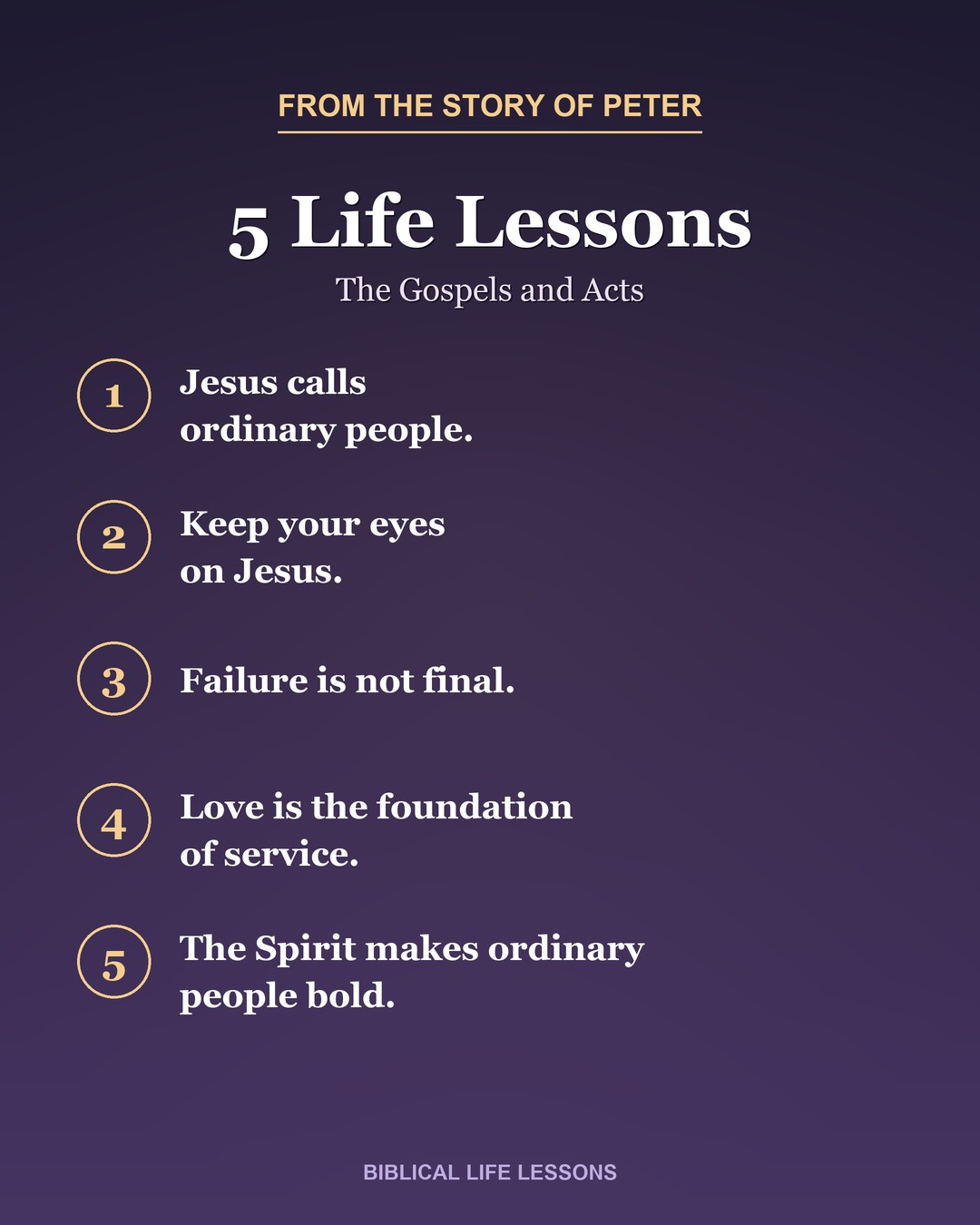
Five Life Lessons from Peter’s Story
1. Jesus calls ordinary people.
Peter was a fisherman with rough edges and no religious training. Jesus did not wait for him to become impressive before calling him. He called him first and changed him along the way. Your ordinary life is exactly where Jesus starts.
2. Keep your eyes on Jesus.
Peter walked on water as long as he looked at Jesus, and sank when he looked at the wind. The storm did not change; his focus did. When fear rises, fix your eyes on Him again, and cry out. He catches us immediately.
3. Failure is not final.
Peter’s denial was public, repeated, and bitter. But Jesus sought him out, asked him three times about his love, and gave him his calling back. Whatever you have done, Jesus is still making breakfast on the shore and inviting you to come.
4. Love is the foundation of service.
Before Jesus told Peter to feed His sheep, He asked him one question: “Do you love me?” Ministry, leadership, and every act of service flow from love for Jesus. Start there.
5. The Holy Spirit makes ordinary people bold.
The man who denied Jesus to a servant girl stood before thousands and before the rulers who had crucified Jesus, and would not be silenced. That change did not come from willpower but from the Holy Spirit. The same Spirit gives courage to every believer today.
Frequently Asked Questions About Peter
What was Peter’s real name?
Peter’s birth name was Simon, or Simeon. Jesus gave him the name Cephas (Aramaic) or Peter (Greek), both meaning “rock” (John 1:42). He is often called Simon Peter.
Why did Peter deny Jesus?
Peter was afraid. Jesus had just been arrested, and Peter was alone in the courtyard of the high priest, where admitting he was a disciple could have cost him his freedom or his life. Despite his earlier promises, fear won in that moment.
Was Peter married?
Yes. The Gospels mention Peter’s mother-in-law, whom Jesus healed (Mark 1:30-31), and Paul says Peter took a believing wife with him on his travels (1 Corinthians 9:5).
What does “on this rock I will build my church” mean?
Jesus said this after Peter confessed that He was the Messiah (Matthew 16:18). Christians have understood it in different ways: some see the rock as Peter himself and his leadership in the early church, others as Peter’s confession of faith, and others as Christ Himself. All agree that the church is built on the truth Peter declared about Jesus.
How did Peter die?
The Bible does not describe Peter’s death, though Jesus hinted at it in John 21:18-19. Early church tradition says he was crucified in Rome around AD 64-68, upside down at his own request.
Did Peter write books of the Bible?
Yes. Peter wrote the letters of 1 Peter and 2 Peter. Early church writers also said that the Gospel of Mark was based on Peter’s preaching and memories of Jesus.
Was Peter the first pope?
The Catholic Church regards Peter as the first bishop of Rome and the first pope. Protestant and Orthodox Christians honor Peter’s leadership among the apostles but understand his role and Matthew 16:18 differently.
Related Reading
For more on how Jesus restored Peter after his failure, read How Does Jesus Restore Us After We’ve Failed? For the conversation by the sea, see Focus on Your Calling: A Lesson from the Final Conversation of Jesus and Peter. For the night he walked on water, read What Happens When You Take Your Eyes Off Jesus. For the day the Spirit came, see The Day of Pentecost: Empowerment and Transformation. For the Roman officer whose household Peter welcomed, read Cornelius: Embracing God’s Inclusive Grace. For a reflection from Peter’s own letter, see Faith Refined by Fire: A Reflection on 1 Peter 1:7-9. For a wider guide to the men and women of Scripture, visit our Characters of the Bible pillar.
A Closing Prayer
Lord Jesus, thank You for Peter, and for the way You called, corrected, and restored him. Thank You that You call ordinary people like me. When the wind and the waves frighten me, help me keep my eyes on You, and catch me when I sink. Where I have failed You, meet me the way You met Peter on the shore, and give me my calling back. Let everything I do for You flow from love for You. Fill me with Your Spirit, and make me bold to speak about what You have done. You know all things; You know that I love You. Amen.
Subscribe for Daily Email Devotionals
MEET FAITH FRIEND AI
Faith Friend is your friendly AI chatbot on BiblicalLifeLessons.com, here to help you explore the Bible, answer your faith-related questions, and guide you through life lessons based on God’s Word. Whether you’re seeking encouragement, understanding Scripture, or deepening your faith, Faith Friend is always ready to chat.