Who Was Elizabeth in the Bible? The Complete Story of John the Baptist’s Mother (Luke 1)
Elizabeth is one of the quiet heroes of the New Testament. She was the wife of a priest, the mother of John the Baptist, and the relative Mary ran to when she was carrying Jesus. Her story fills only one chapter of Scripture — Luke 1 — yet it holds one of the most beautiful pictures of faith, waiting, and joy in the entire Bible.
If you have searched for who Elizabeth was in the Bible, or what her story teaches us today, this is a complete guide. We will walk through her family background, her long years of childlessness, the angel’s message to Zechariah, her five months of seclusion, her Spirit-filled meeting with Mary, the naming of John, and five practical life lessons her story still speaks into ours.
Who Was Elizabeth in the Bible?
Elizabeth was the wife of Zechariah, a priest who served in the temple in Jerusalem, and the mother of John the Baptist — the prophet who prepared the way for Jesus. She was also a relative of Mary, the mother of Jesus. Her story is told in Luke 1, set “in the time of Herod king of Judea” (Luke 1:5), just before the birth of Christ.
“Both of them were righteous in the sight of God, observing all the Lord’s commands and decrees blamelessly. But they were childless because Elizabeth was not able to conceive, and they were both very old.” (Luke 1:6-7, NIV)
Three things stand out from her introduction. She was righteous — Luke describes her and Zechariah as blameless before God, a rare description in Scripture. She was barren — like Sarah, Rebekah, Rachel, and Hannah before her, she had carried the pain of childlessness for many years. And she was old — by the time God answered, the door to having children seemed to have closed for good.
The Family Background: A Daughter of Aaron
Luke tells us that Elizabeth “was also a descendant of Aaron” (Luke 1:5). That means she came from the priestly family line, just like her husband Zechariah, who belonged to the priestly division of Abijah. A priest marrying a woman from a priestly family was considered a special honor.
Her name carries that heritage too. Elizabeth is the Greek form of the Hebrew name Elisheba — the same name as the wife of Aaron himself (Exodus 6:23). The name is usually understood to mean “my God is an oath” or “God has sworn.” It is a fitting name for a woman whose life would show that God keeps His promises.
Righteous, Faithful — and Childless
In Elizabeth’s culture, childlessness was often seen as a sign of God’s disfavor. People assumed something must be wrong. Yet Luke goes out of his way to say the opposite: Elizabeth and Zechariah were righteous and blameless. Their barrenness was not a punishment.
That detail matters. Elizabeth lived for decades with a painful gap between her faithfulness and her circumstances. She kept walking with God anyway. She did not become bitter or walk away from her faith. She carried what she later called her “disgrace among the people” (Luke 1:25) quietly, year after year, while continuing to honor God.
The Angel’s Message to Zechariah (Luke 1:8-25)
One day Zechariah was chosen by lot to burn incense in the temple — an honor many priests received only once in a lifetime, if ever. While he was alone in the holy place, an angel appeared beside the altar of incense:
“But the angel said to him: ‘Do not be afraid, Zechariah; your prayer has been heard. Your wife Elizabeth will bear you a son, and you are to call him John.'” (Luke 1:13, NIV)
“Your prayer has been heard.” After all those years, the prayers Elizabeth and Zechariah had prayed for a child had not been lost. The angel — who introduced himself as Gabriel — said their son would be “a joy and delight” to them, would be filled with the Holy Spirit even before birth, and would go before the Lord “in the spirit and power of Elijah” to prepare a people for Him (Luke 1:14-17).
Zechariah struggled to believe it: “How can I be sure of this? I am an old man and my wife is well along in years” (Luke 1:18). Because of his unbelief, he was unable to speak until the promise came true (Luke 1:20).
Five Months of Seclusion
Zechariah went home, and Elizabeth became pregnant. Then she did something unexpected: she remained in seclusion for five months (Luke 1:24). Scripture does not tell us exactly why. Perhaps she wanted to be sure before telling anyone. Perhaps she simply wanted time alone with God after so many years of waiting. What Luke does record is her response:
“‘The Lord has done this for me,’ she said. ‘In these days he has shown his favor and taken away my disgrace among the people.'” (Luke 1:25, NIV)
Her first words in Scripture are not about herself. They are about God. “The Lord has done this for me.” After a lifetime of whispers and pity, Elizabeth did not respond with pride or with an “I told you so.” She responded with worship.
Elizabeth and Mary: The Visitation (Luke 1:39-56)
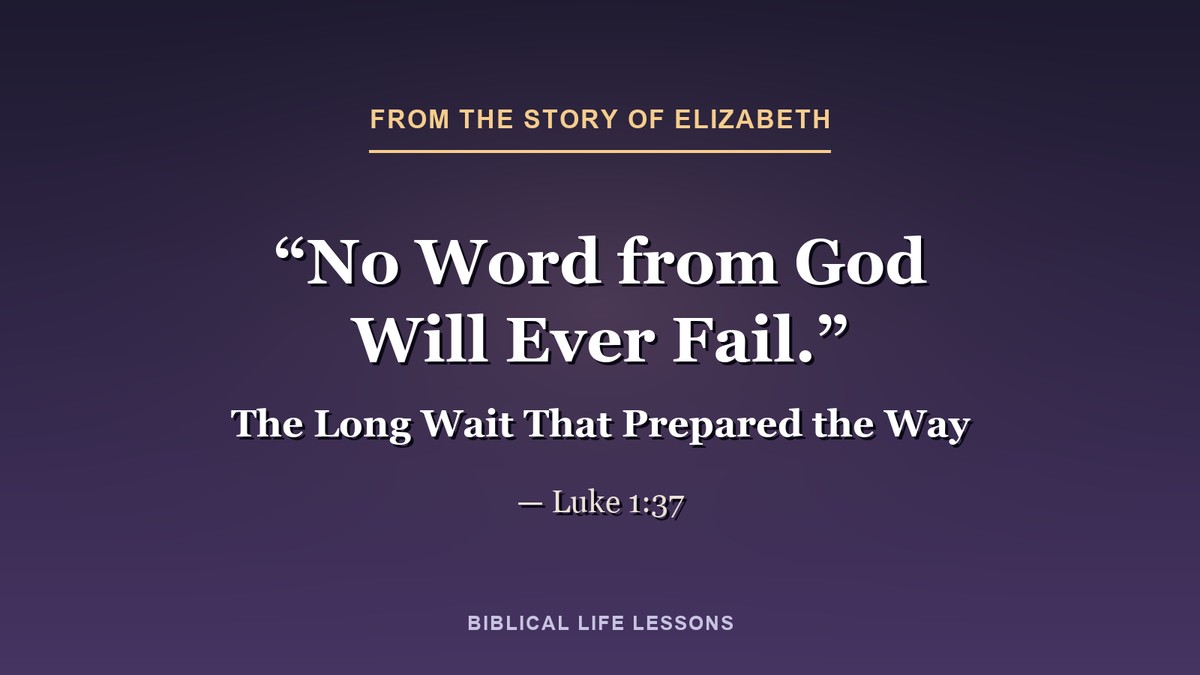
In Elizabeth’s sixth month, Gabriel appeared to a young woman in Nazareth named Mary and told her she would give birth to the Son of God. As a sign, he pointed to Elizabeth: “Even Elizabeth your relative is going to have a child in her old age, and she who was said to be unable to conceive is in her sixth month. For no word from God will ever fail” (Luke 1:36-37).
Mary hurried to the hill country of Judea to see her. As soon as Mary greeted her, the baby in Elizabeth’s womb leaped, and Elizabeth was filled with the Holy Spirit:
“In a loud voice she exclaimed: ‘Blessed are you among women, and blessed is the child you will bear! But why am I so favored, that the mother of my Lord should come to me? As soon as the sound of your greeting reached my ears, the baby in my womb leaped for joy. Blessed is she who has believed that the Lord would fulfill his promises to her!'” (Luke 1:42-45, NIV)
This is one of the most remarkable moments in the Gospels. Elizabeth — older, married to a priest, and carrying her own miracle child — honored a young woman from Nazareth without a trace of envy. Before anyone else in Luke’s Gospel, she called the unborn Jesus “my Lord.” Her words prompted Mary’s great song of praise, the Magnificat (Luke 1:46-55). Mary stayed with Elizabeth for about three months (Luke 1:56) — two women, both carrying impossible promises, encouraging each other.
“His Name Is John” (Luke 1:57-66)
When Elizabeth gave birth to a son, her neighbors and relatives “shared her joy” (Luke 1:58). On the eighth day, at his circumcision, they expected the baby to be named Zechariah after his father. But Elizabeth spoke up: “No! He is to be called John” (Luke 1:60).
The relatives protested that no one in the family had that name, and they turned to Zechariah. He asked for a writing tablet and wrote, “His name is John” (Luke 1:63). Immediately his voice returned, and he began praising God. The name John means “the LORD is gracious” — and that is exactly what Elizabeth’s life had shown.
Luke does not tell us anything more about Elizabeth after this. We do not know when she died. But her son grew up to become the voice crying in the wilderness, the one who baptized Jesus. Jesus later said of him, “Among those born of women there is no one greater than John” (Luke 7:28).
Five Life Lessons from Elizabeth’s Story
1. Faithfulness does not guarantee an easy life — but it is never wasted.
Elizabeth was righteous and blameless, and she was still childless for decades. Her story quietly corrects the idea that if we do everything right, life will go smoothly. Sometimes the faithful carry the heaviest burdens. But her years of faithfulness were not wasted. God was preparing her for a role in the greatest story ever told.
2. God hears the prayers you may have stopped praying.
“Your prayer has been heard.” By the time Gabriel spoke those words, Elizabeth and Zechariah were very old. It is likely they had stopped asking for a child long before. Yet God had not forgotten a single prayer. If you have given up on something you once prayed for, Elizabeth’s story is a reminder: God’s silence is not the same as God’s refusal.
3. Celebrate other people’s blessings without envy.
Elizabeth had every reason to make the moment about herself. She had waited longer. She was older. Her husband was a priest. Instead, she lifted up Mary: “Why am I so favored, that the mother of my Lord should come to me?” Unlike the rivalry between Rachel and Leah, Elizabeth’s response shows what it looks like to rejoice when God is doing something great in someone else’s life — even something greater than in your own.
4. Let God, not people, define your story.
For years, Elizabeth lived with what she called “disgrace among the people.” Her neighbors had their own explanation for her pain. But God had the final word: “The Lord has done this for me.” Whatever labels others have put on you because of your circumstances, they do not get the last word. God does.
5. Have the courage to follow God’s word, even against tradition.
“No! He is to be called John.” Everyone in the room expected Elizabeth to follow family tradition. She chose to follow what God had said instead. Following God sometimes means going against what everyone around you expects. Elizabeth’s quiet courage reminds us that obedience matters more than approval.
Frequently Asked Questions About Elizabeth
Who was Elizabeth’s husband?
Elizabeth was married to Zechariah, a priest who belonged to the priestly division of Abijah (Luke 1:5). He served in the temple in Jerusalem, where the angel Gabriel appeared to him while he was burning incense (Luke 1:8-11).
Who was Elizabeth’s son?
Elizabeth’s son was John the Baptist, the prophet who prepared the way for Jesus and later baptized Him in the Jordan River (Luke 1:57-63; Matthew 3:13-17). Jesus said that among those born of women, no one was greater than John (Luke 7:28).
How were Elizabeth and Mary related?
The angel Gabriel called Elizabeth Mary’s “relative” (Luke 1:36). Some older translations use the word “cousin,” but the Greek word simply means a relative or kinswoman. Scripture does not tell us the exact family connection.
How old was Elizabeth when she had John?
The Bible does not give Elizabeth’s exact age. Luke says she and Zechariah “were both very old” (Luke 1:7), and Gabriel told Mary that Elizabeth was having a child “in her old age” (Luke 1:36).
Why did Elizabeth hide for five months?
Luke 1:24 says Elizabeth “remained in seclusion” for five months but does not explain why. Many readers think she wanted quiet time to reflect and worship before her pregnancy became public. Her words in Luke 1:25 show her focus: “The Lord has done this for me.”
What does the name Elizabeth mean?
Elizabeth comes from the Hebrew name Elisheba, which is usually understood to mean “my God is an oath” or “God has sworn.” Elisheba was also the name of Aaron’s wife (Exodus 6:23), and Elizabeth was a descendant of Aaron (Luke 1:5).
Where is Elizabeth’s story in the Bible?
Elizabeth’s story is found entirely in Luke 1: her introduction and the angel’s message to Zechariah (Luke 1:5-25), Gabriel’s mention of her to Mary (Luke 1:36-37), Mary’s visit (Luke 1:39-56), and the birth and naming of John (Luke 1:57-66).
Related Reading
For the woman whose story Elizabeth’s echoes most closely, see Who Was Sarah in the Bible? The Complete Story of Abraham’s Wife. For her son, read What John the Baptist Teaches Us About Getting Smaller So God Gets Bigger. For her young relative, see What Mary Teaches Us About Saying Yes to a Life We Didn’t Plan. For two more faithful people who waited for the Messiah, read What Simeon Teaches Us About Waiting With Hope and What Anna the Prophetess Teaches Us About Worship While You Wait. And for a wider guide to the men and women of Scripture, visit our Characters of the Bible pillar.
A Closing Prayer
Father, thank You for Elizabeth. Thank You that You saw her faithfulness through all the years of waiting, and that You heard every prayer she prayed. Help me keep walking with You when my circumstances do not make sense. Free me from envy, and teach me to celebrate what You are doing in other people’s lives. When others try to define my story, remind me that You have the final word. And give me the courage to follow what You say, even when it goes against what everyone expects. In Jesus’ name, Amen.
Subscribe for Daily Email Devotionals
MEET FAITH FRIEND AI
Faith Friend is your friendly AI chatbot on BiblicalLifeLessons.com, here to help you explore the Bible, answer your faith-related questions, and guide you through life lessons based on God’s Word. Whether you’re seeking encouragement, understanding Scripture, or deepening your faith, Faith Friend is always ready to chat.