Who Was Esther in the Bible? The Complete Story of the Queen Who Saved Her People
Esther is one of the most famous women in the Bible. She was a Jewish orphan who became queen of the Persian Empire, and she risked her life to save her people from destruction. Her story is full of drama — a banished queen, a beauty contest, an assassination plot, a villain’s scheme, two banquets, and a sleepless king. And yet the book that bears her name never once mentions God by name.
If you have searched for who Esther was in the Bible, or what her story teaches us today, this is a complete guide. We will walk through her background as an orphan raised by Mordecai, how she became queen, Haman’s plot against the Jews, the famous words “for such a time as this,” her courageous approach to the king, the two banquets, Haman’s downfall, the festival of Purim, and five practical life lessons her story still speaks into ours.
Who Was Esther in the Bible?
Esther was a young Jewish woman living in exile in the Persian city of Susa who became the wife of King Xerxes and queen of Persia. Her Hebrew name was Hadassah. Raised by her cousin Mordecai after her parents died, she used her royal position to stop a plan to wipe out the Jewish people across the empire. Her story is told in the book of Esther.
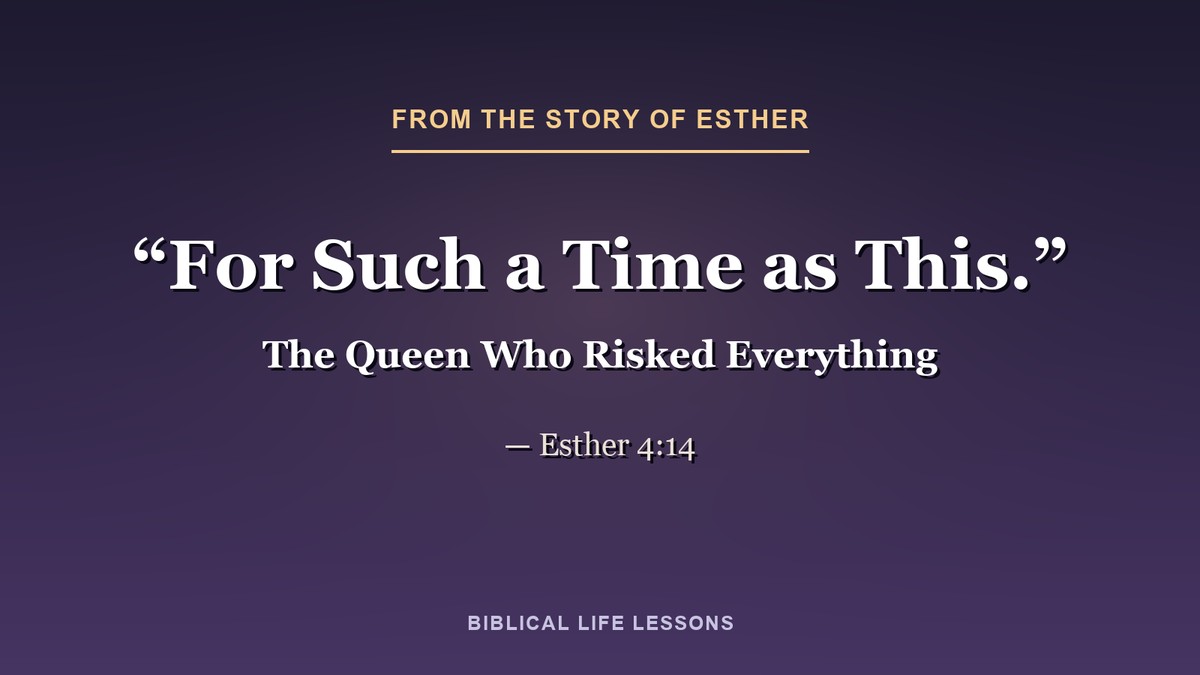
“And who knows but that you have come to your royal position for such a time as this?” (Esther 4:14, NIV)
Three things stand out about her. She was an outsider — an orphan, a woman, and a member of an exiled minority in a foreign empire. She was placed — God positioned her in the palace before anyone knew why it mattered. And she was courageous — when the moment came, she risked her life to speak up for her people.
The Background: An Orphan in Exile
The story of Esther takes place in the Persian Empire, several decades after Babylon had carried the people of Judah into exile. Persia now ruled the known world. King Xerxes (also called Ahasuerus) reigned over 127 provinces “stretching from India to Cush” (Esther 1:1), and his royal residence was the citadel of Susa.
Many Jews still lived scattered throughout the empire. Among them was Mordecai, a Benjamite whose family had been carried into exile from Jerusalem (Esther 2:5-6). Mordecai “had a cousin named Hadassah, whom he had brought up because she had neither father nor mother. This young woman, who was also known as Esther, had a lovely figure and was beautiful, and Mordecai had taken her as his own daughter when her father and mother died” (Esther 2:7).
Esther’s Hebrew name, Hadassah, means “myrtle.” Her Persian name, Esther, is often connected to the Persian word for “star.” She was an orphan girl with two names — one from her people and one from the empire she lived in — and she would soon have to decide which identity she would stand on.
From Orphan to Queen (Esther 1-2)
The story begins with a royal banquet. When Queen Vashti refused the king’s command to appear before his drunken guests, Xerxes removed her as queen (Esther 1:10-19). His advisers suggested a search throughout the empire for beautiful young women, from whom the king would choose a new queen.
Esther was among the young women taken to the palace. Following Mordecai’s instructions, she did not reveal her nationality or family background (Esther 2:10). She went through twelve months of beauty treatments (Esther 2:12), and Scripture notes that “Esther won the favor of everyone who saw her” (Esther 2:15). When her turn came, “the king was attracted to Esther more than to any of the other women… So he set a royal crown on her head and made her queen instead of Vashti” (Esther 2:17).
Around the same time, Mordecai overheard two royal officials plotting to assassinate the king. He told Esther, who reported it to the king, giving Mordecai credit. The plot was stopped, and the event was recorded in the king’s official records (Esther 2:21-23). No one rewarded Mordecai at the time — but that detail would matter later.
Haman’s Plot Against the Jews (Esther 3)
King Xerxes promoted a man named Haman the Agagite above all his other officials. Everyone was commanded to kneel before Haman — but Mordecai refused (Esther 3:2). When Haman learned that Mordecai was a Jew, his anger grew into something much darker. He “looked for a way to destroy all Mordecai’s people, the Jews, throughout the whole kingdom of Xerxes” (Esther 3:6).
Haman cast pur — the lot — to choose a date for the massacre, and it fell on the thirteenth day of the twelfth month, Adar (Esther 3:7). He told the king that a certain people did not obey the king’s laws, offered ten thousand talents of silver, and received the king’s signet ring to seal the decree. Orders went out to every province “to destroy, kill and annihilate all the Jews — young and old, women and children — on a single day” (Esther 3:13). The king and Haman sat down to drink, “but the city of Susa was bewildered” (Esther 3:15).
“For Such a Time as This” (Esther 4)
When Mordecai learned of the decree, he tore his clothes, put on sackcloth, and wailed loudly in the city. Jews across the empire mourned, fasted, and wept (Esther 4:1-3). Through a messenger, Mordecai sent Esther a copy of the decree and urged her to go to the king and plead for her people.
Esther explained the danger. Anyone who approached the king in his inner court without being summoned would be put to death — unless the king extended his gold scepter. And she had not been called to the king for thirty days (Esther 4:11). Mordecai’s response is one of the most famous passages in the Old Testament:
“Do not think that because you are in the king’s house you alone of all the Jews will escape. For if you remain silent at this time, relief and deliverance for the Jews will arise from another place, but you and your father’s family will perish. And who knows but that you have come to your royal position for such a time as this?” (Esther 4:13-14, NIV)
Esther made her decision:
“Go, gather together all the Jews who are in Susa, and fast for me. Do not eat or drink for three days, night or day. I and my attendants will fast as you do. When this is done, I will go to the king, even though it is against the law. And if I perish, I perish.” (Esther 4:16, NIV)
The orphan who had hidden her identity now chose to stand with her people, no matter the cost. She did not rush in. She prepared by fasting and asked her community to stand with her.
Esther Approaches the King (Esther 5)
On the third day, Esther put on her royal robes and stood in the inner court of the palace. When the king saw her, “he was pleased with her and held out to her the gold scepter that was in his hand” (Esther 5:2). Her life was spared. “What is it, Queen Esther? What is your request? Even up to half the kingdom, it will be given you” (Esther 5:3).
Surprisingly, Esther did not make her request right away. Instead, she invited the king and Haman to a banquet. At that banquet, the king asked again — and again she waited, inviting them to a second banquet the next day (Esther 5:4-8). Her patience and timing were part of her wisdom.
Meanwhile, Haman left the first banquet thrilled to be honored — until he saw Mordecai at the king’s gate, still refusing to bow. At his wife’s suggestion, Haman had a pole set up, fifty cubits (about seventy-five feet) high, on which to impale Mordecai the next morning (Esther 5:14).
A Sleepless Night (Esther 6)
That night, “the king could not sleep” (Esther 6:1). He ordered the royal records to be read to him — and they happened to include the account of Mordecai exposing the assassination plot. The king asked what honor Mordecai had received. The answer: nothing.
At that very moment, Haman arrived at the palace to ask permission to execute Mordecai. Before he could speak, the king asked him, “What should be done for the man the king delights to honor?” Thinking the king meant him, Haman described a grand public honor. Then the king told him to do exactly that for Mordecai (Esther 6:6-10). Haman had to lead Mordecai through the city on the king’s horse, proclaiming his honor.
The book never mentions God. But a sleepless night, a forgotten record, and perfect timing all point to the One working behind the scenes.
The Second Banquet and Haman’s Downfall (Esther 7)
At the second banquet, the king asked Esther again what she wanted. This time, she spoke:
“If I have found favor with you, Your Majesty, and if it pleases you, grant me my life — this is my petition. And spare my people — this is my request. For I and my people have been sold to be destroyed, killed and annihilated.” (Esther 7:3-4, NIV)
The king demanded to know who would dare do such a thing. Esther answered, “An adversary and enemy! This vile Haman!” (Esther 7:6). The king was furious. When he learned of the pole Haman had built for Mordecai, he ordered Haman to be impaled on it (Esther 7:9-10). The trap Haman had set for Mordecai became his own end.
A New Decree and the Festival of Purim (Esther 8-10)
Haman was gone, but his decree still stood — under Persian law, a royal decree could not be revoked. So the king gave Mordecai his signet ring and allowed Esther and Mordecai to write a new decree. It gave the Jews in every city the right to assemble and defend themselves on the day of the planned attack (Esther 8:8-11).
When the thirteenth of Adar came, the day their enemies had hoped to destroy them became a day of victory instead (Esther 9:1). Mordecai rose to become second in rank to the king (Esther 10:3). Mordecai and Esther established the festival of Purim — named after the pur, the lot Haman cast — to be celebrated every year as “days of feasting and joy and giving presents of food to one another and gifts to the poor” (Esther 9:22). Queen Esther herself wrote with full authority to confirm the celebration (Esther 9:29). Jewish communities still celebrate Purim today, reading the book of Esther aloud.
Five Life Lessons from Esther’s Story
1. God is at work even when He seems hidden.
The book of Esther never names God, yet His fingerprints are everywhere — an orphan placed in the palace, a recorded good deed, a sleepless king, perfectly timed events. There may be seasons when God feels silent or absent in your life. Esther’s story is a reminder that God’s silence is not His absence. He is often working most powerfully behind the scenes.
2. You are where you are for a reason.
“Who knows but that you have come to your royal position for such a time as this?” Esther did not choose her position, but God used it. Your job, your neighborhood, your family, and your relationships are not accidents. Ask God what He wants to do through you right where you are — and for whom He has placed you there.
3. Prepare for courage with prayer and community.
Esther did not rush into the king’s court on impulse. She fasted for three days and asked her people to fast with her. Courage that lasts is usually prepared in prayer and supported by others. Before your hardest conversations and biggest decisions, seek God first — and invite others to stand with you.
4. Wisdom knows when to speak.
Esther had the king’s attention at the first banquet, but she waited. Her patience allowed God to move during the sleepless night between the two banquets. Speaking up for what is right matters — but so does timing. Wisdom often means waiting for the right moment rather than the first moment.
5. Silence has a cost; use your influence for others.
Mordecai warned Esther that staying silent would not protect her. Esther could have kept her identity hidden and stayed safe in the palace. Instead, she risked everything to speak up for people who had no voice before the king. Whatever influence you have — at work, in your church, in your community — God gives it to you not just for your own comfort, but for the good of others.
Frequently Asked Questions About Esther
What was Esther’s Hebrew name?
Esther’s Hebrew name was Hadassah, which means “myrtle” (Esther 2:7). Her Persian name, Esther, is often linked to the Persian word for “star.”
How were Esther and Mordecai related?
Mordecai was Esther’s cousin. After her parents died, Mordecai raised her as his own daughter (Esther 2:7, 15). Some older translations describe him as her uncle, but the Hebrew text says Esther was the daughter of Mordecai’s uncle, Abihail.
Who was Esther’s husband?
Esther’s husband was King Xerxes of Persia, also known as Ahasuerus. He is generally identified with Xerxes I, who ruled the Persian Empire in the fifth century BC (Esther 1:1).
What does “for such a time as this” mean?
The phrase comes from Mordecai’s message to Esther in Esther 4:14: “And who knows but that you have come to your royal position for such a time as this?” Mordecai was suggesting that God had placed Esther in the palace for the very purpose of saving her people.
Why isn’t God mentioned in the book of Esther?
The book of Esther is one of only two books in the Bible that do not mention God by name. Many scholars believe this is intentional, showing that God works through ordinary events and human choices even when He seems hidden. His providence is visible throughout the story, even though His name is not.
What is Purim?
Purim is a Jewish festival that celebrates the deliverance of the Jews from Haman’s plot. It is named after the pur, or lot, that Haman cast to choose the date of the massacre (Esther 3:7; 9:24-26). It is celebrated each year on the 14th and 15th of Adar with feasting, gifts of food, gifts to the poor, and the public reading of the book of Esther.
Where is Esther’s story in the Bible?
Esther’s story is told in the book of Esther, which has ten chapters. It is found in the Old Testament after Nehemiah and before Job.
Related Reading
For a short devotional on Esther’s courage, see What Esther Teaches Us About Showing Up When It Costs Us. For the cousin who raised her, read The Wisdom and Courage of Mordecai. For another wise woman who stopped a disaster by speaking to a powerful man, see Who Was Abigail in the Bible? For another woman God raised up to lead in a crisis, read Who Was Deborah in the Bible? For more women of faith, see Women of Faith in the Bible. And for a wider guide to the men and women of Scripture, visit our Characters of the Bible pillar.
A Closing Prayer
Father, thank You for Esther. Thank You that even when Your name is not spoken, Your hand is never absent. Help me trust that You are working behind the scenes of my life. Show me why You have placed me where I am, and give me the courage to act when the moment comes. Teach me to prepare with prayer, to wait with wisdom, and to speak up for those who have no voice. And if I must risk something for what is right, let me say with Esther, “If I perish, I perish,” trusting that my life is in Your hands. In Jesus’ name, Amen.
Subscribe for Daily Email Devotionals
MEET FAITH FRIEND AI
Faith Friend is your friendly AI chatbot on BiblicalLifeLessons.com, here to help you explore the Bible, answer your faith-related questions, and guide you through life lessons based on God’s Word. Whether you’re seeking encouragement, understanding Scripture, or deepening your faith, Faith Friend is always ready to chat.