Who Was Leah in the Bible? The Complete Story of Jacob’s First Wife (Genesis 29-35)
Leah is one of the most overlooked women in the Bible — and one of the most important. She was the wife Jacob did not choose, the sister who lived in Rachel’s shadow, and a woman who spent years longing for a love she never fully received. Yet God saw her. Through Leah came Levi, the tribe of priests, and Judah, the tribe of kings — the line that led to David and, ultimately, to Jesus.
If you have searched for who Leah was in the Bible, or what her story teaches us today, this is a complete guide. We will walk through her family background, the wedding-night deception, the meaning behind her children’s names, her rivalry with Rachel, her place in Jacob’s family, her burial beside Jacob, her surprising legacy, and five practical life lessons her story still speaks into ours.
Who Was Leah in the Bible?
Leah was the older daughter of Laban, the older sister of Rachel, and the first wife of Jacob. She is one of the four great matriarchs of Israel, alongside Sarah, Rebekah, and Rachel. Leah gave birth to six of Jacob’s twelve sons and to his only recorded daughter, Dinah. Her story is told mainly in Genesis 29-35.
“When the LORD saw that Leah was not loved, he enabled her to conceive, but Rachel remained childless.” (Genesis 29:31, NIV)
Three things stand out about her. She was unloved — Scripture says it plainly, more than once. She was seen — the very first thing God does in her story is notice her pain. And she was fruitful — the woman her husband overlooked became the mother of half the tribes of Israel.
The Family Background: Laban’s Older Daughter
Leah grew up in Paddan Aram, near Haran, in the household of her father Laban — the brother of Rebekah. That made Leah and Jacob first cousins. Genesis introduces the two sisters side by side: “Laban had two daughters; the name of the older was Leah, and the name of the younger was Rachel. Leah had weak eyes, but Rachel had a lovely figure and was beautiful” (Genesis 29:16-17).
The Hebrew word translated “weak” can also mean “tender” or “delicate,” so scholars are not certain whether it describes a flaw or simply a gentle, less striking appearance. Either way, the contrast is clear. From the beginning, Leah was the sister people looked past. When Jacob arrived and fell in love, it was Rachel he wanted.
The Wedding-Night Switch (Genesis 29:15-30)
Jacob agreed to work seven years for Rachel. But when the wedding night came, Laban secretly brought Leah to Jacob instead. In the darkness, Jacob did not realize it. “When morning came, there was Leah!” (Genesis 29:25).
Jacob was furious with Laban, who claimed that local custom required the older daughter to marry first. A week later, Jacob also married Rachel and agreed to work another seven years. Scripture sums up the result in one painful line: Jacob “loved Rachel more than Leah” (Genesis 29:30).
We are never told what Leah thought or whether she had any choice in her father’s plan. But we can imagine that morning — waking up as a bride and watching her new husband’s face fall when he saw her. From the first day of her marriage, Leah knew she was not the one he wanted.
The Names of Her Sons: A Window into Leah’s Heart (Genesis 29:31-35)
Then God stepped in. “When the LORD saw that Leah was not loved, he enabled her to conceive” (Genesis 29:31). The names Leah gave her first four sons tell the story of her heart, one child at a time:
Reuben — “It is because the LORD has seen my misery. Surely my husband will love me now” (Genesis 29:32).
Simeon — “Because the LORD heard that I am not loved, he gave me this one too” (Genesis 29:33).
Levi — “Now at last my husband will become attached to me, because I have borne him three sons” (Genesis 29:34).
Three times, Leah hoped a son would finally win Jacob’s love. Three times, it did not. But with her fourth son, something changed:
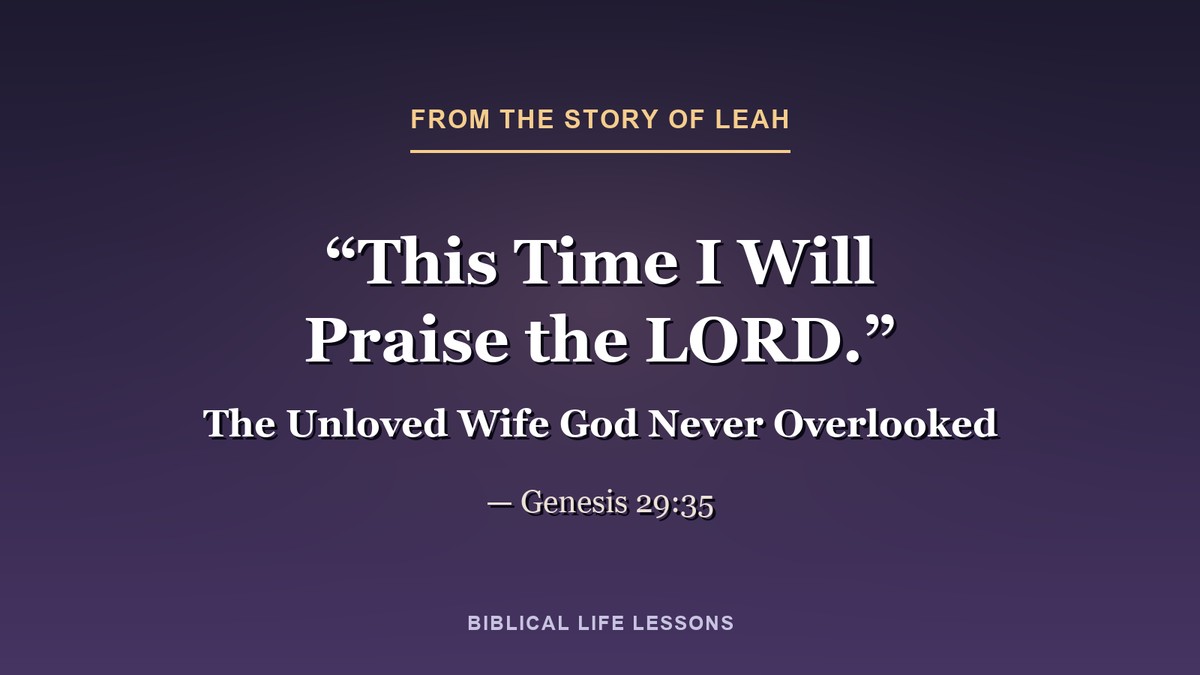
“She conceived again, and when she gave birth to a son she said, ‘This time I will praise the LORD.’ So she named him Judah. Then she stopped having children.” (Genesis 29:35, NIV)
For the first time, Leah’s son’s name says nothing about Jacob. It is about God. Leah had not stopped longing for her husband’s love, but she had found something to hold on to that did not depend on it. And it was through Judah — the son of praise — that God would bring Israel’s kings and, one day, the Messiah.
Rivalry with Rachel (Genesis 30)
Leah had children; Rachel had Jacob’s heart. Each sister envied what the other had. When Rachel gave her servant Bilhah to Jacob to have children through her, Leah did the same with her servant Zilpah, who bore Gad and Asher (Genesis 30:9-13).
The rivalry reached a low point over a handful of mandrakes — a plant believed in the ancient world to help with fertility. When Leah’s son Reuben found some, Rachel asked for them. Leah’s reply exposed years of hurt: “Wasn’t it enough that you took away my husband? Will you take my son’s mandrakes too?” (Genesis 30:15). Rachel traded a night with Jacob for the mandrakes.
God listened to Leah, and she gave birth to two more sons, Issachar and Zebulun, and later a daughter, Dinah (Genesis 30:17-21). At Zebulun’s birth, Leah said, “God has presented me with a precious gift. This time my husband will treat me with honor, because I have borne him six sons” (Genesis 30:20). Even after praising God at Judah’s birth, the old longing for Jacob’s approval had not completely gone away.
Leaving Laban and Facing Esau (Genesis 31-33)
After twenty years, God told Jacob to return to Canaan. For once, Leah and Rachel stood together. “Do we still have any share in the inheritance of our father’s estate?” they asked. “Does he not regard us as foreigners?” (Genesis 31:14-15). Both sisters agreed to leave their father’s house with Jacob.
But Jacob’s favoritism did not change. When he went to meet his brother Esau, who was approaching with four hundred men, Jacob arranged his family in order: “He put the female servants and their children in front, Leah and her children next, and Rachel and Joseph in the rear” (Genesis 33:2). Even in a moment of danger, the order revealed who Jacob valued most.
Leah’s Death and Burial (Genesis 49)
Scripture does not record when or how Leah died. Rachel died on the road near Bethlehem and was buried there. But at the end of Jacob’s life, as he gave instructions for his own burial, he said something striking:
“There Abraham and his wife Sarah were buried, there Isaac and his wife Rebekah were buried, and there I buried Leah.” (Genesis 49:31, NIV)
Jacob asked to be buried in the cave of Machpelah — beside Leah. The wife he had not chosen, the one he had placed ahead of Rachel in the line of danger, was the one who rested beside him in the family tomb of Abraham and Isaac. In death, Leah received a place of honor she had longed for in life.
Leah’s Surprising Legacy
Leah’s legacy reaches far beyond what she could have seen in her lifetime. Through her son Levi came the tribe of priests — including Moses, Aaron, and every priest who served at the tabernacle and temple. Through her son Judah came the royal line of Israel — King David and his descendants.
And through Judah came Jesus Himself. Matthew’s genealogy traces Jesus’ family line through “Jacob the father of Judah and his brothers” (Matthew 1:2). Revelation 5:5 calls Jesus “the Lion of the tribe of Judah.” The unloved wife became an ancestor of the Messiah.
Centuries later, when Boaz married Ruth, the people of Bethlehem blessed her with these words: “May the LORD make the woman who is coming into your home like Rachel and Leah, who together built up the family of Israel” (Ruth 4:11). Leah’s name was spoken with honor alongside her sister’s.
Five Life Lessons from Leah’s Story
1. God sees the unloved.
The first thing God does in Leah’s story is see her: “When the LORD saw that Leah was not loved.” People may overlook you, compare you, or choose someone else. God does not. If you have ever felt like the second choice, Leah’s story is a reminder that you are never invisible to Him.
2. Do not build your identity on winning someone’s love.
Reuben, Simeon, Levi — Leah’s first three sons carry the same hope: “Surely my husband will love me now.” Each time, she was disappointed. When we tie our worth to another person’s approval, we will always come up empty. Our identity is safest when it rests on God’s love, not on whether someone else finally notices us.
3. Praise can be the turning point.
“This time I will praise the LORD.” Leah’s circumstances had not changed when Judah was born. Jacob still loved Rachel more. But Leah’s focus changed. Choosing to praise God in the middle of disappointment does not deny the pain — it lifts our eyes above it. And as Leah discovered, God can do great things through the moment we choose praise.
4. Rivalry steals joy from everyone.
Leah and Rachel spent years competing, bargaining, and comparing. Neither sister won. Both lived with bitterness. When we measure our lives against someone else’s, we miss the blessings already in our own hands. Leah had six sons and a daughter; Rachel had Jacob’s love. Neither could see what she had because she was fixed on what the other had.
5. God writes legacy through the overlooked.
Leah was not the favorite wife. Her story is often told as a footnote to Rachel’s. Yet through her came the priests and the kings of Israel, and the Savior of the world. God often chooses the overlooked to carry His greatest purposes. What looks like second place to people may be exactly where God is doing His most important work.
Frequently Asked Questions About Leah
Who was Leah’s husband?
Leah’s husband was Jacob, the son of Isaac and Rebekah, whom God later renamed Israel. Leah’s father, Laban, tricked Jacob into marrying Leah when Jacob had agreed to work for her younger sister Rachel (Genesis 29:21-25).
Why did Laban trick Jacob into marrying Leah?
Laban told Jacob, “It is not our custom here to give the younger daughter in marriage before the older one” (Genesis 29:26). He also gained another seven years of Jacob’s labor by giving him Rachel afterward. Scripture does not tell us whether Leah agreed to the plan.
How many children did Leah have?
Leah had seven children: six sons — Reuben, Simeon, Levi, Judah, Issachar, and Zebulun — and one daughter, Dinah (Genesis 29:31-35; 30:17-21). Her servant Zilpah also bore Gad and Asher, whom Leah named (Genesis 30:9-13).
What does “Leah had weak eyes” mean?
Genesis 29:17 says “Leah had weak eyes, but Rachel had a lovely figure and was beautiful.” The Hebrew word translated “weak” can also mean “tender” or “delicate.” It may describe a physical weakness, or simply that Leah’s appearance was less striking than Rachel’s. Either way, the verse highlights how people compared the two sisters.
Is Jesus descended from Leah?
Yes. Jesus descended from Judah, Leah’s fourth son (Matthew 1:2-3; Luke 3:33). Through Judah came King David and his royal line. Revelation 5:5 calls Jesus “the Lion of the tribe of Judah.”
Where is Leah buried?
Leah was buried in the cave of Machpelah near Hebron, the family tomb where Abraham, Sarah, Isaac, and Rebekah were buried. Jacob said, “there I buried Leah,” and asked to be buried there beside her (Genesis 49:29-31). Rachel, by contrast, was buried near Bethlehem.
Where is Leah’s story in the Bible?
Leah’s story is told mainly in Genesis 29 (her marriage and first four sons), Genesis 30 (her rivalry with Rachel and her other children), Genesis 31 (leaving Laban), Genesis 33 (meeting Esau), and Genesis 49:31 (her burial). She is also mentioned in Ruth 4:11.
Related Reading
For her sister’s story, read Who Was Rachel in the Bible? For her husband, see Who Was Jacob in the Bible? For the matriarchs who came before her, read Who Was Sarah in the Bible? and Who Was Rebekah in the Bible? For a descendant of her son Levi, see Who Was Aaron in the Bible? For another woman who prayed through the pain of a rival, read Who Was Hannah in the Bible? And for a wider guide to the men and women of Scripture, visit our Characters of the Bible pillar.
A Closing Prayer
Father, thank You for Leah. Thank You that when no one else saw her, You did. When I feel overlooked or second-best, remind me that I am fully seen and fully loved by You. Free me from building my worth on anyone’s approval. Teach me to say, like Leah, “This time I will praise the LORD,” even when my circumstances have not changed. Guard my heart from rivalry and comparison. And use my life, even the parts others overlook, to carry Your purposes to the generations after me. In Jesus’ name, Amen.
Subscribe for Daily Email Devotionals
MEET FAITH FRIEND AI
Faith Friend is your friendly AI chatbot on BiblicalLifeLessons.com, here to help you explore the Bible, answer your faith-related questions, and guide you through life lessons based on God’s Word. Whether you’re seeking encouragement, understanding Scripture, or deepening your faith, Faith Friend is always ready to chat.