Who Was Abigail in the Bible? The Complete Story of David’s Wise Wife (1 Samuel 25)
Abigail is one of the wisest women in the Bible. In a single afternoon, she stopped a future king from committing a massacre, saved her entire household, and reminded David who God had called him to be. Her story takes up just one chapter — 1 Samuel 25 — but it is one of the clearest pictures in Scripture of what godly wisdom looks like under pressure.
If you have searched for who Abigail was in the Bible, or what her story teaches us today, this is a complete guide. We will walk through her difficult marriage to Nabal, the insult that nearly cost her family everything, her bold ride to meet David, the speech that changed his mind, Nabal’s death, her marriage to David, and five practical life lessons her story still speaks into ours.
Who Was Abigail in the Bible?
Abigail was the wife of a wealthy but foolish man named Nabal, and later became one of the wives of King David. She lived during the years when David was on the run from King Saul, hiding in the wilderness of Judah with a band of about six hundred men. Her story is told in 1 Samuel 25.
“His name was Nabal and his wife’s name was Abigail. She was an intelligent and beautiful woman, but her husband was surly and mean in his dealings.” (1 Samuel 25:3, NIV)
Three things stand out from her introduction. She was intelligent — Scripture mentions her understanding before her beauty. She was married to a hard man — the contrast between husband and wife is drawn in the very first verse that names them. And she was trusted — when disaster came, it was Abigail the servants ran to, not Nabal.
The Background: A Wise Woman Married to a Fool
Nabal was a rich man from Maon who owned property in Carmel, a town in the hill country of Judah. He had three thousand sheep and a thousand goats (1 Samuel 25:2). He was from the family of Caleb — a proud lineage. But his character was nothing to be proud of.
The name Nabal means “fool” in Hebrew. Abigail herself would later say of him, “He is just like his name — his name means Fool, and folly goes with him” (1 Samuel 25:25). One of his own servants described him this way: “He is such a wicked man that no one can talk to him” (1 Samuel 25:17).
We are not told how Abigail came to be married to Nabal. In that culture, marriages were usually arranged by families, and a wealthy husband would have seemed like a good match. Whatever the reason, Abigail lived every day with a man who was harsh, proud, and impossible to reason with. Yet she did not let his foolishness shape her character.
David’s Request and Nabal’s Insult (1 Samuel 25:4-13)
It was sheep-shearing time — a season of feasting and celebration, when wealthy owners were expected to be generous. For months, David and his men had been living near Nabal’s shepherds in the wilderness. They had not stolen from them. In fact, they had protected them. As one of Nabal’s servants later said, “Night and day they were a wall around us the whole time we were herding our sheep near them” (1 Samuel 25:16).
So David sent ten young men to Nabal with a polite request: please share whatever you can with us. Nabal’s answer was an insult:
“Nabal answered David’s servants, ‘Who is this David? Who is this son of Jesse? Many servants are breaking away from their masters these days. Why should I take my bread and water, and the meat I have slaughtered for my shearers, and give it to men coming from who knows where?'” (1 Samuel 25:10-11, NIV)
Nabal knew exactly who David was. His words were a deliberate put-down — calling the anointed future king a runaway servant. When David heard, he told his men, “Each of you strap on your sword!” (1 Samuel 25:13). About four hundred men set out with him. David vowed that by morning not one male in Nabal’s household would be left alive (1 Samuel 25:22).
Abigail Acts Quickly (1 Samuel 25:14-20)
One of Nabal’s servants ran to Abigail and told her everything — how David’s men had protected them, how Nabal had insulted David’s messengers, and how disaster was coming. He said, “Now think it over and see what you can do” (1 Samuel 25:17).
Abigail did not hesitate. “Abigail acted quickly” (1 Samuel 25:18). She gathered two hundred loaves of bread, two skins of wine, five dressed sheep, five seahs of roasted grain, a hundred cakes of raisins, and two hundred cakes of pressed figs, and loaded them on donkeys. She sent her servants ahead and followed behind them. And she did not tell her husband (1 Samuel 25:19).
She rode down into a mountain ravine — and there, coming toward her, was David with four hundred armed men.
The Speech That Stopped a King (1 Samuel 25:23-31)
When Abigail saw David, she got off her donkey and bowed down before him with her face to the ground. Then she gave one of the longest speeches by a woman recorded in the Old Testament. She asked that the blame fall on her. She called her husband exactly what he was — a fool. She offered her gift. And then she did something remarkable: she reminded David of his future.
“The LORD your God will certainly make a lasting dynasty for my lord, because you fight the LORD’s battles, and no wrongdoing will be found in you as long as you live.” (1 Samuel 25:28, NIV)
Abigail told David that when God made him ruler over Israel, he would not want “the staggering burden of needless bloodshed or of having avenged himself” on his conscience (1 Samuel 25:31). In other words: You are going to be king. Do not stain your future with revenge today. Let God fight this battle for you.
Her words worked. David’s anger broke:
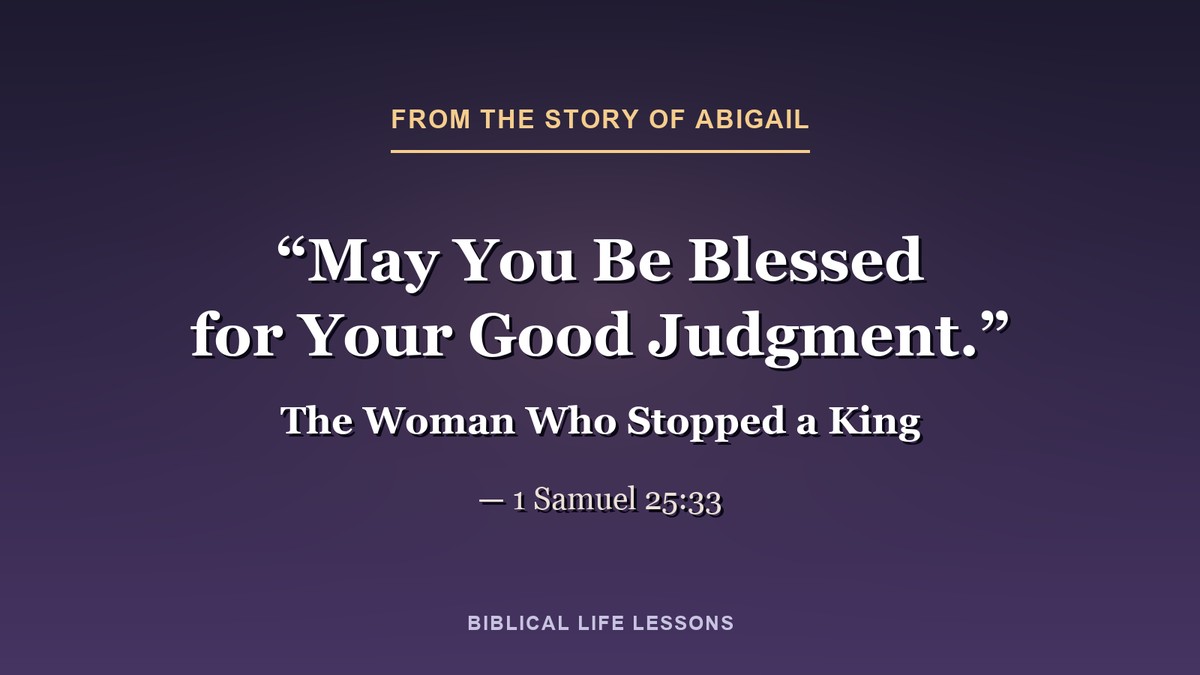
“David said to Abigail, ‘Praise be to the LORD, the God of Israel, who has sent you today to meet me. May you be blessed for your good judgment and for keeping me from bloodshed this day and from avenging myself with my own hands.'” (1 Samuel 25:32-33, NIV)
David accepted her gift and sent her home in peace (1 Samuel 25:35). A massacre was avoided because one woman had the courage to step into the path of an angry army and speak wisdom.
Nabal’s Death (1 Samuel 25:36-38)
When Abigail returned home, Nabal was holding a banquet “like that of a king,” and he was very drunk. Wisely, she told him nothing until morning (1 Samuel 25:36). When he was sober, she told him everything — how close he had come to death, and what she had done.
“His heart failed him and he became like a stone” (1 Samuel 25:37). About ten days later, “the LORD struck Nabal and he died” (1 Samuel 25:38). David did not have to lift a finger. The judgment David had been ready to carry out with his sword, God carried out in His own time and His own way.
Abigail Becomes David’s Wife (1 Samuel 25:39-42)
When David heard that Nabal had died, he praised God for upholding his cause and keeping him from doing wrong (1 Samuel 25:39). Then he sent messengers to ask Abigail to become his wife. She bowed down and said, “I am your servant and am ready to serve you and wash the feet of my lord’s servants” (1 Samuel 25:41). She went with David’s messengers, attended by five of her servants, and became his wife.
Abigail’s life with David was not easy. She shared in his years as a fugitive. When the Amalekites raided the town of Ziklag, Abigail was taken captive along with David’s other wife Ahinoam, and David pursued the raiders and rescued them (1 Samuel 30:5, 18). Later she went with David to Hebron when he was made king over Judah (2 Samuel 2:2). There she gave birth to David’s second son, Kileab (2 Samuel 3:3), who is called Daniel in 1 Chronicles 3:1.
Five Life Lessons from Abigail’s Story
1. Wisdom moves quickly when it matters.
“Abigail acted quickly.” She did not wait for her husband to come around, call a meeting, or hope the problem would go away. She saw the danger, made a plan, and moved. Some situations call for patience. Others call for fast, decisive action. Wisdom knows the difference — and when lives are on the line, it does not stall.
2. A gentle answer can turn away a sword.
Abigail faced four hundred armed men led by a furious leader. She did not argue, accuse, or threaten. She bowed, spoke humbly, and offered a gift. Proverbs 15:1 says, “A gentle answer turns away wrath, but a harsh word stirs up anger.” Abigail lived that proverb before it was written down. When tension is rising, the calmest voice in the room is often the most powerful one.
3. Remind people of who God has called them to be.
Abigail did not just stop David’s anger. She lifted his eyes to his calling: “you fight the LORD’s battles.” She helped him see that revenge today would cost him tomorrow. One of the most loving things we can do for someone who is about to make a terrible decision is to remind them of who they really are in God’s eyes.
4. You do not have to become like the foolish people around you.
Abigail was married to a man whose very name meant “fool.” She could have grown bitter, harsh, or careless. Instead, she stayed wise, generous, and full of faith. You may live or work around difficult, foolish, or unkind people. Their character does not have to become yours. You get to choose who you become.
5. Leave vengeance to God.
David was ready to take revenge with his own hands. Abigail persuaded him to leave it with God — and within ten days, God dealt with Nabal Himself. Romans 12:19 says, “Do not take revenge, my dear friends, but leave room for God’s wrath.” When someone has wronged you, it is tempting to settle the score. Abigail’s story shows that God is fully able to defend you — and that stepping back keeps your own hands clean.
Frequently Asked Questions About Abigail
Who was Abigail’s first husband?
Abigail’s first husband was Nabal, a wealthy man from Maon with property in Carmel. He was a descendant of Caleb and is described as “surly and mean in his dealings” (1 Samuel 25:3). His name means “fool.”
Why did David want to kill Nabal?
David and his men had protected Nabal’s shepherds and flocks in the wilderness. When David politely asked Nabal for provisions during the sheep-shearing feast, Nabal insulted him and refused (1 Samuel 25:4-11). In anger, David set out with four hundred men to kill every male in Nabal’s household (1 Samuel 25:13, 22).
How did Nabal die?
After Abigail told Nabal how close he had come to being killed by David, “his heart failed him and he became like a stone.” About ten days later, “the LORD struck Nabal and he died” (1 Samuel 25:37-38).
Did Abigail marry David?
Yes. After Nabal died, David sent messengers asking Abigail to become his wife, and she agreed (1 Samuel 25:39-42). She was one of David’s early wives, along with Ahinoam of Jezreel.
Did Abigail have children with David?
Yes. Abigail gave birth to David’s second son while they lived in Hebron. He is called Kileab in 2 Samuel 3:3 and Daniel in 1 Chronicles 3:1. The Bible does not record anything else about his life.
Is there more than one Abigail in the Bible?
Yes. Besides Abigail the wife of Nabal and David, there is also an Abigail who was David’s sister, the mother of Amasa (1 Chronicles 2:16-17; 2 Samuel 17:25). They are two different women.
Where is Abigail’s story in the Bible?
Abigail’s story is told mainly in 1 Samuel 25. She is also mentioned in 1 Samuel 27:3 and 30:5, 18 (the raid on Ziklag), 2 Samuel 2:2 and 3:3, and 1 Chronicles 3:1.
Related Reading
For a short devotional on Abigail, see What Abigail Teaches Us About Wisdom When Tension Is Rising. For the man she stopped, read What David Teaches Us About Seeking God Before You Move Forward and The Heart of a King: Lessons from David’s Life and Legacy. For another wise and courageous woman of Israel, see Who Was Deborah in the Bible? For another woman whose story is told in 1 Samuel, read Who Was Hannah in the Bible? And for a wider guide to the men and women of Scripture, visit our Characters of the Bible pillar.
A Closing Prayer
Father, thank You for Abigail. Thank You for her wisdom, her courage, and her humility. Give me the wisdom to see trouble coming and the courage to act when it matters. Teach me to speak gently when tension is rising. Help me remind others of who You have called them to be. Keep me from becoming like the foolish or unkind people around me. And when I am wronged, help me leave vengeance in Your hands. In Jesus’ name, Amen.
Subscribe for Daily Email Devotionals
MEET FAITH FRIEND AI
Faith Friend is your friendly AI chatbot on BiblicalLifeLessons.com, here to help you explore the Bible, answer your faith-related questions, and guide you through life lessons based on God’s Word. Whether you’re seeking encouragement, understanding Scripture, or deepening your faith, Faith Friend is always ready to chat.