What Samuel Teaches Us About Hearing God When You’re Not Sure It’s Him
You have been trying to hear from God. Not in a dramatic way — you would not have called it that. But there is a decision you have been sitting with. A quiet nudge you have been trying to identify. A question you have been bringing back to prayer week after week, hoping this time you will hear something. And underneath the trying, there is a smaller, more uncomfortable question you have not quite let yourself ask: what does God’s voice actually sound like? How do I know if I heard Him — or if I am just talking to myself?
If any part of you has been sitting in the dark trying to tell the difference between His voice and everyone else’s, please meet a young boy in the tabernacle who kept running to the wrong person in the middle of the night — and who eventually said one of the most important prayers in Scripture.
Scripture Focus: 1 Samuel 3:8-10
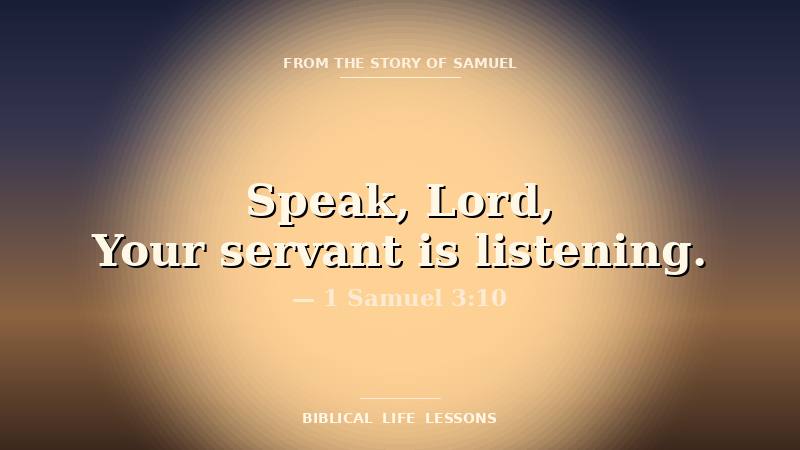
“A third time the Lord called, ‘Samuel!’ And Samuel got up and went to Eli and said, ‘Here I am; you called me.’ Then Eli realized that the Lord was calling the boy. So Eli told Samuel, ‘Go and lie down, and if he calls you, say, “Speak, Lord, for your servant is listening.”‘ So Samuel went and lay down in his place. The Lord came and stood there, calling as at the other times, ‘Samuel! Samuel!’ Then Samuel said, ‘Speak, for your servant is listening.'” (NIV)
Look at the setting. It is night in the tabernacle at Shiloh. Samuel is a boy — probably around twelve — apprenticing under an old priest named Eli. The text says something startling right before this passage: “In those days the word of the Lord was rare; there were not many visions” (1 Samuel 3:1). God had gone quiet. And then, in the dark, He speaks. But Samuel does not recognize the voice. He hears his name, gets up, runs to Eli. Eli sends him back. It happens again. And again. It takes three tries — and an older, wiser voice — before Samuel is finally able to say the sentence that changed his life: Speak, Lord, for your servant is listening.
Three Things Samuel Teaches Us About Hearing God When You’re Not Sure It’s Him
1. God speaks in a voice familiar enough that you might mistake it for someone else’s.
Notice that Samuel did not run outside looking for a stranger. He ran to Eli — the closest, safest voice in his life. He assumed God’s voice would be something else, something dramatic and unmistakable, and God’s voice came in a register he was already used to. This is one of the most important things you can learn about hearing God. He rarely speaks in a voice completely alien to you. Sometimes He sounds like conviction rising in the middle of a conversation. Sometimes He sounds like a Scripture verse that will not leave you alone. Sometimes He sounds like a friend saying the exact thing you needed to hear. If you have been waiting for a voice you have never heard before, you may be missing the voice you are already hearing.
A simple prayer: “Lord, help me recognize You. I am tired of running to the wrong door. Speak, and I will listen.”
2. Someone older, wiser, and imperfect still has something to teach you about listening.
Eli was not a great priest by that point in his life. His sons were corrupt. His eyesight was failing. His leadership was ending in judgment. And yet — in the middle of the night, when Samuel came to him the third time — Eli was still spiritually discerning enough to say, “That is God. Go back and listen.” Do not underestimate the older, quieter, less-impressive voices around you. The mentor, the parent, the pastor, the friend who has walked with God longer than you have. God very often speaks to us through people who are still recognizing His voice themselves. If Samuel had not run to Eli, he might have kept mistaking the call all night. Who is your Eli?
3. Hearing God is not a technique. It is a posture.
Read Samuel’s finished prayer slowly: “Speak, Lord, for your servant is listening.” Notice what he does not say. He does not say, “Speak, Lord, and I will tell You what I think.” He does not say, “Speak, Lord, and I will decide if I agree.” He does not even say, “Speak, Lord, when I am ready.” He says: speak — because I am already listening. That posture — attentive, obedient, unhurried — is not something you achieve. It is something you settle into. Most of us are not struggling to hear God because He has stopped speaking. We are struggling because our posture has been so noisy for so long. Try Samuel’s prayer for one week. See what changes when you stop asking Him to shout and start actually listening.
Practical Steps to Take Today
- Pray Samuel’s exact sentence. Out loud, in the morning, before the day starts. “Speak, Lord, for your servant is listening.” Then wait five minutes without adding anything.
- Name your Eli. Who is the older, wiser, imperfect person in your life who has helped you recognize God’s voice before? Reach out to them this week. Not with a crisis — just with the question you have been sitting with.
- Watch for the voice you already know. The Scripture that keeps coming back. The conviction that will not sit down. The friend who said the thing on a random Tuesday. God is usually already speaking. You are usually already hearing. Trust that more.
- Lower the volume of everything else. Podcasts, social feeds, background TV. Not because they are evil, but because Samuel heard God in the quiet of the tabernacle at night, not in a crowd. Give Him the same kind of room.
- Do the last thing you thought He said. Sometimes we cannot hear the next word because we have not obeyed the last one. If there is a small step of obedience already in your mind, take it. That is often what unlocks the next.
Reflection Questions
- What familiar voice — a friend, a verse, a conviction — might already be God speaking to me that I have been running to the wrong door about?
- Who is my “Eli” — the older, imperfect, spiritually discerning person God has placed near me — and when did I last let them speak into my listening?
- What would change today if I stopped asking God to speak louder and started praying Samuel’s actual prayer: “Speak, Lord, for your servant is listening”?
A Closing Prayer
Lord, I want to hear You. I have been running to the wrong door in the middle of the night, trying to figure out what You are saying, wondering if I am just making it up. Thank You for Samuel. Thank You for a story about a boy who got it wrong three times and still ended up with one of the most quoted prayers in Scripture. Give me Eli’s discernment in the people around me. Give me Samuel’s posture in my own heart. Quiet the noise, and when You speak, help me recognize You. Speak, Lord — Your servant is listening. In Jesus’ name, Amen.
Subscribe for Daily Email Devotionals
Subscribe for Daily Email Devotionals
MEET FAITH FRIEND AI
Faith Friend is your friendly AI chatbot on BiblicalLifeLessons.com, here to help you explore the Bible, answer your faith-related questions, and guide you through life lessons based on God’s Word. Whether you’re seeking encouragement, understanding Scripture, or deepening your faith, Faith Friend is always ready to chat.