Who Was Samuel in the Bible? The Complete Story of the Prophet Who Listened
Samuel was born as the answer to a desperate prayer and given back to God as a little boy. He heard God call his name in the night when “the word of the LORD was rare.” He grew up to be Israel’s last judge, a prophet the whole nation trusted, and the man who anointed both of Israel’s first kings. He stood at one of the great turning points in the Bible, the moment Israel asked for a king.
If you have searched for who Samuel was in the Bible, or what his story teaches us today, this is a complete guide. We will walk through Hannah’s prayer, Samuel’s childhood in the tabernacle, the night God called him, the fall of Eli’s house, the victory at Ebenezer, Israel’s demand for a king, the anointing and rejection of Saul, the anointing of David, Samuel’s death, and five practical life lessons his story still speaks into ours.
Who Was Samuel in the Bible?
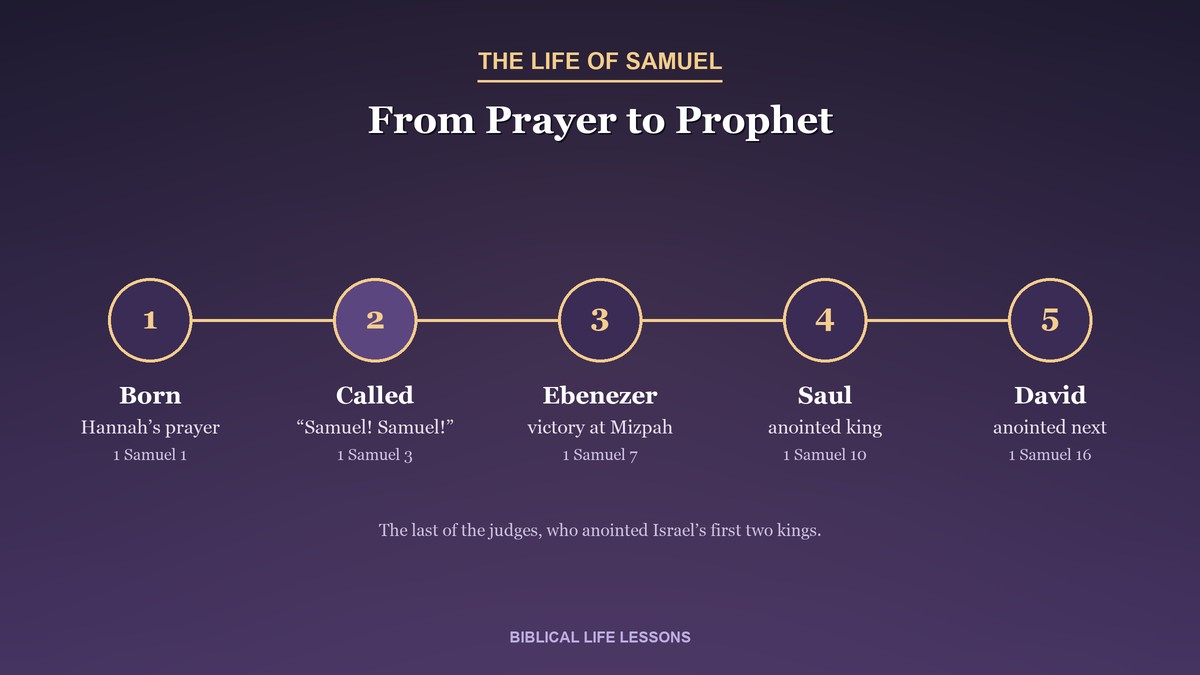
Samuel was a prophet, priest, and the last of Israel’s judges, who lived around the 11th century BC. He was the son of Elkanah and Hannah from Ramah in the hill country of Ephraim (1 Samuel 1:1, 19). He led Israel through the transition from the time of the judges to the time of the kings, anointing both Saul and David. His story is told in 1 Samuel 1-25. His name sounds like the Hebrew for “heard by God.”
“The LORD was with Samuel as he grew up, and he let none of Samuel’s words fall to the ground.” (1 Samuel 3:19, NIV)
Three things stand out about him. He was a listener, from his first night in the tabernacle to his last years. He was a man of integrity, who could ask the whole nation to name a single wrong he had done to them. And he was a man of prayer, who said it would be a sin to stop praying for the people who had disappointed him.
Born from a Mother’s Prayer (1 Samuel 1-2)
Samuel’s story begins with his mother’s tears. Hannah was childless, and her husband’s other wife, Peninnah, provoked her year after year. At the tabernacle in Shiloh, Hannah prayed so deeply that the priest Eli thought she was drunk. She promised that if God gave her a son, she would give him to the LORD for all the days of his life.
God remembered Hannah. She gave birth to a son and “named him Samuel, saying, ‘Because I asked the LORD for him'” (1 Samuel 1:20). When he was weaned, she brought him to Eli and kept her promise:
“I prayed for this child, and the LORD has granted me what I asked of him. So now I give him to the LORD. For his whole life he will be given over to the LORD.” (1 Samuel 1:27-28, NIV)
Every year, Hannah made her son a little robe and brought it to him when she came to offer the yearly sacrifice (1 Samuel 2:19). Meanwhile, Eli’s own sons, Hophni and Phinehas, were serving as priests while treating the LORD’s offerings with contempt and sleeping with the women who served at the tabernacle. Against that dark background, “the boy Samuel continued to grow in stature and in favor with the LORD and with people” (1 Samuel 2:26).
“Speak, for Your Servant Is Listening” (1 Samuel 3)
“In those days the word of the LORD was rare; there were not many visions” (1 Samuel 3:1). One night, while young Samuel was lying down in the tabernacle near the ark of God, he heard someone call his name. He ran to Eli: “Here I am; you called me.” Eli said he had not called, and sent him back to bed.
It happened again, and then a third time. Finally Eli realized that the LORD was calling the boy. He told Samuel what to say if he heard the voice again. The LORD came and stood there, calling as before, “Samuel! Samuel!”
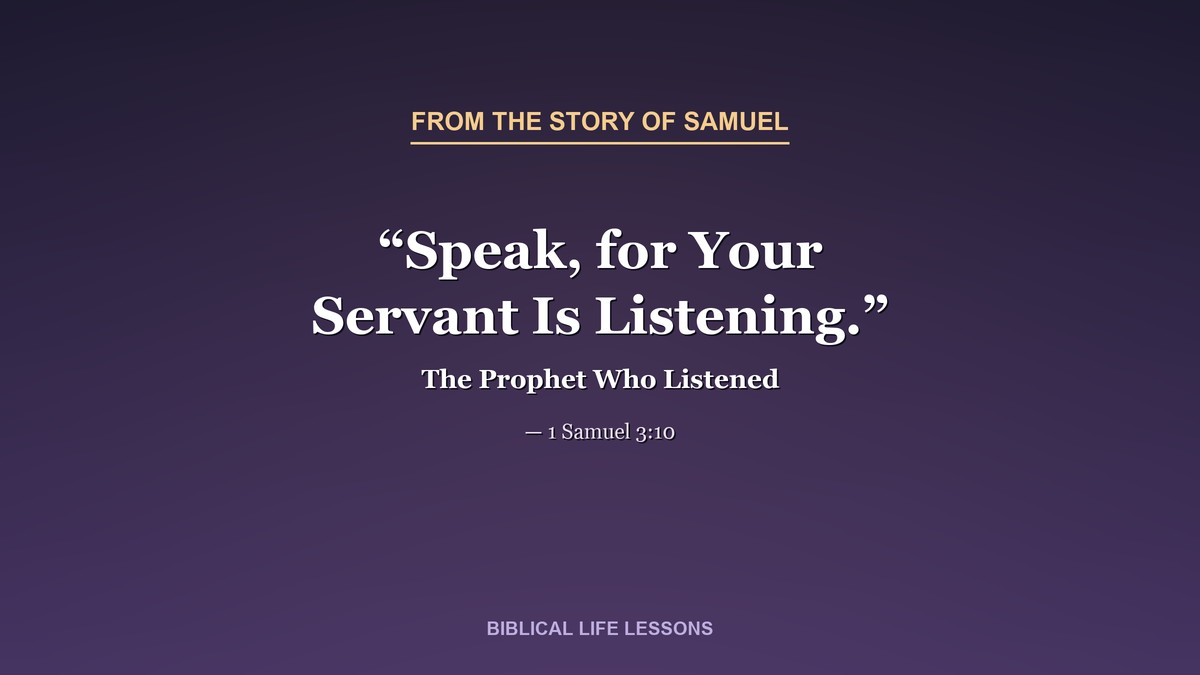
“Then Samuel said, ‘Speak, for your servant is listening.'” (1 Samuel 3:10, NIV)
The first message God gave Samuel was a hard one: judgment on Eli’s family because Eli had failed to restrain his sons. In the morning, Samuel was afraid to tell Eli, but Eli insisted, and Samuel told him everything. From that time on, “all Israel from Dan to Beersheba recognized that Samuel was attested as a prophet of the LORD” (1 Samuel 3:20).
The Ark Is Captured (1 Samuel 4-6)
Israel went to battle against the Philistines and brought the ark of the covenant onto the battlefield, treating it like a good-luck charm. Israel was defeated, Eli’s two sons were killed, and the ark was captured. When the elderly Eli heard the news, he fell backward and died. The Philistines soon discovered the ark was not a trophy they could keep; plagues broke out wherever it went, and they sent it back.
Ebenezer: “Thus Far the LORD Has Helped Us” (1 Samuel 7)
Twenty years later, Samuel called the people to return to the LORD with all their hearts and put away their foreign gods. They gathered at Mizpah, fasted, and confessed their sin. When the Philistines heard Israel was gathered, they attacked. Samuel cried out to the LORD for Israel, and God thundered against the Philistines and threw them into panic.
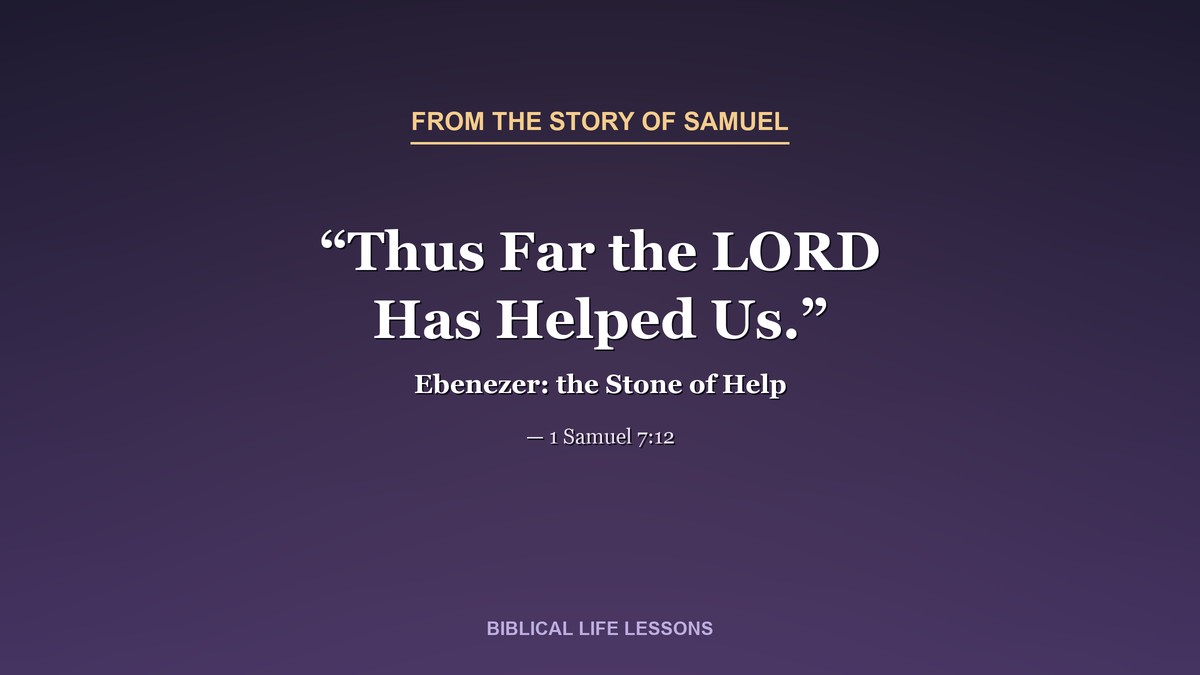
Samuel set up a stone as a memorial and named it Ebenezer, which means “stone of help”:
“Thus far the LORD has helped us.” (1 Samuel 7:12, NIV)
For the rest of his life, Samuel led Israel as judge. Every year he traveled a circuit from Bethel to Gilgal to Mizpah, then returned home to Ramah, where he built an altar to the LORD (1 Samuel 7:15-17).
“Give Us a King” (1 Samuel 8)
When Samuel grew old, he appointed his sons as judges, but they did not walk in his ways; they took bribes and perverted justice. The elders of Israel came to Samuel with a demand: “Appoint a king to lead us, such as all the other nations have” (1 Samuel 8:5).
Samuel was hurt and displeased, and he prayed. God’s answer was striking: “It is not you they have rejected, but they have rejected me as their king” (1 Samuel 8:7). God told Samuel to give the people what they asked for, but to warn them first. Samuel described what a king would take from them: their sons, their daughters, their fields, a tenth of their harvests. The people refused to listen. “We want a king over us.”
Samuel Anoints Saul (1 Samuel 9-12)
God led a tall, handsome young man named Saul to Samuel while Saul was out searching for his father’s lost donkeys. Samuel anointed him privately with oil, and later Saul was publicly chosen as king.
In his farewell speech, Samuel asked the people to testify against him: “Whose ox have I taken? Whose donkey have I taken? Whom have I cheated? Whom have I oppressed?” (1 Samuel 12:3). No one could name anything. Then, even though the people had rejected his leadership, he promised to keep caring for them: “As for me, far be it from me that I should sin against the LORD by failing to pray for you” (1 Samuel 12:23).
“To Obey Is Better Than Sacrifice” (1 Samuel 13-15)
Saul’s reign started well but quickly went wrong. Once, when Samuel was late, Saul grew impatient and offered a sacrifice himself, something only a priest was to do (1 Samuel 13). Later, God commanded Saul to destroy the Amalekites completely, but Saul kept the best of the livestock and spared the king, then claimed he had saved the animals to sacrifice to God.
Samuel’s answer has echoed through the centuries:
“Does the LORD delight in burnt offerings and sacrifices as much as in obeying the LORD? To obey is better than sacrifice, and to heed is better than the fat of rams.” (1 Samuel 15:22, NIV)
God rejected Saul as king. Samuel never went to see Saul again, but “Samuel mourned for him” (1 Samuel 15:35).
Samuel Anoints David (1 Samuel 16)
God told Samuel to stop mourning and go to Bethlehem, to the family of Jesse. One by one, Jesse’s sons passed before Samuel, and each time God said no. The LORD reminded him, “People look at the outward appearance, but the LORD looks at the heart” (1 Samuel 16:7). Finally the youngest son, David, was brought in from the fields, and Samuel anointed him. “From that day on the Spirit of the LORD came powerfully upon David.”
Later, when David was running from Saul, he fled to Samuel at Ramah, and the old prophet sheltered him (1 Samuel 19:18). When Samuel died, “all Israel assembled and mourned for him; and they buried him at his home in Ramah” (1 Samuel 25:1).
Samuel in the Rest of Scripture
Samuel is remembered as one of the greatest prophets in Israel’s history. God named him alongside Moses as a great intercessor (Jeremiah 15:1). Peter spoke of “all the prophets from Samuel on” who foretold the days of Jesus (Acts 3:24), and Hebrews lists him among the heroes of faith (Hebrews 11:32).
Five Life Lessons from Samuel’s Story
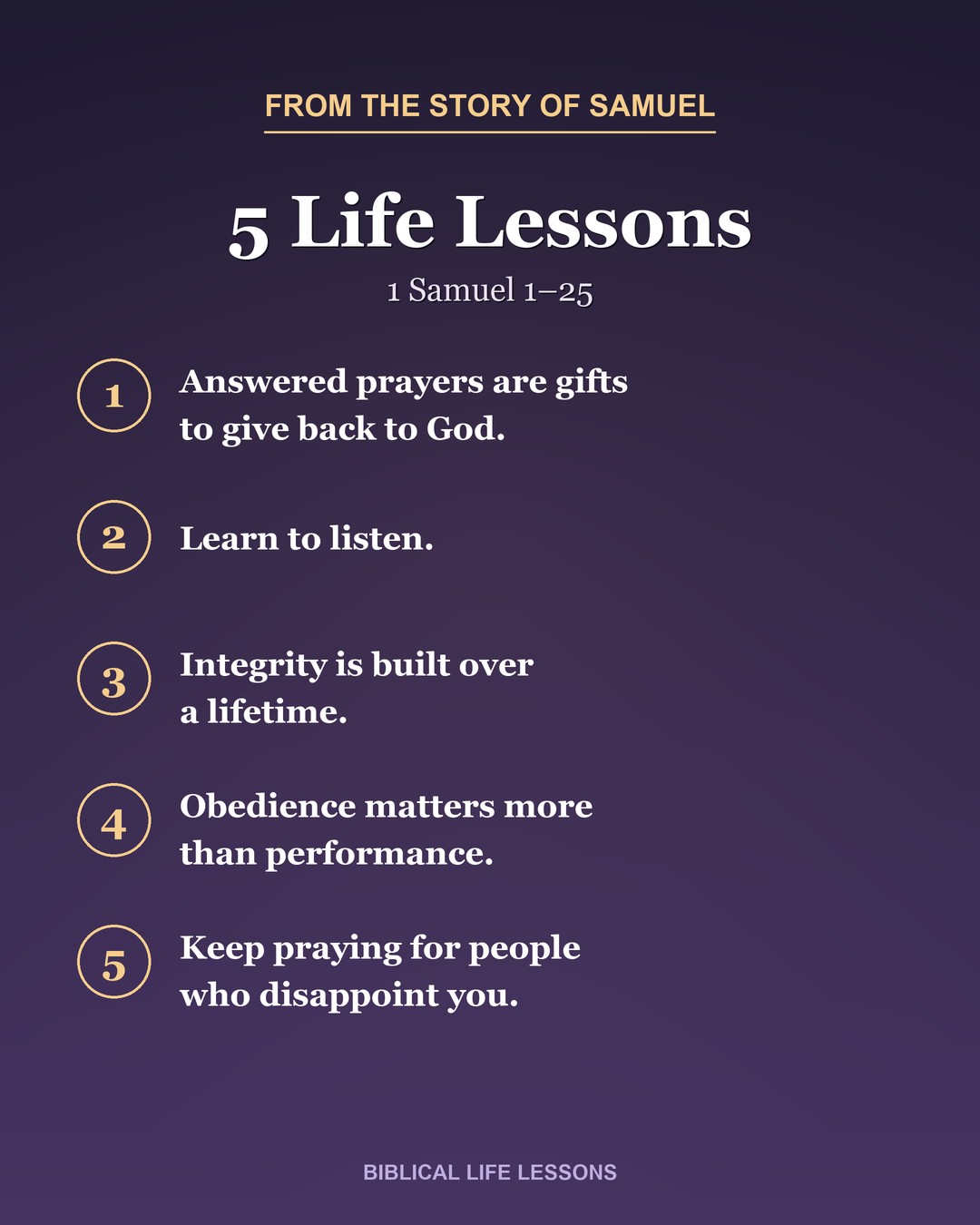
1. Answered prayers are gifts to give back to God.
Hannah prayed for a son and then gave him back to the LORD. Her open hands made room for one of the greatest lives in Israel’s history. Whatever God has given you, offer it back to Him.
2. Learn to listen.
Samuel heard God’s voice three times before he understood who was speaking. Hearing God is something we grow into, often with help from others. Make room to pray, “Speak, for your servant is listening.”
3. Integrity is built over a lifetime.
After decades of leadership, Samuel could stand before the whole nation and ask them to name one wrong he had done. Character is not built in one great moment but in thousands of small, honest choices.
4. God wants obedience more than religious performance.
Saul offered sacrifices while ignoring what God actually said. Samuel reminded him that God is not impressed by outward religion without a listening, obedient heart.
5. Keep praying for people who disappoint you.
The people rejected Samuel’s leadership, and Saul failed him badly. Samuel kept praying and kept mourning. Refusing to stop praying for others, even when they hurt or disappoint us, is part of loving them.
Frequently Asked Questions About Samuel
Who were Samuel’s parents?
Samuel’s parents were Elkanah and Hannah, from Ramah in the hill country of Ephraim (1 Samuel 1:1-20). Hannah’s prayer for a son is one of the most famous prayers in the Bible.
How old was Samuel when God called him?
The Bible calls him “the boy Samuel” but does not give his age. The Jewish historian Josephus later wrote that he was about twelve.
What does Ebenezer mean?
Ebenezer means “stone of help.” Samuel named the memorial stone after God gave Israel victory over the Philistines, saying, “Thus far the LORD has helped us” (1 Samuel 7:12).
Why did Israel want a king?
Samuel’s sons were corrupt, and the people wanted a king “such as all the other nations have” to lead them and fight their battles (1 Samuel 8:5, 20). God said that in asking for a king, they were rejecting Him as their king.
Was Samuel a priest, a prophet, or a judge?
All three. He served in the tabernacle from childhood and offered sacrifices, he was recognized as a prophet throughout Israel, and he was the last of the judges who led the nation before the kings (1 Samuel 3:20; 7:15).
Who wrote 1 and 2 Samuel?
The books do not name their author. They are named after Samuel because he is the central figure at the beginning, but they continue well past his death into the reign of David.
How did Samuel die?
Samuel died of old age, and all Israel gathered to mourn him. He was buried at his home in Ramah (1 Samuel 25:1).
Related Reading
For the mother whose prayer began his story, read Who Was Hannah in the Bible? For a devotional on her long wait, see What Hannah’s Tears Teach Us About Praying Through a Long, Painful Wait. For the night God called his name, read Samuel’s Encounter: Embracing the Call of God and What Samuel Teaches Us About Hearing God When You’re Not Sure It’s Him. For the first king he anointed, see King Saul: A Tragic Figure in Biblical History, and for the second, read Who Was David in the Bible? For a wider guide to the men and women of Scripture, visit our Characters of the Bible pillar.
A Closing Prayer
Lord, thank You for Samuel, and for Hannah, who gave him back to You. Whatever You have given me, I offer it back to You. Teach me to listen for Your voice, and give me the humility to say, “Speak, for Your servant is listening.” Build in me a life of quiet integrity. Help me choose obedience over religious show. And keep me praying for the people who have disappointed me, as Samuel did. Thus far You have helped me, and I trust You for every step ahead. In Jesus’ name, Amen.
Subscribe for Daily Email Devotionals
MEET FAITH FRIEND AI
Faith Friend is your friendly AI chatbot on BiblicalLifeLessons.com, here to help you explore the Bible, answer your faith-related questions, and guide you through life lessons based on God’s Word. Whether you’re seeking encouragement, understanding Scripture, or deepening your faith, Faith Friend is always ready to chat.