Who Was David in the Bible? The Complete Story of the Shepherd King
David is one of the most loved and most complicated people in the Bible. He was a shepherd boy who killed a giant, a fugitive who refused to harm the king hunting him, a musician who wrote many of the psalms, and the greatest king in Israel’s history. He was also an adulterer and a murderer, whose family was torn apart by the consequences. Yet God called him “a man after my own heart.”
If you have searched for who David was in the Bible, or what his story teaches us today, this is a complete guide. We will walk through his anointing, his victory over Goliath, his friendship with Jonathan, his years on the run from Saul, his rise to the throne, God’s covenant with him, his sin with Bathsheba, his repentance, the heartbreak of Absalom, how his life points to Jesus, and five practical life lessons his story still speaks into ours.
Who Was David in the Bible?
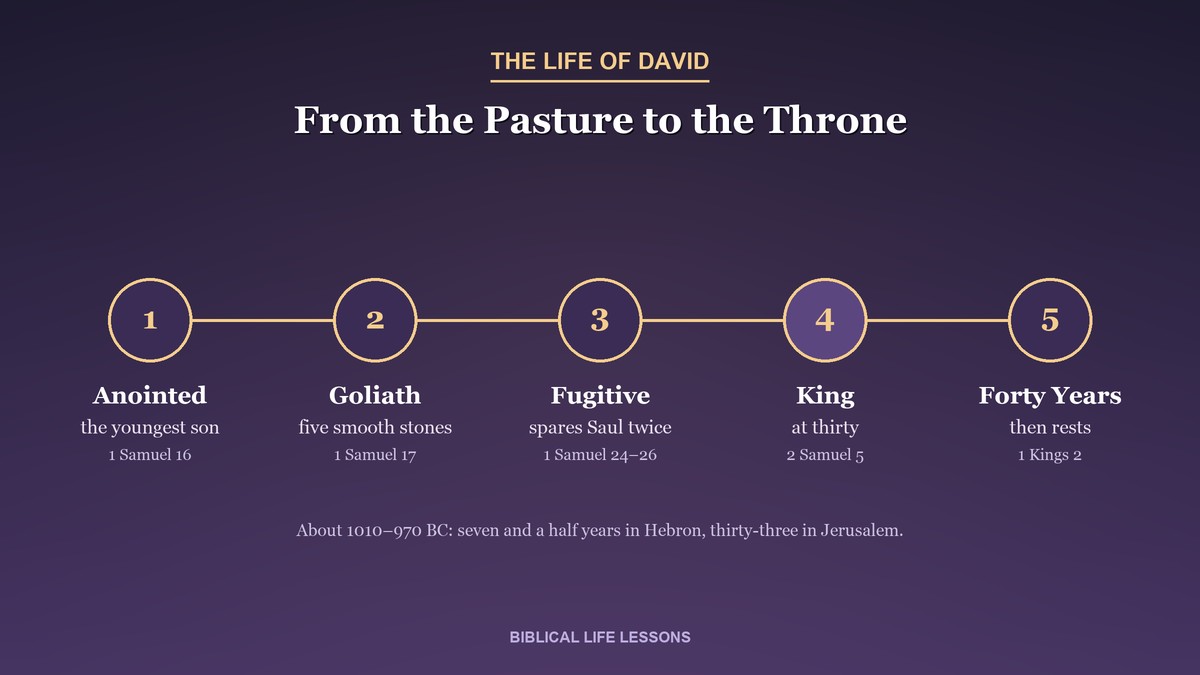
David was the second king of Israel, who reigned around 1010-970 BC. He was the youngest son of Jesse, from the tribe of Judah, and grew up in Bethlehem tending his father’s sheep. He became king at thirty and reigned forty years, first in Hebron and then in Jerusalem, which he made Israel’s capital (2 Samuel 5:4-5). His story is told in 1 Samuel 16 through 1 Kings 2, and many of the psalms carry his name. His great-grandmother was Ruth (Ruth 4:17).
“I have found David son of Jesse, a man after my own heart; he will do everything I want him to do.” (Acts 13:22, NIV)
Three things stand out about him. He trusted God, from the pasture to the battlefield to the throne. He was a worshiper, pouring out his joy, fear, anger, and grief to God in song. And when he sinned badly, he repented honestly. That, more than his victories, may be why he was called a man after God’s own heart.
The Shepherd Boy Anointed (1 Samuel 16)
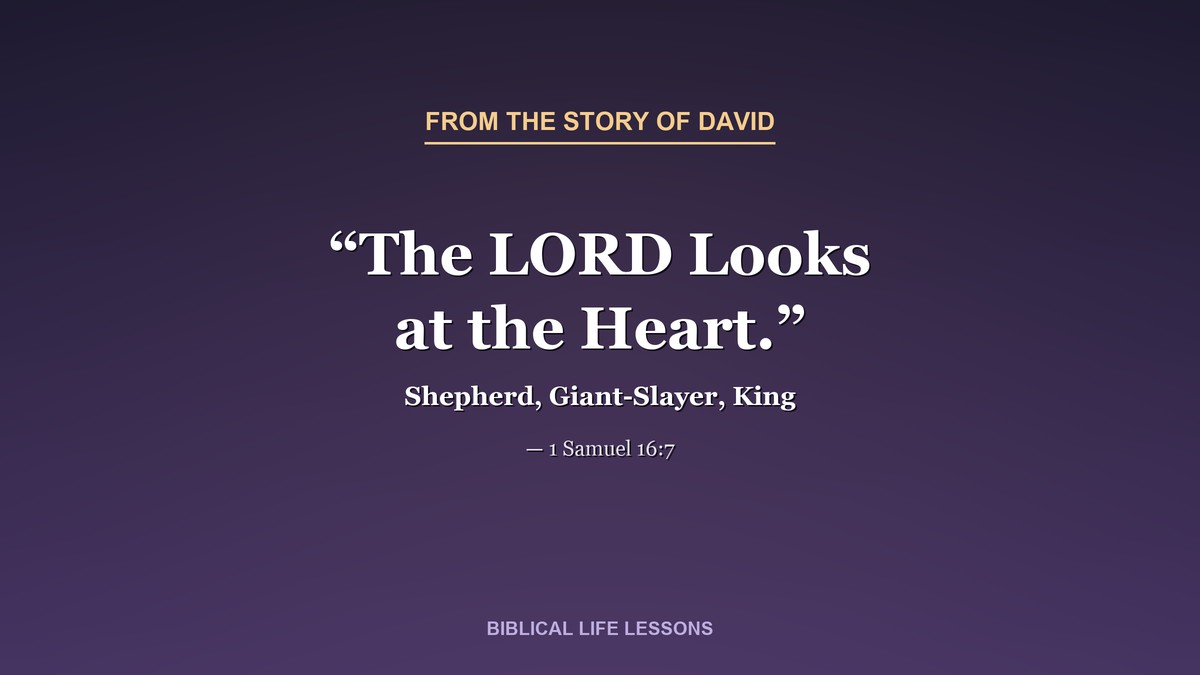
Israel’s first king, Saul, had disobeyed God, and the LORD sent the prophet Samuel to Bethlehem to anoint one of Jesse’s sons as the next king. Jesse lined up seven of his sons. Samuel looked at the tall, impressive eldest and thought he must be the one. God corrected him:
“The LORD does not look at the things people look at. People look at the outward appearance, but the LORD looks at the heart.” (1 Samuel 16:7, NIV)
None of the seven was chosen. The youngest had not even been invited; he was out with the sheep. When David was brought in, the LORD said, “Rise and anoint him; this is the one.” Samuel anointed him, “and from that day on the Spirit of the LORD came powerfully upon David” (1 Samuel 16:12-13). Soon David was playing the harp in Saul’s court to calm the troubled king, who had no idea who he was.
David and Goliath (1 Samuel 17)
The Philistine army camped across a valley from Israel, and their champion, Goliath of Gath, came out every morning and evening for forty days to challenge any Israelite to single combat. He stood over nine feet tall and was covered in bronze armor. No one in Saul’s army would face him.
David arrived bringing food to his older brothers and heard the giant’s taunts. “Who is this uncircumcised Philistine that he should defy the armies of the living God?” he asked (1 Samuel 17:26). Saul doubted that a young shepherd could fight a warrior, but David explained that he had already killed a lion and a bear to protect his father’s sheep: “The LORD who rescued me from the paw of the lion and the paw of the bear will rescue me from the hand of this Philistine” (1 Samuel 17:37).
David refused Saul’s armor. He took his staff, his sling, and five smooth stones from a stream. When Goliath mocked him, David answered:
“You come against me with sword and spear and javelin, but I come against you in the name of the LORD Almighty, the God of the armies of Israel, whom you have defied.” (1 Samuel 17:45, NIV)
“The battle is the LORD’s,” David said (1 Samuel 17:47). He ran toward the giant, slung one stone, and struck Goliath in the forehead. The giant fell facedown, and the Philistines fled.
Jonathan’s Friendship and Saul’s Jealousy (1 Samuel 18-20)
After the battle, Saul’s son Jonathan “became one in spirit with David, and he loved him as himself” (1 Samuel 18:1). Jonathan, the heir to the throne, gave David his own robe and sword, recognizing that God had chosen David.
Saul felt the opposite. When the women of Israel sang, “Saul has slain his thousands, and David his tens of thousands” (1 Samuel 18:7), jealousy took hold of him. Twice he hurled a spear at David while David played the harp. He sent him into dangerous battles, hoping the Philistines would kill him. Eventually Jonathan warned David that his father was determined to kill him, and the two friends said a tearful goodbye.
Years on the Run (1 Samuel 21-30)
For years David lived as a fugitive, hiding in caves and deserts with a band of about six hundred men, many of them “in distress or in debt or discontented” (1 Samuel 22:2). Many psalms come from this season of fear and waiting.
Twice David had the chance to kill Saul. Once, in a cave near En Gedi, Saul came in alone, and David’s men urged him to strike. David only cut off a corner of Saul’s robe, and even that troubled his conscience: “The LORD forbid that I should do such a thing to my master, the LORD’s anointed” (1 Samuel 24:6). Another time he crept into Saul’s camp at night and took the king’s spear and water jug, but again refused to harm him (1 Samuel 26). David was willing to wait for God to give him the throne rather than take it by force.
During these years he also met Abigail, whose wisdom kept him from taking revenge on her foolish husband Nabal (1 Samuel 25). Saul and Jonathan were eventually killed in battle with the Philistines. David did not celebrate. He wept and wrote a lament: “How the mighty have fallen!” (2 Samuel 1:19).
King of Israel (2 Samuel 2-6)
David was anointed king over Judah at Hebron, and seven and a half years later, over all Israel. He captured the fortress of Zion and made Jerusalem, “the City of David,” his capital. Then he brought the ark of the covenant, the symbol of God’s presence, into the city. “Wearing a linen ephod, David was dancing before the LORD with all his might” (2 Samuel 6:14). The king of Israel was not too proud to worship with his whole heart.
God’s Covenant with David (2 Samuel 7)
Once he was settled in his palace, David wanted to build a house for God. Through the prophet Nathan, God turned the idea around: God would build a “house” for David, a dynasty that would last forever.
“Your house and your kingdom will endure forever before me; your throne will be established forever.” (2 Samuel 7:16, NIV)
David was overwhelmed: “Who am I, Sovereign LORD, and what is my family, that you have brought me this far?” (2 Samuel 7:18). He also showed covenant kindness of his own, seeking out Jonathan’s disabled son Mephibosheth and giving him a permanent seat at the king’s table (2 Samuel 9).
David and Bathsheba (2 Samuel 11-12)
David’s greatest failure began in an idle moment. “In the spring, at the time when kings go off to war,” David sent his army out but “remained in Jerusalem” (2 Samuel 11:1). From his roof he saw a beautiful woman bathing. She was Bathsheba, the wife of Uriah, one of his loyal soldiers. David sent for her and slept with her, and she became pregnant.
David tried to cover it up. When that failed, he arranged for Uriah to be placed in the fiercest part of a battle and abandoned, and Uriah was killed. Then David married Bathsheba. “But the thing David had done displeased the LORD” (2 Samuel 11:27).
God sent Nathan to tell David a story about a rich man who stole a poor man’s only lamb. David burned with anger and declared that the man deserved to die. Nathan answered, “You are the man!” (2 Samuel 12:7). David did not make excuses. “I have sinned against the LORD,” he said (2 Samuel 12:13). Psalm 51 is traditionally linked to this moment:
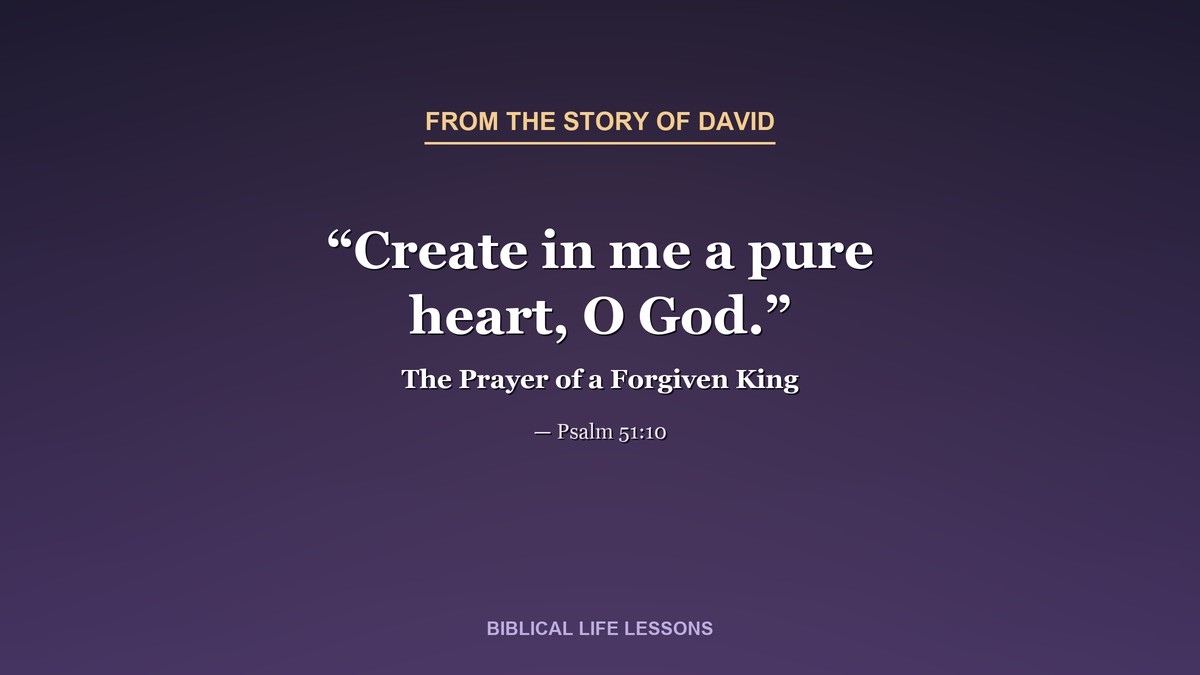
“Create in me a pure heart, O God, and renew a steadfast spirit within me.” (Psalm 51:10, NIV)
God forgave David, but the consequences were real. The child died, and Nathan warned that violence would never leave David’s household. Later, Bathsheba gave birth to another son, Solomon, who would become the next king.
Absalom’s Rebellion (2 Samuel 13-18)
The years that followed brought deep sorrow. David’s son Amnon assaulted his half-sister Tamar, and her brother Absalom murdered Amnon in revenge. Later Absalom won the hearts of the people and led a rebellion against his own father. David fled Jerusalem barefoot and weeping.
When the rebellion was crushed, David’s men killed Absalom against the king’s orders. David did not celebrate his victory. He cried out, “O my son Absalom! My son, my son Absalom! If only I had died instead of you—O Absalom, my son, my son!” (2 Samuel 18:33). It is one of the most heartbreaking moments in the Bible.
David’s Final Years (1 Kings 1-2)
In old age, David saw Solomon crowned as his successor. He gathered materials for the temple that Solomon would build, and he charged his son to walk faithfully in God’s ways. “Then David rested with his ancestors and was buried in the City of David. He had reigned forty years over Israel” (1 Kings 2:10-11).
David and Jesus
God’s promise that David’s throne would last forever was never forgotten. The prophets looked forward to a coming king from David’s line. The very first verse of the New Testament calls Jesus “the son of David” (Matthew 1:1), and the angel told Mary that God would give her son “the throne of his father David” (Luke 1:32). Jesus was born in Bethlehem, the town of David. He is the true Shepherd King, the one whose kingdom will never end.
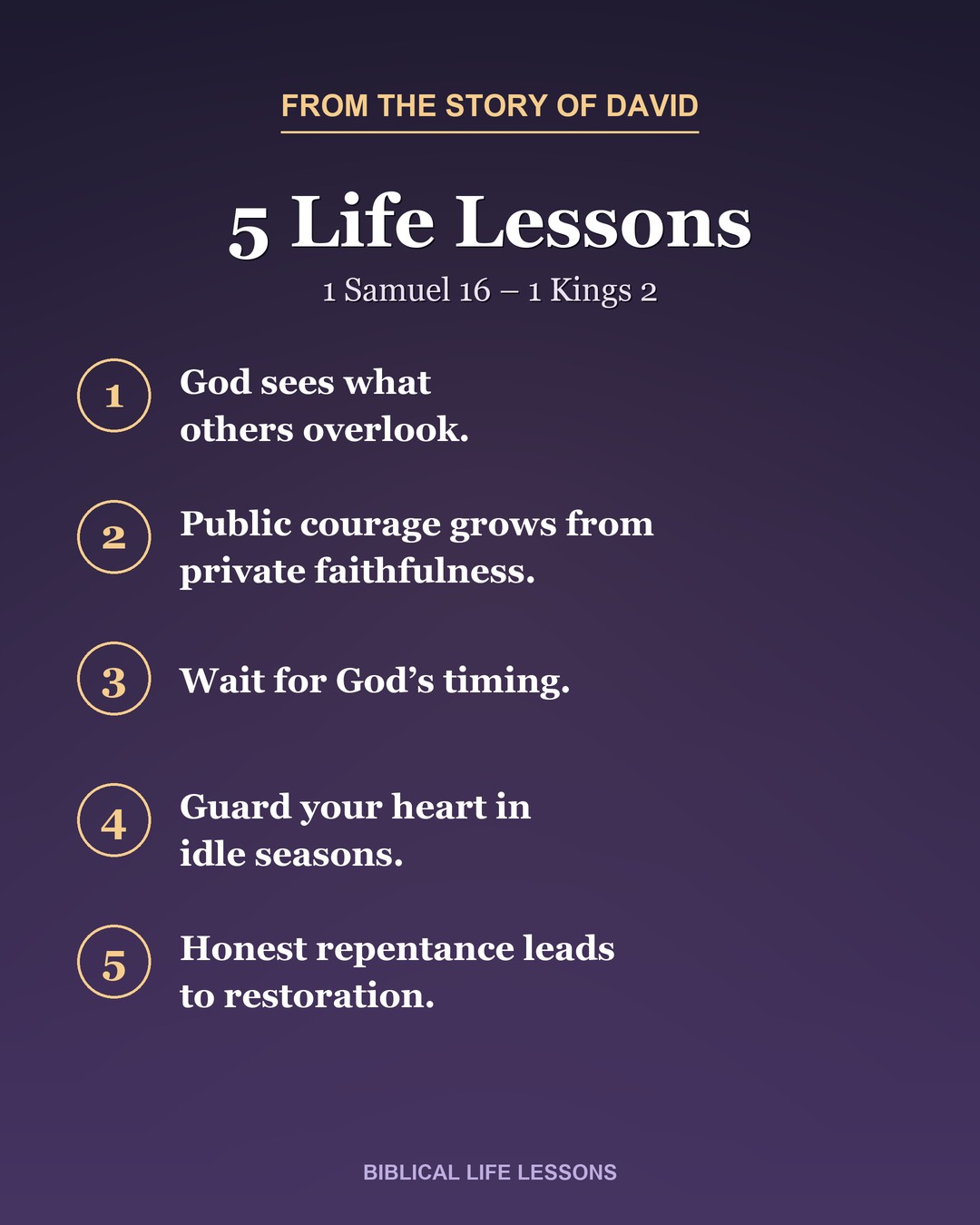
Five Life Lessons from David’s Story
1. God sees what others overlook.
David’s own father did not think to invite him. God chose him anyway, because “the LORD looks at the heart.” If you feel overlooked, remember that God’s choices are not based on appearance, rank, or what others expect.
2. Public courage grows from private faithfulness.
Before Goliath, there was a lion and a bear that no one saw. David’s confidence on the battlefield came from years of trusting God in the pasture. The small, hidden places where you trust God now are preparing you for the giants ahead.
3. Wait for God’s timing.
David was anointed king years before he wore a crown, and twice he could have taken the throne by force. He waited. Doing the right thing in God’s time is better than grabbing what God has promised in your own.
4. Guard your heart in idle seasons.
David’s greatest fall came not in battle but on a quiet evening when he was not where he should have been. No one is beyond temptation, no matter how faithful they have been. Stay alert, and stay accountable.
5. Honest repentance leads to restoration.
David’s sin was terrible, but his repentance was real. He did not hide, blame, or excuse. He confessed and asked God to make his heart new. No failure is too great for God’s mercy when we come to Him honestly.
Frequently Asked Questions About David
Why was David called a man after God’s own heart?
God described David this way when He chose him to replace Saul (1 Samuel 13:14; Acts 13:22). David was far from perfect, but he loved God, trusted Him, worshiped Him wholeheartedly, and repented honestly when confronted with his sin.
How old was David when he became king?
David was thirty years old when he became king, and he reigned for forty years: seven and a half years over Judah in Hebron and thirty-three years over all Israel in Jerusalem (2 Samuel 5:4-5).
How tall was Goliath?
The Hebrew text of 1 Samuel 17:4 says Goliath was “six cubits and a span,” which is a little over nine feet. Some ancient manuscripts give a shorter height of about six feet nine inches.
How many psalms did David write?
Seventy-three psalms carry David’s name in their titles, including the well-known Psalm 23 and Psalm 51. The New Testament also credits him with some psalms that have no title.
Who were David’s wives?
The Bible names several, including Michal (Saul’s daughter), Abigail, Ahinoam, and Bathsheba, the mother of Solomon (2 Samuel 3:2-5). Like many ancient kings, David had multiple wives, which caused great conflict in his family.
Was David related to Jesus?
Yes. Jesus was a descendant of David through both the genealogy in Matthew 1 and the one in Luke 3, which is why He is often called the “Son of David.”
How did David die?
David died of old age after reigning forty years, and was buried in Jerusalem, the City of David (1 Kings 2:10-11).
Related Reading
For his most famous victory, read Triumph of Courage: The Epic Tale of David and Goliath. For what he accomplished as king, see The Achievements of King David in the Bible. For a devotional on his habit of seeking God first, read What David Teaches Us About Seeking God Before You Move Forward, and for the psalm he is best known for, see What David Teaches Us About Letting God Shepherd Us Through the Valley. For the wise woman who stopped him from taking revenge, read Who Was Abigail in the Bible? and for his great-grandmother, see Who Was Ruth in the Bible? For a wider guide to the men and women of Scripture, visit our Characters of the Bible pillar.
A Closing Prayer
Father, thank You for David, and for looking past the outside to the heart. Give me a heart that loves You like his did. Make me faithful in the hidden places, so that I am ready for the giants I will face. Teach me to wait for Your timing instead of grabbing what I want. Guard me in my idle moments, and when I fall, give me the courage to confess honestly. Create in me a pure heart, O God, and renew a steadfast spirit within me. Thank You for Jesus, the Son of David, whose kingdom will never end. In His name, Amen.
Subscribe for Daily Email Devotionals
MEET FAITH FRIEND AI
Faith Friend is your friendly AI chatbot on BiblicalLifeLessons.com, here to help you explore the Bible, answer your faith-related questions, and guide you through life lessons based on God’s Word. Whether you’re seeking encouragement, understanding Scripture, or deepening your faith, Faith Friend is always ready to chat.