Who Was Ruth in the Bible? The Complete Story of Loyalty and Redemption (Book of Ruth)
Ruth is one of the most beloved women in the Bible. She was a widow, a foreigner, and a poor gleaner in someone else’s field — and she became the great-grandmother of King David and an ancestor of Jesus. Her story fills a short book of just four chapters, yet it holds some of the most beautiful words of loyalty ever spoken: “Where you go I will go, and where you stay I will stay.”
If you have searched for who Ruth was in the Bible, or what her story teaches us today, this is a complete guide. We will walk through her background as a woman of Moab, the losses that brought her to a crossroads, her famous vow to Naomi, her meeting with Boaz in the barley fields, the night at the threshing floor, her redemption and marriage, her place in the family line of David and Jesus, and five practical life lessons her story still speaks into ours.
Prefer to watch? Here is Ruth’s story as a short animated devotional, with Scripture, reflection, and a closing prayer.
Who Was Ruth in the Bible?
Ruth was a Moabite woman who married into an Israelite family, lost her husband, and chose to follow her mother-in-law Naomi back to Bethlehem. There she met Boaz, a relative of Naomi’s husband, who married her as her “guardian-redeemer.” Their son Obed was the grandfather of King David. Ruth is one of only two women with a book of the Bible named after her — the other is Esther.
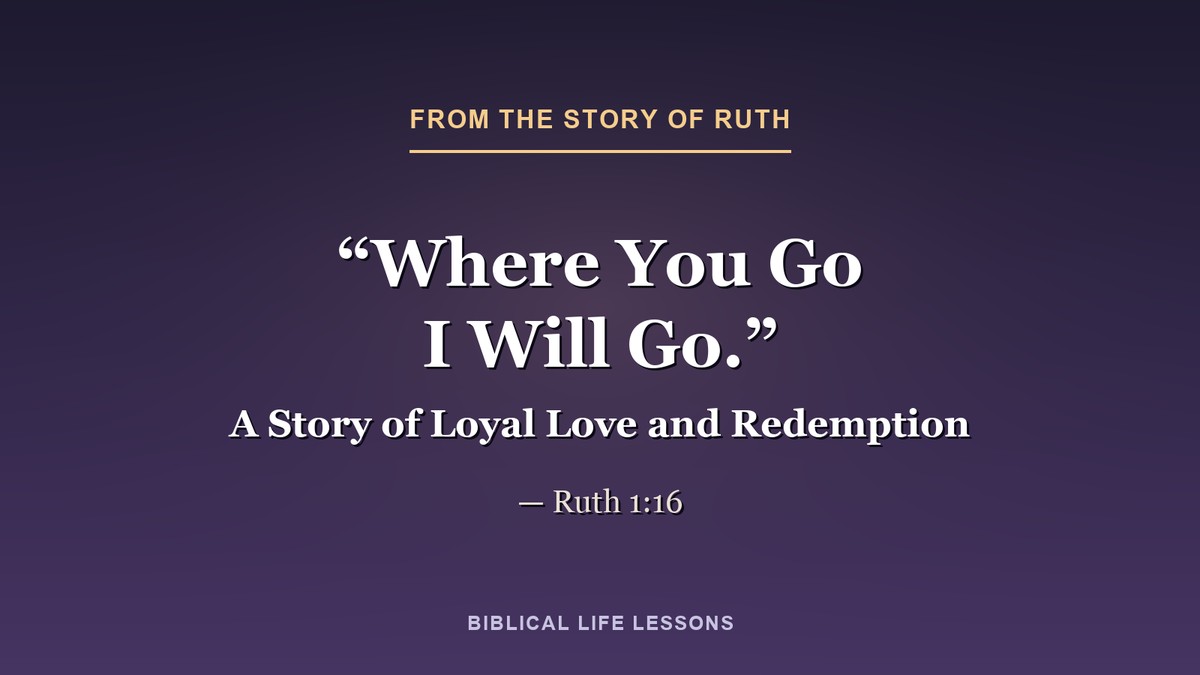
“But Ruth replied, ‘Don’t urge me to leave you or to turn back from you. Where you go I will go, and where you stay I will stay. Your people will be my people and your God my God.'” (Ruth 1:16, NIV)
Three things stand out about her. She was an outsider — a Moabite in Israel, from a nation often at odds with God’s people. She was loyal — she stayed with Naomi when it would have been far easier to leave. And she was redeemed — the foreign widow became part of the family through which God would bring His King.
The Background: A Famine and a Move to Moab (Ruth 1:1-5)
Ruth’s story begins “in the days when the judges ruled” (Ruth 1:1) — a dark and unstable period in Israel’s history. A famine struck the land, and a man named Elimelek left Bethlehem in Judah with his wife Naomi and their two sons, Mahlon and Kilion, to live in the country of Moab.
Moab lay east of the Dead Sea. Its people descended from Lot (Genesis 19:37), and the relationship between Moab and Israel was often hostile. The law of Moses even said that no Moabite could enter the assembly of the LORD (Deuteronomy 23:3). It was not a natural place for an Israelite family to put down roots.
While they were there, Elimelek died. His two sons married Moabite women — Orpah and Ruth. Ruth married Mahlon (Ruth 4:10). About ten years later, both sons died as well, leaving three widows: Naomi, Orpah, and Ruth (Ruth 1:4-5).
Ruth’s Choice: “Where You Go I Will Go” (Ruth 1:6-18)
When Naomi heard that the LORD had provided food for His people in Judah, she decided to return home. Her daughters-in-law set out with her, but on the road Naomi urged them to go back to their mothers’ homes, where they could remarry and build new lives. She had nothing left to offer them.
Both women wept. Orpah kissed Naomi goodbye and returned to her people. “But Ruth clung to her” (Ruth 1:14). When Naomi urged her again to follow Orpah, Ruth answered with words that have echoed for three thousand years:
“Where you go I will go, and where you stay I will stay. Your people will be my people and your God my God. Where you die I will die, and there I will be buried. May the LORD deal with me, be it ever so severely, if even death separates you and me.” (Ruth 1:16-17, NIV)
Ruth was choosing far more than a home. She was choosing a people who might never accept her, a life of likely poverty and widowhood, and above all, a God — the God of Israel. And notice that she called on Him by name: “May the LORD deal with me.” This was not just loyalty to Naomi. It was faith.
Return to Bethlehem (Ruth 1:19-22)
When the two widows arrived in Bethlehem, the whole town was stirred. “Can this be Naomi?” the women asked. Naomi’s reply was full of grief: “Don’t call me Naomi… Call me Mara, because the Almighty has made my life very bitter. I went away full, but the LORD has brought me back empty” (Ruth 1:20-21). Naomi means “pleasant”; Mara means “bitter.”
But Naomi was not entirely empty. Standing beside her was Ruth. And the chapter ends with a quiet note of hope: they arrived in Bethlehem “as the barley harvest was beginning” (Ruth 1:22).
Gleaning in the Field of Boaz (Ruth 2)
To provide for Naomi, Ruth went to glean — to gather the leftover grain behind the harvesters. God’s law commanded landowners to leave the edges and leftovers of their fields for the poor, the widow, and the foreigner (Leviticus 19:9-10). Ruth was all three.
Scripture says, “As it turned out, she was working in a field belonging to Boaz,” a wealthy relative of Elimelek’s clan (Ruth 2:3). It sounds like coincidence, but the whole book quietly shows God’s hand behind ordinary events.
Boaz noticed Ruth and treated her with remarkable kindness. He told her to stay in his field, ordered his young men not to bother her, and invited her to drink from their water jars (Ruth 2:8-9). Ruth bowed down and asked, “Why have I found such favor in your eyes that you notice me — a foreigner?” (Ruth 2:10). Boaz had heard everything she had done for Naomi, and he blessed her:
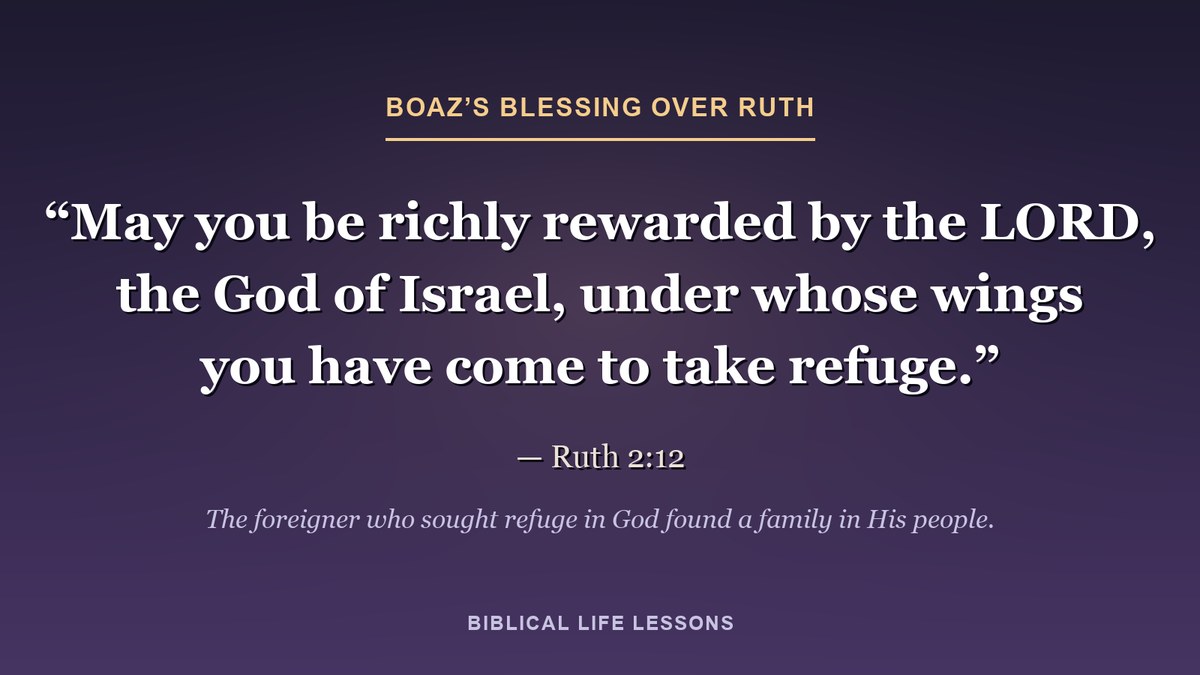
“May the LORD repay you for what you have done. May you be richly rewarded by the LORD, the God of Israel, under whose wings you have come to take refuge.” (Ruth 2:12, NIV)
At mealtime, Boaz invited Ruth to eat with his workers, and he quietly told his men to pull out extra stalks for her to gather (Ruth 2:14-16). By evening she had gathered about an ephah of barley — enough for several weeks. When Naomi heard whose field it was, her hope began to return: “The LORD bless him!… That man is our close relative; he is one of our guardian-redeemers” (Ruth 2:20). Ruth continued gleaning in Boaz’s fields until the end of the barley and wheat harvests.
What Is a Guardian-Redeemer?
To understand the rest of Ruth’s story, it helps to know what a guardian-redeemer (in Hebrew, go’el) was. Under the law of Moses, when an Israelite fell into poverty and had to sell family land, a close relative had the right — and responsibility — to buy it back so it stayed in the family (Leviticus 25:25). A related custom called for a brother or near relative to marry a widow who had no son, so that the dead man’s family line would continue (Deuteronomy 25:5-10).
A guardian-redeemer was, in other words, a family member who stepped in to rescue a relative from loss. That role sits at the very heart of Ruth’s story — and it points forward to the greatest Redeemer of all.
The Threshing Floor (Ruth 3)
When the harvest ended, Naomi made a bold plan. She told Ruth to wash, put on her best clothes, and go to the threshing floor where Boaz would be winnowing barley. After he lay down for the night, Ruth was to uncover his feet and lie down — a culturally understood way of asking him to act as her protector and redeemer.
Ruth did exactly as Naomi said. In the middle of the night, Boaz woke, startled to find a woman at his feet. Ruth spoke plainly: “I am your servant Ruth. Spread the corner of your garment over me, since you are a guardian-redeemer of our family” (Ruth 3:9). The phrase echoes Boaz’s own blessing — Ruth had come to take refuge under God’s “wings,” and now she asked Boaz to spread his “wing” (the same Hebrew word) over her.
Boaz was moved: “This kindness is greater than that which you showed earlier… All the people of my town know that you are a woman of noble character” (Ruth 3:10-11). But there was one complication: another relative was more closely related than Boaz and had the first right to redeem. Boaz promised to settle the matter the next day, and he sent Ruth home before dawn with six measures of barley for Naomi.
Redemption at the Town Gate (Ruth 4:1-12)
The next morning, Boaz went to the town gate — the place where legal business was done — and gathered ten elders as witnesses. When the closer relative came by, Boaz explained that Naomi was selling Elimelek’s land. The man was happy to buy it — until he learned that redeeming the land meant marrying Ruth and raising a son in the dead man’s name. “Then I cannot redeem it because I might endanger my own estate” (Ruth 4:6).
So Boaz stepped in. In the custom of the day, the relative took off his sandal and handed it to Boaz to confirm the transfer (Ruth 4:7-8). Boaz announced before everyone that he had acquired the land and “Ruth the Moabite, Mahlon’s widow, as my wife” (Ruth 4:10). The elders blessed the marriage: “May the LORD make the woman who is coming into your home like Rachel and Leah, who together built up the family of Israel” (Ruth 4:11).
Ruth’s Legacy: The Line of David and Jesus (Ruth 4:13-22)
Ruth and Boaz married, and “the LORD enabled her to conceive, and she gave birth to a son” (Ruth 4:13). The women of Bethlehem rejoiced with Naomi: “Praise be to the LORD, who this day has not left you without a guardian-redeemer.” And they said something remarkable about Ruth: she was a daughter-in-law “who loves you and who is better to you than seven sons” (Ruth 4:14-15).
Naomi — who once called herself Mara, bitter and empty — held the baby in her arms and cared for him (Ruth 4:16). They named him Obed. The book then closes with a short genealogy that reveals why this story matters so much: “Obed the father of Jesse, and Jesse the father of David” (Ruth 4:22).
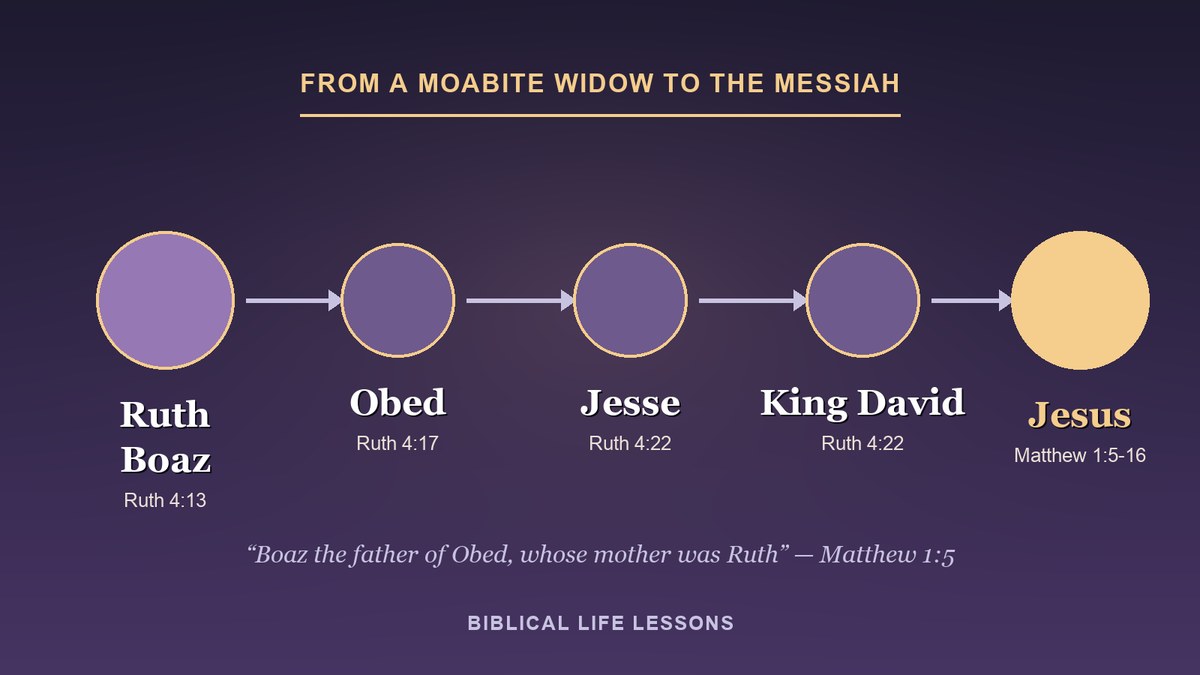
The Moabite widow who had nothing became the great-grandmother of Israel’s greatest king. And centuries later, Matthew’s Gospel names her in the family line of Jesus: “Boaz the father of Obed, whose mother was Ruth” (Matthew 1:5). God wove a foreigner into the very line of the Messiah — a beautiful picture of His plan to bless all nations.
Five Life Lessons from Ruth’s Story
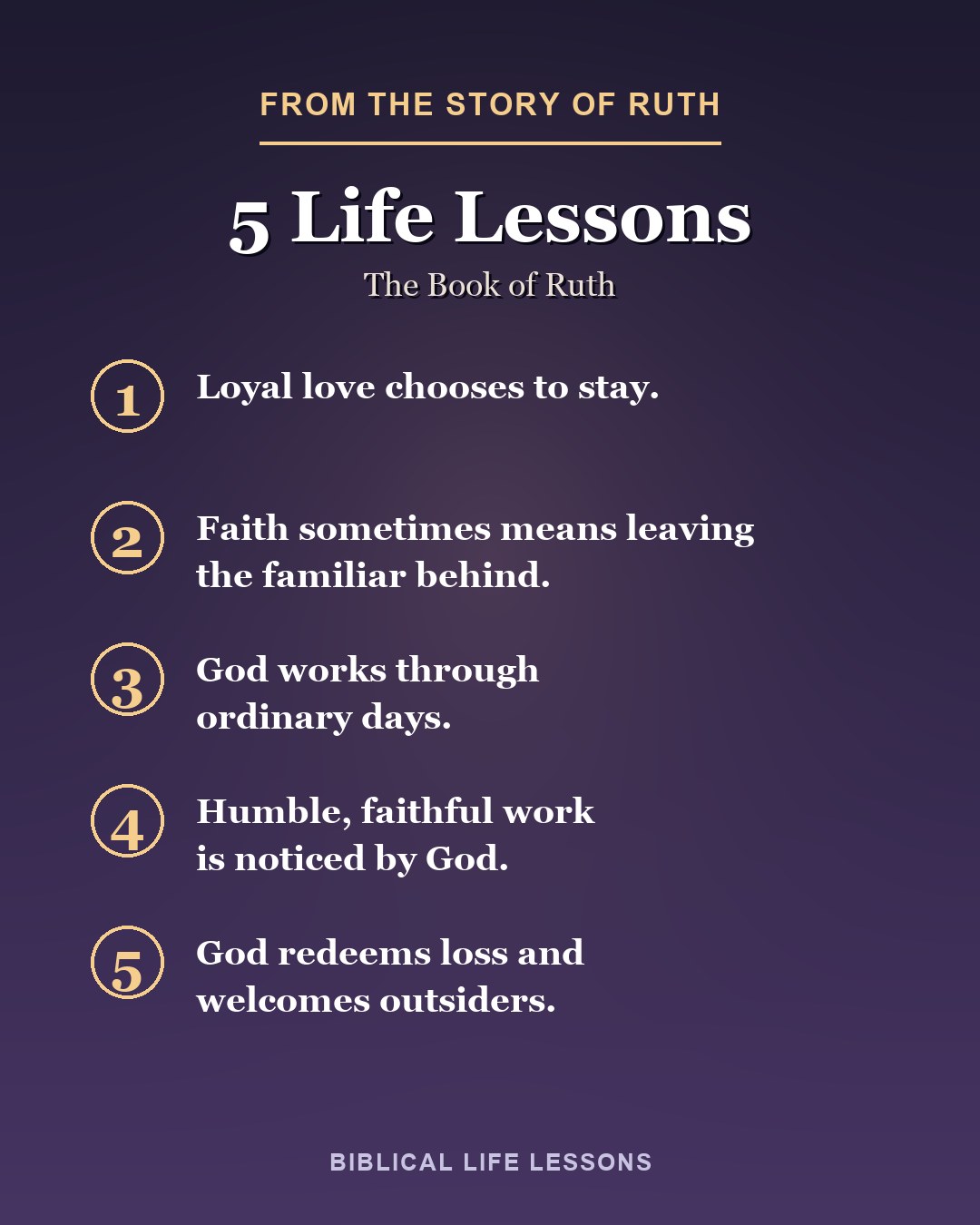
1. Loyal love chooses to stay.
Orpah’s choice to return home was understandable. Ruth’s choice to stay was extraordinary. The Hebrew word often used to describe this kind of love is hesed — loyal, covenant love that keeps showing up when it would be easier to walk away. In a world of easy exits, Ruth’s story calls us to faithful, committed love for the people God has placed in our lives.
2. Faith sometimes means leaving the familiar behind.
“Your people will be my people and your God my God.” Ruth left her homeland, her family, and her gods to follow the God of Israel. Following God can cost us comfort, familiarity, and even relationships. But Ruth’s story shows that what we leave behind for God is never greater than what He has prepared for us.
3. God works through ordinary days.
“As it turned out, she was working in a field belonging to Boaz.” There are no miracles or prophets in the book of Ruth — just a widow working hard on an ordinary day. Yet God was guiding every step. Your ordinary routines — work, errands, caring for family — are not outside of God’s plan. He is often most at work in the moments that seem most ordinary.
4. Humble, faithful work is noticed by God.
Ruth did not wait for someone to rescue her. She went out to glean, worked from morning until evening, and quietly cared for Naomi. Her reputation spread: “All the people of my town know that you are a woman of noble character.” Faithful, humble work — especially work done to care for others — honors God and often opens doors we could never have planned.
5. God redeems loss and welcomes outsiders.
Ruth began her story as a grieving foreigner with no future. She ended it as a wife, a mother, and an ancestor of the Messiah. Naomi went from “empty” to holding a grandson in her arms. Boaz’s role as guardian-redeemer points to Jesus, who redeems us at His own cost. No one is too far outside, and no loss is too great, for God’s redemption.
Frequently Asked Questions About Ruth
Who was Ruth’s first husband?
Ruth’s first husband was Mahlon, the son of Elimelek and Naomi (Ruth 4:10). Mahlon died in Moab, leaving Ruth a widow before she moved to Bethlehem with Naomi.
Who was Ruth’s second husband?
Ruth’s second husband was Boaz, a wealthy landowner in Bethlehem and a relative of Naomi’s late husband, Elimelek. He married Ruth as her guardian-redeemer (Ruth 4:9-13).
Why was it significant that Ruth was a Moabite?
The Moabites were descendants of Lot and were often in conflict with Israel. The law said no Moabite could enter the assembly of the LORD (Deuteronomy 23:3). Ruth’s acceptance into Israel — and into the family line of David and Jesus — shows God’s grace reaching beyond the boundaries people set.
What is a guardian-redeemer in the book of Ruth?
A guardian-redeemer (Hebrew go’el) was a close relative responsible for helping family members in trouble — buying back land that had been sold (Leviticus 25:25) and, in some cases, marrying a childless widow to carry on the family line (Deuteronomy 25:5-10). Boaz fulfilled this role for Ruth and Naomi.
How is Ruth related to King David?
Ruth was King David’s great-grandmother. Ruth and Boaz had a son named Obed; Obed was the father of Jesse; and Jesse was the father of David (Ruth 4:17, 22).
Is Ruth in the genealogy of Jesus?
Yes. Matthew 1:5 lists Ruth in the family line of Jesus: “Salmon the father of Boaz, whose mother was Rahab, Boaz the father of Obed, whose mother was Ruth.” She is one of only a few women named in Matthew’s genealogy.
Where is Ruth’s story in the Bible?
Ruth’s story is told in the book of Ruth, which has four chapters and appears in the Old Testament between Judges and 1 Samuel. She is also mentioned in Matthew 1:5. In Jewish tradition, the book of Ruth is read during the festival of Shavuot (Pentecost), which celebrates the harvest.
Related Reading
For a short devotional on Ruth’s faithfulness in grief, see What Ruth Teaches Us About Walking With God Through Loss. For the woman she refused to leave, read What Naomi Teaches Us About Coming Home When Grief Has Turned Bitter and Ruth and Naomi: A Tale of Loyalty, Love, and Faithfulness. For her redeemer, see What Boaz Teaches Us About Being the Person Who Shows Up and Boaz: A Man of Godly Character and Purpose. For her famous great-grandson, read 10 Achievements of King David in the Bible. For the matriarchs named in the elders’ blessing, see Who Was Leah in the Bible? And for the only other woman with a book of the Bible named after her, read Who Was Esther in the Bible? For a wider guide to the men and women of Scripture, visit our Characters of the Bible pillar.
A Closing Prayer
Father, thank You for Ruth. Thank You that You saw a grieving foreign widow and wove her into the story of Your King. Give me Ruth’s loyal love — the kind that stays when it would be easier to leave. Help me follow You even when it means leaving the familiar behind. Open my eyes to Your hand in my ordinary days. Bless the humble work of my hands. And thank You for Jesus, my Redeemer, who paid the price to bring me into Your family. In His name, Amen.
Subscribe for Daily Email Devotionals
MEET FAITH FRIEND AI
Faith Friend is your friendly AI chatbot on BiblicalLifeLessons.com, here to help you explore the Bible, answer your faith-related questions, and guide you through life lessons based on God’s Word. Whether you’re seeking encouragement, understanding Scripture, or deepening your faith, Faith Friend is always ready to chat.