Who Was Joseph in the Bible? The Complete Story from the Pit to the Palace
Joseph’s story is one of the longest and most carefully told in the book of Genesis. He was his father’s favorite, sold into slavery by his own brothers, falsely accused, forgotten in prison, and then raised in a single day to the second-highest office in Egypt. Years later, the brothers who betrayed him knelt in front of him, and he had the power to do anything he wanted to them. What he did next is one of the most moving scenes in the Bible.
If you have searched for who Joseph was in the Bible, or what his story teaches us today, this is a complete guide. We will walk through his family, his dreams, the pit, Potiphar’s house, the prison, Pharaoh’s palace, the reunion with his brothers, his famous words in Genesis 50:20, and five practical life lessons his story still speaks into ours.
Prefer to watch? Here is Joseph’s story as a short animated devotional, with Scripture, reflection, and a closing prayer.
Who Was Joseph in the Bible?
Joseph was the eleventh of the twelve sons of Jacob, and the firstborn of Jacob’s beloved wife Rachel (Genesis 30:22-24). Sold into slavery at seventeen, he became the governor of Egypt at thirty and saved the region from a devastating famine. His story fills Genesis 37-50. (He is a different man from Joseph of Nazareth, the husband of Mary, who appears in the Gospels.)
“You intended to harm me, but God intended it for good to accomplish what is now being done, the saving of many lives.” (Genesis 50:20, NIV)
Three things stand out about him. He was faithful, refusing to give up on God in slavery, temptation, or prison. He was patient, waiting about thirteen years between his dreams and his rise to power. And he was merciful, forgiving the people who had done him the greatest harm. Through all of it, the writer keeps returning to one simple truth: “The LORD was with Joseph.”
Jacob’s Favorite Son (Genesis 37:1-11)
Joseph grew up in a family full of old wounds. His father Jacob had four wives and twelve sons, and he made no secret of who came first. Rachel had been the woman Jacob loved most, and Joseph was her son.
“Now Israel loved Joseph more than any of his other sons, because he had been born to him in his old age; and he made an ornate robe for him.” (Genesis 37:3, NIV)
That robe was a daily reminder of the family’s divide. His brothers “hated him and could not speak a kind word to him” (Genesis 37:4). Joseph did not help matters. At seventeen, he brought their father a bad report about them, and then told them about two dreams. In the first, their sheaves of grain bowed down to his. In the second, the sun, moon, and eleven stars bowed down to him. The dreams were from God, but the telling only deepened their hatred. Even Jacob rebuked him, though he “kept the matter in mind” (Genesis 37:11).
Thrown into the Pit (Genesis 37:12-36)
When Jacob sent Joseph to check on his brothers, they saw him coming from a distance. “Here comes that dreamer!” they said. “Come now, let’s kill him and throw him into one of these cisterns and say that a ferocious animal devoured him. Then we’ll see what comes of his dreams” (Genesis 37:19-20).
Reuben talked them out of killing him, secretly planning to rescue him later. So they stripped off the robe and threw Joseph into an empty cistern. Then they sat down to eat. When a caravan of traders came by, Judah suggested they make a profit instead, and they sold their brother for twenty shekels of silver.
They dipped the robe in goat’s blood and brought it to their father. Jacob recognized it and tore his clothes, refusing to be comforted: “In mourning will I go down to the grave to my son” (Genesis 37:35). Meanwhile, Joseph was on his way to Egypt, where he was sold to Potiphar, the captain of Pharaoh’s guard.
Potiphar’s House (Genesis 39)
Joseph had lost his home, his family, and his freedom. Yet Genesis 39 opens with a surprising sentence:
“The LORD was with Joseph so that he prospered, and he lived in the house of his Egyptian master.” (Genesis 39:2, NIV)
Potiphar noticed, and he eventually put Joseph in charge of everything he owned. But Potiphar’s wife noticed Joseph too, and she tried day after day to seduce him. His answer shows what kind of man he had become: “How then could I do such a wicked thing and sin against God?” (Genesis 39:9). No one in Egypt would have known. No one from his family would ever have found out. Joseph refused anyway, because he knew God would know.
One day, when no one else was in the house, she grabbed him by his cloak. He left it in her hand and ran. She used the cloak as evidence and accused him of attacking her. For the second time, a garment was used to tell a lie about Joseph, and for the second time, he lost everything. This time he had done exactly the right thing.
Forgotten in Prison (Genesis 39:20-40:23)
Joseph was thrown into the prison where the king’s prisoners were held. And again, the writer tells us: “the LORD was with him; he showed him kindness and granted him favor in the eyes of the prison warden” (Genesis 39:21). Soon Joseph was running the prison, too.
Two of Pharaoh’s officials, his chief cupbearer and chief baker, were locked up with him. When each had a troubling dream, Joseph told them, “Do not interpretations belong to God?” (Genesis 40:8). He explained that the cupbearer would be restored in three days and the baker would be executed. Then Joseph made a small, very human request: “When all goes well with you, remember me and show me kindness; mention me to Pharaoh and get me out of this prison” (Genesis 40:14).
Everything happened just as he said. And then comes one of the quietest heartbreaks in Genesis: “The chief cupbearer, however, did not remember Joseph; he forgot him” (Genesis 40:23). Two more full years went by.
From the Prison to the Palace (Genesis 41)
Then Pharaoh had two dreams that no one in Egypt could explain: seven gaunt cows devouring seven fat ones, and seven thin heads of grain swallowing seven full ones. At last the cupbearer remembered. Joseph was brought up from the dungeon, shaved, and given clean clothes. When Pharaoh said he had heard Joseph could interpret dreams, Joseph did not take the credit: “I cannot do it, but God will give Pharaoh the answer he desires” (Genesis 41:16).
The dreams meant seven years of abundance followed by seven years of severe famine. Joseph proposed a plan to store grain during the good years, and Pharaoh was astonished: “Can we find anyone like this man, one in whom is the spirit of God?” (Genesis 41:38). That same day, the prisoner became the second most powerful man in Egypt. “Joseph was thirty years old when he entered the service of Pharaoh king of Egypt” (Genesis 41:46).
Pharaoh gave him an Egyptian name, Zaphenath-Paneah, and a wife, Asenath. Joseph named his two sons in a way that tells us what was happening in his heart. He called the first Manasseh, because “God has made me forget all my trouble,” and the second Ephraim, because “God has made me fruitful in the land of my suffering” (Genesis 41:51-52).
His Brothers Come to Egypt (Genesis 42-44)
The famine reached Canaan, and Jacob sent ten of his sons to Egypt to buy grain. When they arrived, they bowed down before the governor with their faces to the ground. “Although Joseph recognized his brothers, they did not recognize him” (Genesis 42:8). More than twenty years after those first dreams, the sheaves had bowed.
Joseph did not reveal himself right away. He spoke harshly, accused them of being spies, held Simeon in custody, and demanded that they bring their youngest brother, Benjamin. It seems he was testing whether they had changed. As they spoke among themselves about their guilt over what they had done to him, not knowing he could understand, Joseph turned away and wept (Genesis 42:21-24).
The final test came when Joseph’s silver cup was planted in Benjamin’s sack, and Joseph declared that Benjamin would stay behind as his slave. Here was the brothers’ chance to abandon another favored son of Rachel. Instead Judah, the very man who had suggested selling Joseph, stepped forward and begged to take Benjamin’s place: “Please let your servant remain here as my lord’s slave in place of the boy” (Genesis 44:33). The brothers had changed.
“I Am Joseph” (Genesis 45)
Joseph could not hold back any longer. He sent everyone else out of the room and wept so loudly that the Egyptians heard him. Then he said, “I am Joseph! Is my father still living?” (Genesis 45:3). His brothers were too terrified to answer.
“And now, do not be distressed and do not be angry with yourselves for selling me here, because it was to save lives that God sent me ahead of you.” (Genesis 45:5, NIV)
Joseph did not pretend that what they had done was harmless. He named it plainly: “the one you sold into Egypt” (Genesis 45:4). But he had come to see a larger story running underneath it. “So then, it was not you who sent me here, but God” (Genesis 45:8). He kissed his brothers and wept over them, and “afterward his brothers talked with him.”
Jacob, who had mourned Joseph for more than twenty years, could not believe the news at first. When father and son finally met in Goshen, Joseph “threw his arms around his father and wept for a long time” (Genesis 46:29).
“God Intended It for Good” (Genesis 50)
After Jacob died, Joseph’s brothers were afraid. Perhaps he had only been waiting until their father was gone. They sent him a message and then came and threw themselves down before him. Joseph wept once more. Then he gave one of the greatest answers in the Bible:
“Don’t be afraid. Am I in the place of God? You intended to harm me, but God intended it for good to accomplish what is now being done, the saving of many lives.” (Genesis 50:19-20, NIV)
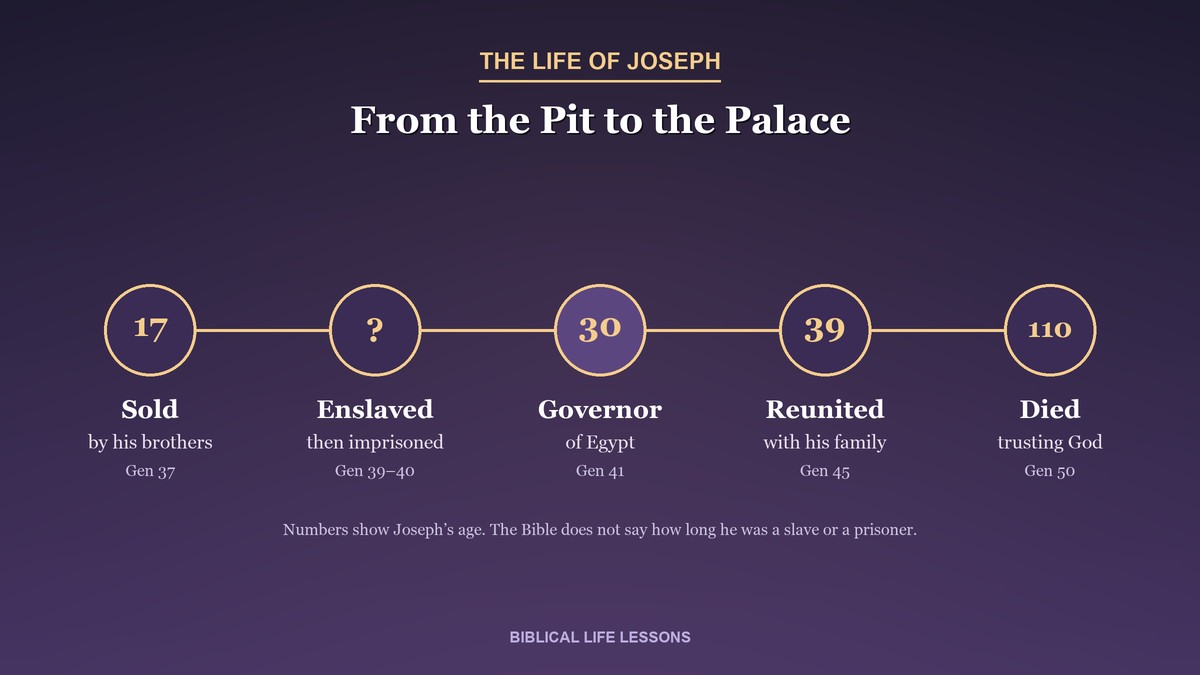
He promised to provide for them and their children, “and he reassured them and spoke kindly to them” (Genesis 50:21). Joseph lived to be 110. Before he died, he told his family that God would surely bring them back to the promised land, and he made them swear to carry his bones with them. Centuries later, Moses took those bones out of Egypt (Exodus 13:19), and they were buried at Shechem (Joshua 24:32). Hebrews 11:22 counts that request as an act of faith.
How Joseph’s Story Points to Jesus
Joseph’s life offers a striking picture of Christ. Both were loved by their fathers and rejected by their brothers. Both were sold for silver, falsely accused, and counted among criminals. Both were raised from the lowest place to the highest, and through their suffering, both brought salvation to many, including those who had betrayed them. What Joseph’s brothers meant for evil, God used to save lives. At the cross, God did the same thing on a far greater scale.
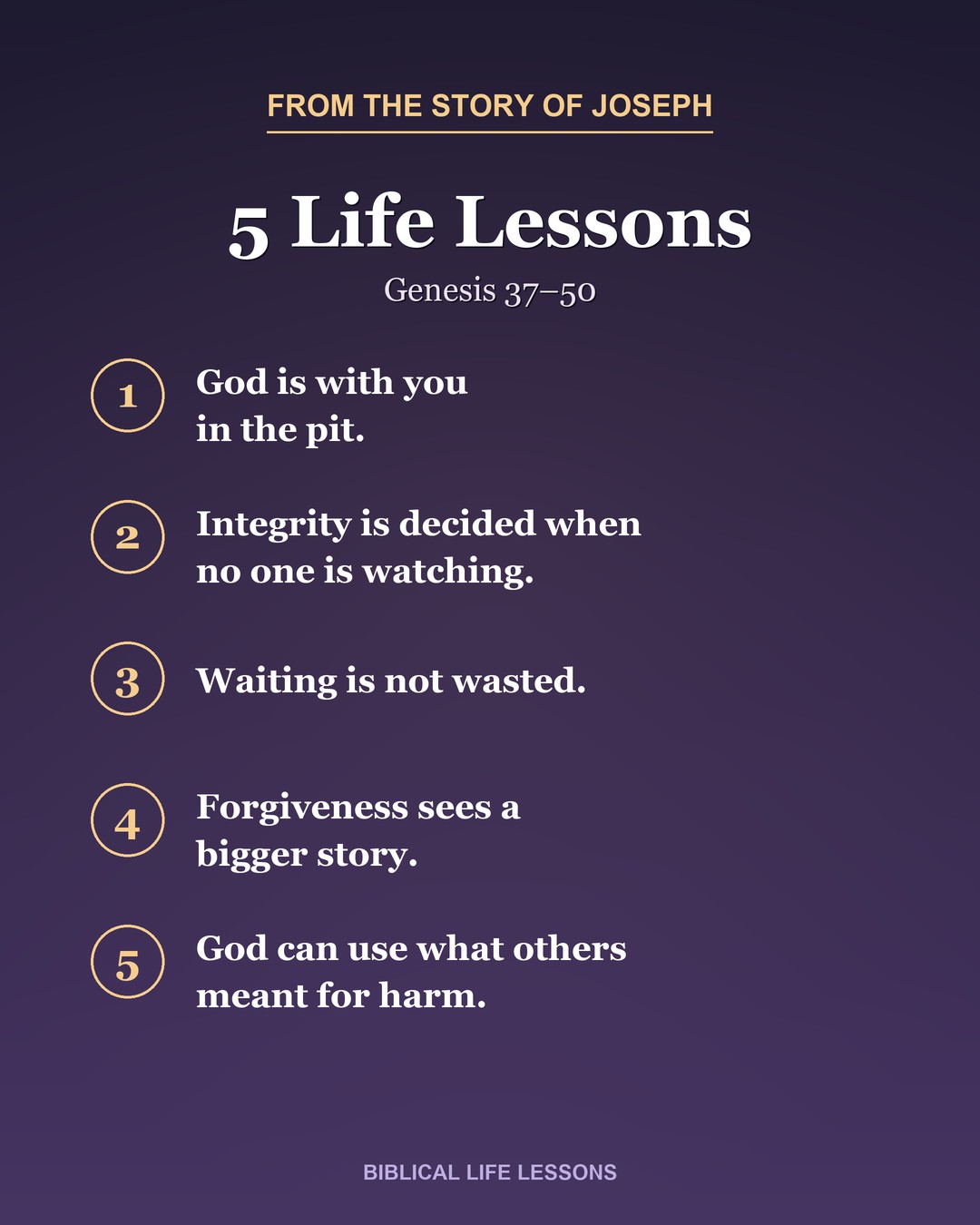
Five Life Lessons from Joseph’s Story
1. God is with you in the pit.
“The LORD was with Joseph” is repeated in the worst seasons of his life, not the best. God’s presence did not keep Joseph out of slavery or prison. It met him there. If you are somewhere you never wanted to be, your circumstances are not evidence that God has left you.
2. Integrity is decided when no one is watching.
Joseph was far from home, and no one would have known. He said no because he lived before God, not before people. And doing the right thing cost him dearly. Integrity does not always get rewarded quickly, but it keeps you free in a way that compromise never can.
3. Waiting is not wasted.
Thirteen years passed between the pit and the palace, including two long years after the cupbearer forgot him. Psalm 105:19 says it was “till what he foretold came to pass, till the word of the LORD proved him true.” God was shaping the man who would one day carry the weight of a nation. Your waiting may be preparing you for something you cannot yet see.
4. Forgiveness sees a bigger story.
Joseph named the wrong honestly, wept over it more than once, and still refused to take revenge. “Am I in the place of God?” he asked. Forgiveness does not mean saying it did not hurt. It means handing the final judgment to God and refusing to let bitterness write the rest of your story.
5. God can use what others meant for harm.
This does not make evil good, and Joseph never said it did. But no betrayal, injustice, or loss is outside God’s reach. “In all things God works for the good of those who love him” (Romans 8:28). What was done to you does not have the final say.
Frequently Asked Questions About Joseph
How old was Joseph when he was sold into slavery?
Joseph was seventeen when the events that led to his sale began (Genesis 37:2). He was thirty when he entered Pharaoh’s service (Genesis 41:46), so about thirteen years passed between the two.
What was Joseph’s coat of many colors?
The King James Version calls it a “coat of many colours,” while the NIV says “an ornate robe” (Genesis 37:3). The exact meaning of the Hebrew phrase is uncertain. Either way, it marked Joseph as his father’s favorite.
Why did Joseph’s brothers hate him?
They resented that their father loved Joseph more than any of them, and his dreams of them bowing down to him made it worse (Genesis 37:4-8).
How many brothers did Joseph have?
Joseph had eleven brothers: ten older half-brothers and one younger full brother, Benjamin, who was also Rachel’s son. He also had a sister named Dinah (Genesis 30:21).
How long was Joseph in prison?
The Bible does not give the exact length. We know he was still there “two full years” after the cupbearer was released (Genesis 41:1), and that his slavery and imprisonment together lasted about thirteen years.
Is Joseph in the Old Testament the same as Mary’s husband?
No. This Joseph, the son of Jacob, lived many centuries before Joseph of Nazareth, the husband of Mary and the earthly father of Jesus.
How did Joseph die?
Joseph died in Egypt at the age of 110. He was embalmed and placed in a coffin there, and his bones were later carried to the promised land (Genesis 50:26; Joshua 24:32).
Related Reading
For a closer look at what it took to release his brothers, read How Did Joseph Forgive the Brothers Who Sold Him? For more on his most famous words, see Turning Evil into Good: The Message of Genesis 50:20. To meet his father, read Who Was Jacob in the Bible? and for his mother, see Who Was Rachel in the Bible? If you are carrying a hurt of your own, read How Can We Forgive When It Still Hurts? For help during a long delay, see In the Waiting: Trusting God When You Don’t Understand. For another young man who served faithfully in a foreign court and explained a king’s dreams, read Who Was Daniel in the Bible? For a wider guide to the men and women of Scripture, visit our Characters of the Bible pillar.
A Closing Prayer
Father, thank You for Joseph, and thank You that You were with him in the pit, in the prison, and in the palace. Be with me in the place I am standing today. Keep me faithful when no one is watching, and patient when it feels like everyone has forgotten me. Show me the people I still need to forgive, and give me the strength to leave judgment in Your hands. Take what was meant to harm me and use it for good, as only You can. Thank You for Jesus, who was betrayed and raised up to save many, and who has forgiven me. In His name, Amen.
Subscribe for Daily Email Devotionals
MEET FAITH FRIEND AI
Faith Friend is your friendly AI chatbot on BiblicalLifeLessons.com, here to help you explore the Bible, answer your faith-related questions, and guide you through life lessons based on God’s Word. Whether you’re seeking encouragement, understanding Scripture, or deepening your faith, Faith Friend is always ready to chat.