Who Was Aaron in the Bible? The Complete Story of Israel’s First High Priest
Aaron is one of the most important — and most human — leaders in the Old Testament. He was Moses’ older brother and spokesman, the man who stood before Pharaoh, and the first high priest of Israel. His descendants served as priests for more than a thousand years. Yet Aaron is also the man who made the golden calf. His story holds both deep faithfulness and painful failure, and it shows how God can still use someone after a terrible mistake.
If you have searched for who Aaron was in the Bible, or what his story teaches us today, this is a complete guide. We will walk through his family background, his role as Moses’ spokesman, the plagues in Egypt, the golden calf, his ordination as high priest, the death of his sons, the budding staff, his death on Mount Hor, and five practical life lessons his story still speaks into ours.
Who Was Aaron in the Bible?
Aaron was the son of Amram and Jochebed from the tribe of Levi, the older brother of Moses and Miriam, and the first high priest of Israel. God chose him to speak for Moses during the exodus from Egypt and later set apart Aaron and his sons to serve as priests. His story runs through Exodus, Leviticus, and Numbers.
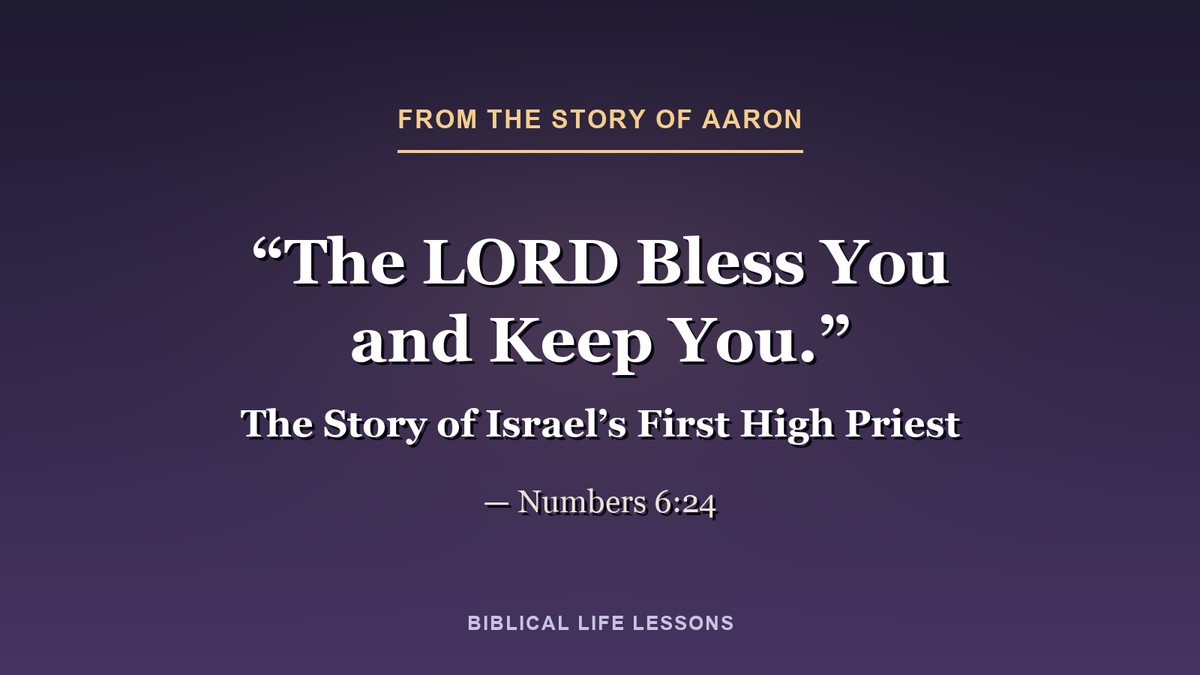
“The LORD bless you and keep you; the LORD make his face shine on you and be gracious to you; the LORD turn his face toward you and give you peace.” (Numbers 6:24-26, NIV)
Those famous words of blessing were given to Aaron and his sons to speak over Israel (Numbers 6:22-23). Three things stand out about Aaron. He was a partner — most of his life was spent at his brother’s side. He was a priest — he stood between God and the people, offering sacrifices and blessing. And he was flawed — at one of the most important moments in Israel’s history, he gave in to pressure and led the people into idolatry.
The Family Background: Born into Slavery
Aaron’s parents were Amram and Jochebed, both from the tribe of Levi (Exodus 6:20). He was three years older than Moses (Exodus 7:7), which means he was born before Pharaoh ordered every Hebrew baby boy to be thrown into the Nile. While Moses grew up in Pharaoh’s palace, Aaron grew up as a slave among his own people. Their sister Miriam was also part of the story from the beginning.
Aaron married Elisheba, the daughter of Amminadab and sister of Nahshon, a leader in the tribe of Judah (Exodus 6:23). They had four sons: Nadab, Abihu, Eleazar, and Ithamar. Centuries later, a woman named Elizabeth — the mother of John the Baptist — would be described as “a descendant of Aaron” (Luke 1:5), carrying a form of the same name as Aaron’s wife.
Moses’ Spokesman (Exodus 4-7)
When God called Moses at the burning bush, Moses resisted. He said he was not a good speaker. God’s patience was tested, but He provided a partner:
“What about your brother, Aaron the Levite? I know he can speak well. He is already on his way to meet you, and he will be glad to see you.” (Exodus 4:14, NIV)
God said Aaron would speak to the people for Moses, “and it will be as if he were your mouth and as if you were God to him” (Exodus 4:16). Aaron met Moses at the mountain of God and kissed him (Exodus 4:27). Together they gathered the elders of Israel, and Aaron told them everything God had said. When the people heard that God had seen their misery, “they bowed down and worshiped” (Exodus 4:31).
Aaron was eighty-three years old when he and Moses stood before Pharaoh (Exodus 7:7). It was Aaron who threw down his staff, which became a snake and swallowed the staffs of Pharaoh’s magicians (Exodus 7:10-12). It was Aaron who stretched out his staff to bring the first plagues — turning the Nile to blood, bringing up frogs, and turning the dust into gnats (Exodus 7:19; 8:5-6, 16-17). Aaron was not the leader, but he was a vital part of God’s deliverance.
Holding Up Moses’ Hands (Exodus 17, 24)
In the wilderness, the Amalekites attacked Israel. While Joshua led the fighting, Moses stood on a hill with the staff of God raised. As long as his hands were up, Israel was winning. When Moses grew tired, “Aaron and Hur held his hands up — one on one side, one on the other — so that his hands remained steady till sunset” (Exodus 17:12).
It is a simple but powerful picture of Aaron’s life. He did not hold the staff. He held up the one who did. Later, at Mount Sinai, Aaron, his sons Nadab and Abihu, and seventy elders of Israel went up the mountain and “saw the God of Israel” (Exodus 24:9-10) — one of the most extraordinary encounters with God in the Old Testament.
The Golden Calf (Exodus 32)
Then came Aaron’s darkest moment. Moses had been on Mount Sinai for forty days receiving God’s law, and the people grew restless. They came to Aaron and said, “Come, make us gods who will go before us. As for this fellow Moses who brought us up out of Egypt, we don’t know what has happened to him” (Exodus 32:1).
Instead of standing firm, Aaron gave in. He collected their gold earrings, melted them down, and shaped a golden calf. The people declared, “These are your gods, Israel, who brought you up out of Egypt” (Exodus 32:4). Aaron built an altar in front of it and announced, “Tomorrow there will be a festival to the LORD” (Exodus 32:5) — trying to mix idolatry with the worship of the true God.
When Moses came down and confronted him, Aaron’s excuse was almost unbelievable:
“Do not be angry, my lord… You know how prone these people are to evil. They said to me, ‘Make us gods who will go before us…’ So I told them, ‘Whoever has any gold jewelry, take it off.’ Then they gave me the gold, and I threw it into the fire, and out came this calf!” (Exodus 32:22-24, NIV)
Aaron blamed the people and made it sound as if the calf had made itself. Deuteronomy 9:20 reveals how serious his sin was: “the LORD was angry enough with Aaron to destroy him, but at that time I prayed for Aaron too.” Aaron survived because his brother interceded for him.
Israel’s First High Priest (Exodus 28-29; Leviticus 8-9)
Remarkably, God did not cast Aaron aside. Even before the golden calf, God had already chosen Aaron and his sons to serve as priests (Exodus 28:1). After the calf, God still kept His plan.
Aaron was given sacred garments “to give him dignity and honor” (Exodus 28:2). On his chest he wore a breastpiece with twelve precious stones, each engraved with the name of one of the tribes of Israel. “Whenever Aaron enters the Holy Place, he will bear the names of the sons of Israel over his heart” (Exodus 28:29). On his turban was a gold plate engraved with the words “HOLY TO THE LORD” (Exodus 28:36).
In Leviticus 8, Moses ordained Aaron and his sons. When Aaron offered the first sacrifices as high priest and blessed the people, “fire came out from the presence of the LORD and consumed the burnt offering,” and the people shouted for joy and fell facedown (Leviticus 9:24). The man who had once built an altar to a golden calf now stood at God’s altar, forgiven and restored.
The Death of Nadab and Abihu (Leviticus 10)
Aaron’s joy did not last long. Soon after his ordination, his two oldest sons, Nadab and Abihu, offered “unauthorized fire before the LORD, contrary to his command.” Fire came out from the presence of the LORD and consumed them (Leviticus 10:1-2). Moses reminded Aaron of God’s word: “Among those who approach me I will be proved holy.” And Scripture records simply, “Aaron remained silent” (Leviticus 10:3).
It is one of the most heartbreaking verses in the Bible. A father who lost two sons in a single day said nothing — perhaps in grief, perhaps in submission, perhaps both. Aaron’s remaining sons, Eleazar and Ithamar, continued to serve as priests.
Failures and Faithfulness in the Wilderness (Numbers 12, 16, 17)
Aaron’s later years show both sides of him again. In Numbers 12, he and Miriam spoke against Moses and questioned his authority. God rebuked them, and Miriam was struck with a skin disease. Aaron humbled himself immediately: “Please, my lord, I ask you not to hold against us the sin we have so foolishly committed” (Numbers 12:11).
But in Numbers 16, after Korah’s rebellion, a deadly plague broke out among the people. Moses told Aaron to take his censer with incense and hurry into the crowd to make atonement. Aaron ran into the middle of the assembly. “He stood between the living and the dead, and the plague stopped” (Numbers 16:48). The old priest literally put himself between God’s judgment and the people.
To settle the question of who God had chosen as priest, God told the leaders of each tribe to bring a staff. Overnight, Aaron’s staff “had not only sprouted but had budded, blossomed and produced almonds” (Numbers 17:8). It was kept in front of the ark of the covenant as a sign (Numbers 17:10; Hebrews 9:4).
Aaron’s Death on Mount Hor (Numbers 20)
At Meribah, when the people complained about water, Moses and Aaron failed to honor God as holy before the people, and God told them they would not lead Israel into the Promised Land (Numbers 20:12). Soon after, God told Moses to take Aaron and his son Eleazar up Mount Hor.
There Moses removed Aaron’s priestly garments and put them on Eleazar, passing the high priesthood to the next generation. Aaron died on top of the mountain at 123 years old (Numbers 20:28; 33:39). “When the whole community learned that Aaron had died, all the Israelites mourned for him thirty days” (Numbers 20:29).
The New Testament points beyond Aaron. Hebrews 5:4 says no one takes the honor of high priest on himself, “but he receives it when called by God, just as Aaron was.” Yet Hebrews also explains that Jesus is a greater high priest — not in the order of Aaron, but in the order of Melchizedek — who “always lives to intercede” for His people (Hebrews 7:11, 25). Aaron’s priesthood was a shadow. Jesus is the reality.
Five Life Lessons from Aaron’s Story
1. Supporting roles matter to God.
Aaron spent most of his life in second place. He spoke for Moses, stood beside Moses, and literally held up Moses’ hands. Yet God used him powerfully. You may not be the person on the stage or in charge. But holding up someone else’s hands — encouraging, serving, supporting — is holy work in God’s eyes.
2. The pressure of the crowd is dangerous.
Aaron did not make the golden calf because he wanted to. He made it because the people wanted it and he did not stand firm. Leaders, parents, and friends all face this temptation: to give people what they want instead of what is right. Aaron’s story warns us that going along with the crowd can lead us — and others — far from God.
3. Own your failures instead of making excuses.
“I threw it into the fire, and out came this calf!” Aaron’s excuse is almost comical, but it is painfully familiar. We all have ways of shifting blame. Real restoration begins when we stop explaining away our sin and simply confess it. God is ready to forgive — but He calls us to be honest about what we have done.
4. Failure does not have to be final.
The man who made the golden calf became Israel’s high priest. God did not erase the seriousness of Aaron’s sin, but He did not throw him away either. If you have failed badly, Aaron’s story is a reminder that God’s grace can restore you and still use you. Your worst moment does not have to be your last word.
5. Carry people on your heart and stand in the gap.
Aaron wore the names of the twelve tribes over his heart. He spoke God’s blessing over them. And when judgment fell, he ran into the crowd and stood between the living and the dead. We are called to do the same — to carry others to God in prayer, to bless them, and to step in when they are hurting. That is the heart of a priest.
Frequently Asked Questions About Aaron
Who were Aaron’s parents and siblings?
Aaron’s parents were Amram and Jochebed, from the tribe of Levi (Exodus 6:20). His younger brother was Moses, and his sister was Miriam (Numbers 26:59). Aaron was three years older than Moses (Exodus 7:7).
Who was Aaron’s wife, and who were his sons?
Aaron’s wife was Elisheba, the daughter of Amminadab and sister of Nahshon (Exodus 6:23). They had four sons: Nadab, Abihu, Eleazar, and Ithamar. Nadab and Abihu died after offering unauthorized fire (Leviticus 10:1-2). Eleazar succeeded Aaron as high priest (Numbers 20:28).
Why did Aaron make the golden calf?
While Moses was on Mount Sinai for forty days, the people grew impatient and demanded that Aaron make gods to lead them (Exodus 32:1). Aaron gave in to their pressure, collected their gold, and made the calf. When Moses confronted him, Aaron blamed the people (Exodus 32:22-24).
What was the role of the high priest?
The high priest served as a mediator between God and the people. He offered sacrifices, cared for the tabernacle, wore special garments bearing the names of the twelve tribes, and once a year entered the Most Holy Place on the Day of Atonement to make atonement for the people (Leviticus 16). Aaron was the first person to hold this role.
What was the significance of Aaron’s staff budding?
After people challenged Aaron’s priesthood, God had each tribe’s leader bring a staff. Overnight, Aaron’s staff sprouted, budded, blossomed, and produced almonds (Numbers 17:8). It proved that God had chosen Aaron and his family as priests. The staff was kept in front of the ark of the covenant (Numbers 17:10; Hebrews 9:4).
How old was Aaron when he died, and where?
Aaron died at 123 years old on Mount Hor, near the border of Edom (Numbers 33:38-39). Before he died, his priestly garments were placed on his son Eleazar, and Israel mourned for him thirty days (Numbers 20:28-29).
Where is Aaron’s story in the Bible?
Aaron’s story is told mainly in Exodus 4-12 (Moses’ spokesman and the plagues), Exodus 17 and 24, Exodus 28-29 (priestly garments), Exodus 32 (the golden calf), Leviticus 8-10 (ordination and his sons’ deaths), and Numbers 12, 16-17, and 20 (his later years and death). He is also mentioned in Psalm 133:2, Luke 1:5, Acts 7:40, and Hebrews 5:4, 7:11, and 9:4.
Related Reading
For the partnership between the two brothers, see Moses and Aaron: Leadership Dynamics in the Exodus. For a closer look at his biggest failure, read Learning from Mistakes: Aaron’s Role in the Golden Calf Incident. For his sister, see 5 Powerful Life Lessons We Can Learn from Miriam in the Bible, and for his mother, What Jochebed Teaches Us About Trusting God With What You Cannot Control. For the man who fought while Aaron held up Moses’ hands, read Who Was Joshua in the Bible? For one of his descendants, see Who Was Elizabeth in the Bible? And for a wider guide to the men and women of Scripture, visit our Characters of the Bible pillar.
A Closing Prayer
Father, thank You for Aaron. Thank You that You used him to speak, to serve, and to bless Your people — and that You did not throw him away after he failed. Help me find joy in holding up others’ hands. Give me the courage to stand firm when the crowd pushes me toward what is wrong. When I fail, help me own it honestly instead of making excuses. Teach me to carry others on my heart and to stand in the gap for them in prayer. And thank You for Jesus, my great High Priest, who always lives to intercede for me. In Jesus’ name, Amen.
Subscribe for Daily Email Devotionals
MEET FAITH FRIEND AI
Faith Friend is your friendly AI chatbot on BiblicalLifeLessons.com, here to help you explore the Bible, answer your faith-related questions, and guide you through life lessons based on God’s Word. Whether you’re seeking encouragement, understanding Scripture, or deepening your faith, Faith Friend is always ready to chat.