Who Was Hannah in the Bible? The Complete Story of Samuel’s Mother (1 Samuel 1-2)
Hannah is one of the most relatable women in the Old Testament. She was loved by her husband, taunted by a rival, misunderstood by a priest, and heartbroken year after year by the child she could not have. Yet her story turned into one of the great answered prayers of Scripture — and her son Samuel became the prophet who anointed Israel’s first two kings.
If you have searched for who Hannah was in the Bible, or what her story teaches us today, this is a complete guide. We will walk through her family background, her painful rivalry with Peninnah, her prayer at Shiloh, the misunderstanding with Eli, the birth of Samuel, the day she gave him back to the Lord, her powerful song of praise, and five practical life lessons her story still speaks into ours.
Who Was Hannah in the Bible?
Hannah was one of the two wives of Elkanah, a man from Ramathaim in the hill country of Ephraim, and the mother of the prophet Samuel. She lived near the end of the period of the judges, when the tabernacle stood at Shiloh and Eli was the priest. Her story is told in 1 Samuel 1-2.
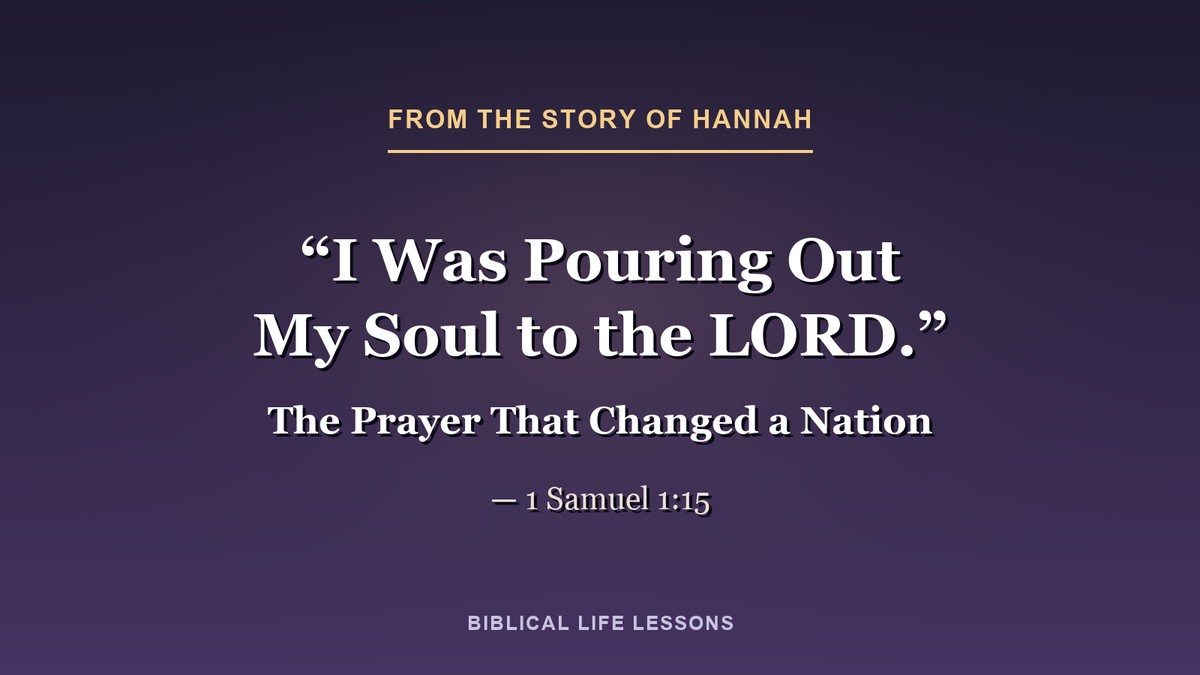
“I am a woman who is deeply troubled. I have not been drinking wine or beer; I was pouring out my soul to the LORD.” (1 Samuel 1:15, NIV)
Three things stand out about her. She was loved — her husband gave her a double portion at the yearly sacrifice because he loved her (1 Samuel 1:5). She was hurting — Scripture says simply that “the LORD had closed her womb.” And she was a woman of prayer — when she reached the end of herself, she did not turn on her rival or her husband. She turned to God.
The Family Background: Elkanah’s Two Wives
Elkanah had two wives: Hannah and Peninnah. “Peninnah had children, but Hannah had none” (1 Samuel 1:2). Scripture does not tell us why Elkanah took a second wife, but many readers believe Hannah’s childlessness was the reason. If so, Hannah lived every day with a living reminder of what she could not give her husband.
Every year the family traveled to Shiloh to worship and offer sacrifices at the tabernacle, where Eli’s sons Hophni and Phinehas served as priests (1 Samuel 1:3). The trip should have been a time of worship and celebration. For Hannah, it became the most painful week of the year.
Peninnah’s Provocation (1 Samuel 1:4-8)
At the sacrifice, Elkanah gave portions of meat to Peninnah and all her sons and daughters. “But to Hannah he gave a double portion because he loved her, and the LORD had closed her womb” (1 Samuel 1:5). That double portion was a sign of love — but it may have made the rivalry worse.
Scripture calls Peninnah Hannah’s “rival,” and says she “kept provoking her in order to irritate her” (1 Samuel 1:6). This was not a one-time insult. “This went on year after year” (1 Samuel 1:7). Every time they went up to the house of the Lord, Peninnah found a way to wound her. Hannah wept and would not eat.
Elkanah tried to comfort her: “Hannah, why are you weeping? Why don’t you eat? Why are you downhearted? Don’t I mean more to you than ten sons?” (1 Samuel 1:8). He meant well. But his love, as real as it was, could not reach the deepest place of her grief. Some pain only God can touch.
Hannah’s Prayer at Shiloh (1 Samuel 1:9-11)
After the meal one year, Hannah stood up and went to the tabernacle. “In her deep anguish Hannah prayed to the LORD, weeping bitterly” (1 Samuel 1:10). Then she made a vow:
“LORD Almighty, if you will only look on your servant’s misery and remember me, and not forget your servant but give her a son, then I will give him to the LORD for all the days of his life, and no razor will ever be used on his head.” (1 Samuel 1:11, NIV)
Notice what Hannah asked for. She asked God to see her (“look on your servant’s misery”) and to remember her. Before she asked for a son, she asked not to be forgotten. And she promised that if God gave her a child, she would give him back — dedicating him to lifelong service, with a vow similar to the Nazirite vow of Numbers 6.
Misunderstood by Eli (1 Samuel 1:12-18)
Eli the priest was sitting by the doorpost of the tabernacle, watching. Hannah was “praying in her heart, and her lips were moving but her voice was not heard” (1 Samuel 1:13). Eli assumed she was drunk and rebuked her: “How long are you going to stay drunk? Put away your wine” (1 Samuel 1:14).
It must have been crushing. She had come to God’s house broken, and God’s priest accused her of being drunk. But Hannah answered him with honesty and dignity: she was not drunk; she was “pouring out my soul to the LORD” out of “great anguish and grief” (1 Samuel 1:15-16).
Eli’s response changed: “Go in peace, and may the God of Israel grant you what you have asked of him” (1 Samuel 1:17). And then comes one of the most beautiful lines in her story: “Then she went her way and ate something, and her face was no longer downcast” (1 Samuel 1:18). Nothing in her situation had changed yet. She was not pregnant. But she had given her burden to God, and she left lighter.
The Birth of Samuel (1 Samuel 1:19-20)
The family returned home to Ramah, “and the LORD remembered her” (1 Samuel 1:19). The same words were used of Rachel generations earlier. Hannah conceived and gave birth to a son. “She named him Samuel, saying, ‘Because I asked the LORD for him'” (1 Samuel 1:20). The name Samuel sounds like the Hebrew for “heard by God” — every time she called her son’s name, she remembered that God had heard her.
Giving Samuel Back to the Lord (1 Samuel 1:21-28)
Hannah did not forget her vow. She stayed home with Samuel until he was weaned — likely around two or three years old in that culture — and then brought him to Shiloh with an offering of a bull, flour, and wine. She presented him to Eli and said:
“I prayed for this child, and the LORD has granted me what I asked of him. So now I give him to the LORD. For his whole life he will be given over to the LORD.” (1 Samuel 1:27-28, NIV)
It is hard to imagine what that moment cost her. The child she had begged God for, year after year, she now placed into God’s service at the tabernacle. She kept her word even when it hurt. And each year after, she made Samuel a little robe and brought it to him when she came up with her husband for the annual sacrifice (1 Samuel 2:19).
Hannah’s Song (1 Samuel 2:1-10)
Instead of weeping as she left her son, Hannah sang. Her prayer in 1 Samuel 2 is one of the great songs of praise in the Old Testament:
“My heart rejoices in the LORD; in the LORD my horn is lifted high. My mouth boasts over my enemies, for I delight in your deliverance. There is no one holy like the LORD; there is no one besides you; there is no Rock like our God.” (1 Samuel 2:1-2, NIV)
Her song celebrates a God who turns things upside down: “He raises the poor from the dust and lifts the needy from the ash heap” (1 Samuel 2:8). It ends by speaking of God’s “king” and “his anointed” (1 Samuel 2:10) — one of the earliest references in Scripture to the anointed one, before Israel even had a king. Centuries later, Mary’s song in Luke 1, the Magnificat, would echo Hannah’s words closely.
And God was not finished blessing Hannah. Eli blessed Elkanah and Hannah, and “the LORD was gracious to Hannah; she gave birth to three sons and two daughters” (1 Samuel 2:21). The woman who once had no children now had six.
Five Life Lessons from Hannah’s Story
1. Pour out your soul — God can handle your honesty.
Hannah did not pray polite, tidy prayers. She wept bitterly. She prayed from “great anguish and grief.” She poured out her soul. Too often we believe we need to clean up our emotions before we come to God. Hannah’s story shows the opposite: God welcomes the raw, honest prayers of hurting people. Bring Him the real thing.
2. Do not let a rival decide how you respond.
Year after year, Peninnah provoked her. And yet Scripture never records Hannah fighting back. She did not trade insults or try to win the rivalry. She took her pain to God instead. When someone keeps pushing your buttons, you do not have to give them the response they are looking for. Take it to the Lord.
3. Being misunderstood does not cancel your prayer.
Even the priest got Hannah wrong. He thought her sincere, desperate prayer was drunkenness. But God was not confused about Hannah’s heart, and neither was she. If people have misread your pain — even people in the church — remember that God sees exactly what is happening in your heart. Answer them with grace, and keep praying.
4. Peace can come before the answer.
“Her face was no longer downcast.” Hannah left Shiloh with peace before she ever became pregnant. Her circumstances had not changed — but she had placed them in God’s hands. You do not have to wait for the answer to stop carrying the weight. Peace comes from trusting the One who holds the answer.
5. Hold your blessings with open hands.
Hannah gave back the very thing she had prayed for. She understood that Samuel was a gift from God before he was ever hers. Our children, careers, homes, and dreams are all gifts to be held with open hands. When we offer them back to God, He often does more with them than we could imagine — Hannah’s son became the prophet who anointed Israel’s first two kings.
Frequently Asked Questions About Hannah
Who was Hannah’s husband?
Hannah’s husband was Elkanah, a man from Ramathaim (also called Ramah) in the hill country of Ephraim (1 Samuel 1:1). He also had a second wife, Peninnah. Scripture says Elkanah loved Hannah and gave her a double portion at the yearly sacrifice (1 Samuel 1:5).
Who was Peninnah in the Bible?
Peninnah was Elkanah’s other wife. Unlike Hannah, she had sons and daughters. The Bible calls her Hannah’s “rival” and says she provoked Hannah year after year because Hannah had no children (1 Samuel 1:6-7).
How many children did Hannah have?
Hannah had six children. Her first son was Samuel (1 Samuel 1:20). After she dedicated Samuel to the Lord, God blessed her with three more sons and two daughters (1 Samuel 2:21).
Why did Eli think Hannah was drunk?
Hannah was praying silently. Her lips were moving, but no sound came out (1 Samuel 1:13). Eli misread her deep emotion as drunkenness. When Hannah explained that she was pouring out her soul to the Lord, Eli blessed her and prayed that God would grant her request (1 Samuel 1:15-17).
What does the name Samuel mean?
Hannah named her son Samuel “because I asked the LORD for him” (1 Samuel 1:20). The name sounds like the Hebrew for “heard by God” and is often understood to mean “God has heard” or “name of God.”
How is Hannah’s song connected to Mary’s song?
Hannah’s prayer in 1 Samuel 2:1-10 and Mary’s song in Luke 1:46-55 (the Magnificat) share many of the same themes: rejoicing in God, praising His holiness, and celebrating how He humbles the proud and lifts up the lowly. Many scholars believe Mary’s song intentionally echoes Hannah’s.
Where is Hannah’s story in the Bible?
Hannah’s story is told in 1 Samuel 1 (her barrenness, prayer, and Samuel’s birth and dedication) and 1 Samuel 2 (her song of praise, the yearly robe she made for Samuel, and the birth of her other children).
Related Reading
For a devotional on Hannah’s prayer, see What Hannah’s Tears Teach Us About Praying Through a Long, Painful Wait and Wisdom in Parenting: Lessons from Hannah’s Prayer. For her son, read What Samuel Teaches Us About Hearing God When You’re Not Sure It’s Him. For other women who waited on God for a child, see Who Was Sarah in the Bible?, Who Was Rachel in the Bible?, and Who Was Elizabeth in the Bible? And for a wider guide to the men and women of Scripture, visit our Characters of the Bible pillar.
A Closing Prayer
Father, thank You for Hannah. Thank You that You saw her misery, heard her prayer, and remembered her. Teach me to pour out my soul to You honestly instead of hiding my pain. When others provoke me, help me bring it to You instead of fighting back. When I am misunderstood, remind me that You see my heart. Give me peace before I see the answer. And help me hold every blessing You give me with open hands, ready to give it back to You. In Jesus’ name, Amen.
Subscribe for Daily Email Devotionals
MEET FAITH FRIEND AI
Faith Friend is your friendly AI chatbot on BiblicalLifeLessons.com, here to help you explore the Bible, answer your faith-related questions, and guide you through life lessons based on God’s Word. Whether you’re seeking encouragement, understanding Scripture, or deepening your faith, Faith Friend is always ready to chat.