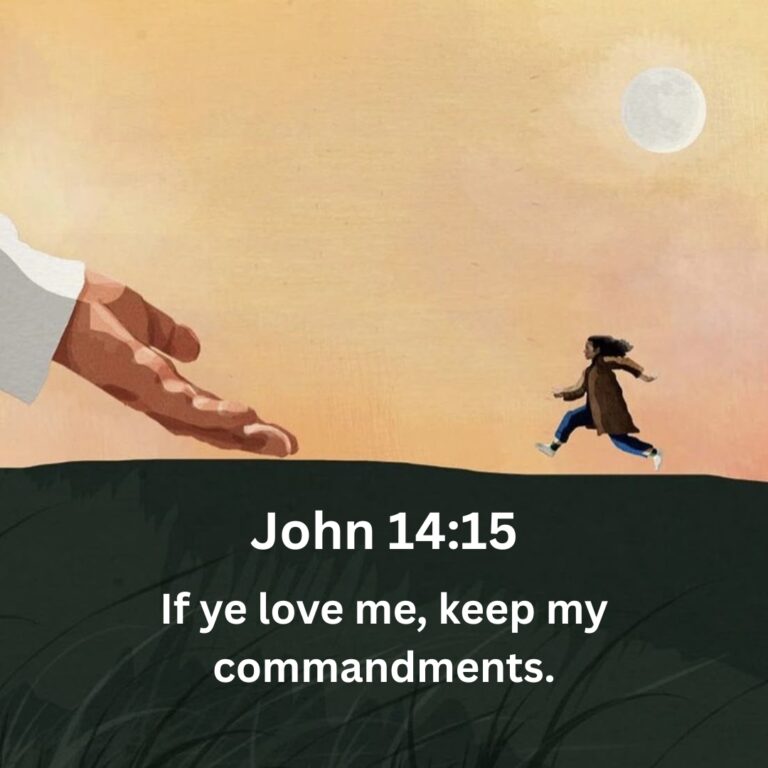
Who Was Job in the Bible? The Complete Story of Faith Through Suffering
Job’s story asks the question every suffering person eventually asks: why? Job was a good man, and in a single day he lost his wealth, his servants, and all ten of his children. Then he lost his health. His friends came to comfort him and ended up accusing him. For chapter after chapter, Job wrestles with God, protesting, grieving, and hoping all at once. And when God finally speaks, He does not give Job the answer he asked for. He gives Job something better.
If you have searched for who Job was in the Bible, or what his story teaches us today, this is a complete guide. We will walk through Job’s life before his trials, the conversation in heaven, his losses, his response, his three friends, his honest laments, his great statements of faith, God’s answer from the storm, Job’s restoration, and five practical life lessons his story still speaks into ours.
Who Was Job in the Bible?
Job was a wealthy and righteous man who lived in the land of Uz, likely east of Israel, probably in the era of the patriarchs. He was “the greatest man among all the people of the East” (Job 1:3). The book that bears his name is one of the wisdom books of the Old Testament and one of the oldest stories in the Bible. Job is also mentioned by the prophet Ezekiel and by James in the New Testament as an example of righteousness and perseverance (Ezekiel 14:14; James 5:11).
“In the land of Uz there lived a man whose name was Job. This man was blameless and upright; he feared God and shunned evil.” (Job 1:1, NIV)
Three things stand out about him. He was faithful, even when faith seemed to bring him nothing. He was honest, bringing his raw questions and pain directly to God. And he was patient, not in the sense of quietly accepting everything, but in the sense of refusing to let go of God no matter what.
Job’s Life Before (Job 1:1-5)
Job had seven sons and three daughters, and enormous wealth: seven thousand sheep, three thousand camels, five hundred yoke of oxen, five hundred donkeys, and many servants. He was also a devoted father. Whenever his children held feasts, Job would rise early the next morning and offer sacrifices for each of them, thinking, “Perhaps my children have sinned and cursed God in their hearts” (Job 1:5).
The Conversation in Heaven (Job 1:6-12)
The book then pulls back the curtain on something Job never sees. The angels come to present themselves before the LORD, and Satan, the accuser, comes with them. God asks, “Have you considered my servant Job? There is no one on earth like him” (Job 1:8).
Satan answers with a question that drives the whole book: “Does Job fear God for nothing?” (Job 1:9). In other words, Job only loves God because God has blessed him. Take away the blessings, and he will curse God to His face. God allows Satan to test Job, but sets a limit: he must not touch Job himself.
Everything Lost in One Day (Job 1:13-22)
What happened next is one of the most devastating passages in the Bible. While one messenger was still speaking, another arrived with worse news. Raiders had taken the oxen and donkeys and killed the servants. Fire from the sky had burned up the sheep and their shepherds. Another band of raiders had taken the camels. And then the final messenger: a mighty wind had struck the house where all of Job’s children were feasting, and it had collapsed on them. All ten were dead.
Job’s response is breathtaking:
“Then Job got up and tore his robe and shaved his head. Then he fell to the ground in worship and said: ‘Naked I came from my mother’s womb, and naked I will depart. The LORD gave and the LORD has taken away; may the name of the LORD be praised.'” (Job 1:20-21, NIV)
“In all this, Job did not sin by charging God with wrongdoing” (Job 1:22). Notice that Job grieved openly. He tore his robe and shaved his head. Faith did not mean pretending he was not shattered. He grieved and worshiped at the same time.
His Health Taken Too (Job 2)
Satan came before God again and argued that if Job’s own body were struck, he would surely curse God. God allowed it, but said Satan must spare Job’s life. Job was covered with painful sores from the soles of his feet to the top of his head. He sat among the ashes, scraping himself with a piece of broken pottery.
His wife, who had also lost all ten children, said, “Are you still maintaining your integrity? Curse God and die!” Job answered, “Shall we accept good from God, and not trouble?” (Job 2:9-10).
Then three friends, Eliphaz, Bildad, and Zophar, came to comfort him. When they saw him from a distance, they barely recognized him. They wept, tore their robes, and sat on the ground with him for seven days and seven nights without saying a word, “because they saw how great his suffering was” (Job 2:13). It was the best thing they did in the entire book.
Job’s Lament and His Friends’ Answers (Job 3-31)
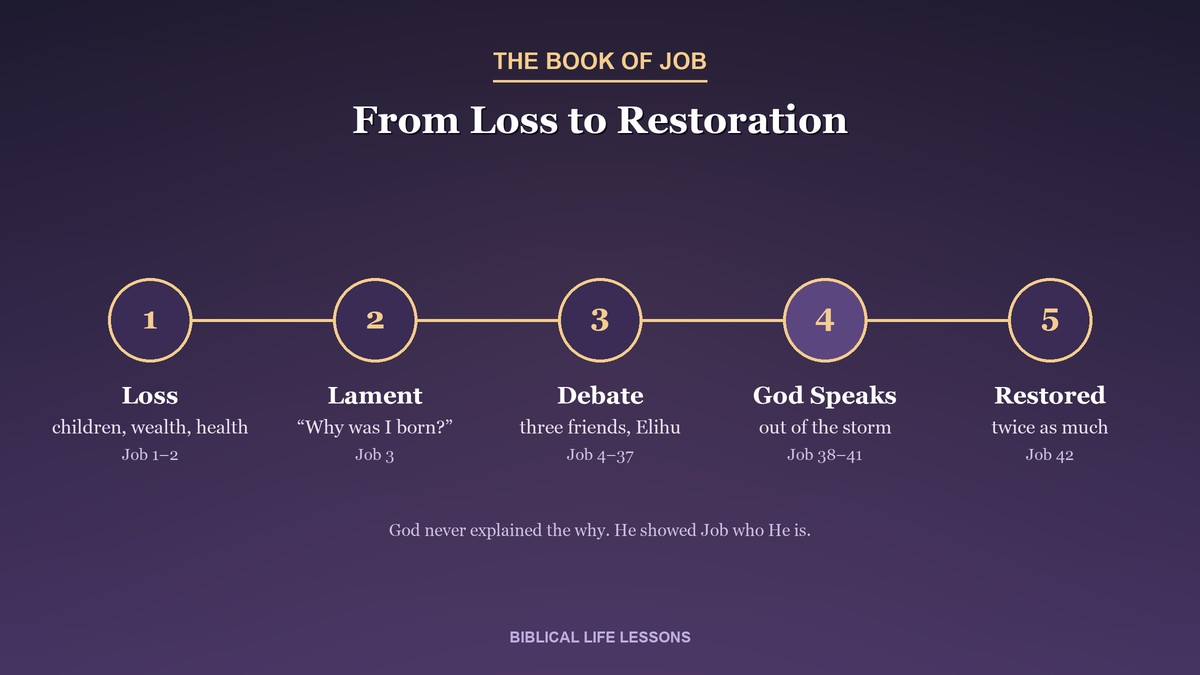
When Job finally spoke, he poured out his anguish. He cursed the day he was born and wished he had never lived (Job 3). His pain was real, and the Bible does not edit it out.
Then his friends began to speak, and the long debate began. Their argument was simple: God is just, so suffering must be punishment for sin. If Job would only confess what he had done, God would restore him. Job insisted that he had not done anything to deserve this. He called them “miserable comforters” (Job 16:2). Their theology was neat, but it did not fit Job’s life, and it did not fit God.
Through the arguments, Job swings between despair and hope. He complains bitterly, he demands a hearing with God, and he says some of the most powerful words of faith in the Bible:
“I know that my redeemer lives, and that in the end he will stand on the earth. And after my skin has been destroyed, yet in my flesh I will see God.” (Job 19:25-26, NIV)
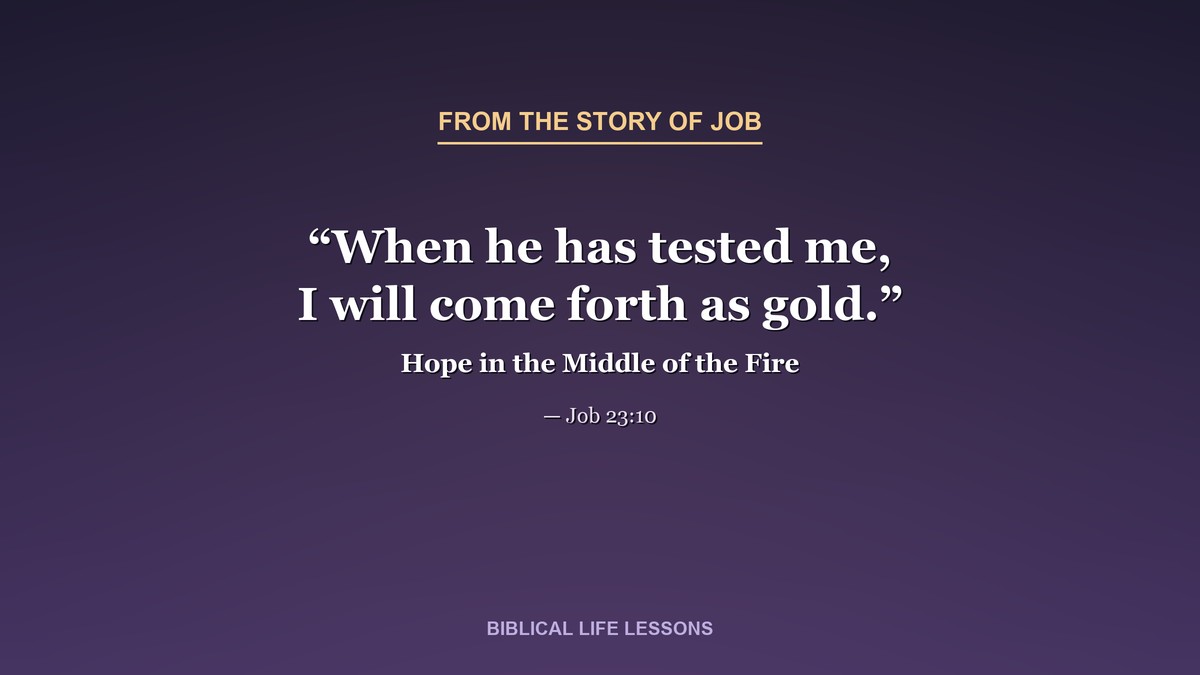
Later he says, “But he knows the way that I take; when he has tested me, I will come forth as gold” (Job 23:10).
A younger man named Elihu then speaks for six chapters, suggesting that God uses suffering to teach and refine (Job 32-37). But it is not Elihu who has the last word.
God Speaks from the Storm (Job 38-41)
“Then the LORD spoke to Job out of the storm” (Job 38:1). Job had asked for answers. God answered with questions:
“Where were you when I laid the earth’s foundation? Tell me, if you understand.” (Job 38:4, NIV)
For four chapters, God takes Job on a tour of creation: the stars, the sea, the snow, the lion and the raven, the wild donkey and the ostrich, the horse and the eagle, the great creatures Behemoth and Leviathan. God never explains the conversation in heaven. He never tells Job why. Instead, He shows Job who He is: the wise, powerful, attentive Creator who cares for every corner of His world.
Job’s response is humble: “I am unworthy—how can I reply to you? I put my hand over my mouth” (Job 40:4). And finally:
“My ears had heard of you but now my eyes have seen you.” (Job 42:5, NIV)
Job’s questions were not all answered. But he had met God, and that was enough.
Job Restored (Job 42)
Then God turned to Job’s friends: “You have not spoken the truth about me, as my servant Job has” (Job 42:7). Job’s honest wrestling had been closer to the truth than their tidy explanations. God told the friends to offer sacrifices, and told Job to pray for them.
“After Job had prayed for his friends, the LORD restored his fortunes and gave him twice as much as he had before” (Job 42:10). His family and friends came to comfort him. God blessed him with twice the flocks and herds, and with seven more sons and three more daughters. The Bible even names the daughters, Jemimah, Keziah, and Keren-Happuch, and says no women in all the land were as beautiful. Job lived 140 more years and saw four generations of his family.
The new children did not replace the ones he lost. But the ending shows that God had not abandoned Job, and that suffering was not the final word.
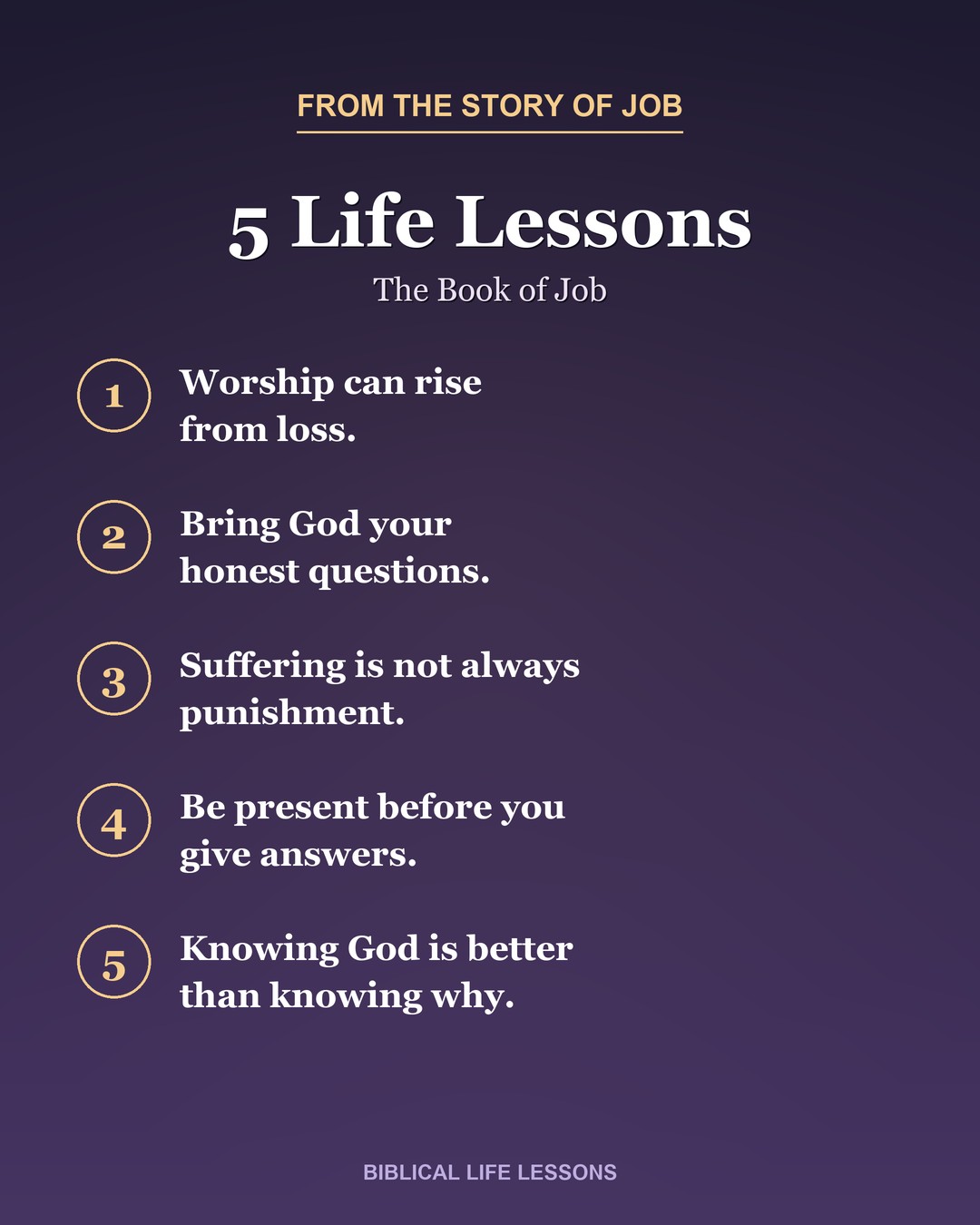
Five Life Lessons from Job’s Story
1. Worship can rise from loss.
Job tore his robe and fell to the ground in grief, and in the same moment he worshiped. Faith does not mean hiding your pain. It means bringing your pain to God and still saying, “May the name of the LORD be praised.”
2. You can bring God your honest questions.
Job complained, protested, and demanded answers, and God said Job had spoken what was right. God is not offended by honest prayers. He would rather hear your raw questions than polite silence.
3. Suffering is not always punishment.
Job’s friends were sure his suffering proved he had sinned, and God said they were wrong. When you are hurting, or when someone you love is, do not assume it is a punishment. Sometimes we suffer for reasons we will never know in this life.
4. Be present before you give answers.
Job’s friends did their best work when they sat with him in silence for seven days. Things went wrong when they started explaining. When someone is grieving, your presence matters more than your explanations.
5. Knowing God is better than knowing why.
God never told Job about the conversation in heaven. He gave Job Himself. “My ears had heard of you but now my eyes have seen you.” In suffering, the deepest answer is not an explanation but a closer relationship with the God who is there.
Frequently Asked Questions About Job
Why did God allow Job to suffer?
The book shows Satan accusing Job of loving God only for His blessings, and God allowing a test to show that Job’s faith was real (Job 1:9-12). But the book never gives Job, or us, a complete explanation. Its main message is that God can be trusted even when we do not understand.
Did Job ever curse God?
No. Job complained, lamented, and questioned God strongly, but he never cursed Him. The Bible says, “In all this, Job did not sin by charging God with wrongdoing” (Job 1:22; see also 2:10).
Who were Job’s three friends?
Eliphaz the Temanite, Bildad the Shuhite, and Zophar the Naamathite (Job 2:11). A younger man, Elihu, also speaks later in the book (Job 32-37).
What does “I know that my redeemer lives” mean?
In Job 19:25, Job expresses confidence that someone would ultimately stand up for him and vindicate him, and that he would see God. Christians have long heard in these words a hope fulfilled in Jesus, our living Redeemer.
How long did Job suffer?
The Bible does not say. The book mentions months of misery (Job 7:3), and the long conversations suggest a significant period of time, but no exact length is given.
Was Job a real person?
The prophet Ezekiel names Job alongside Noah and Daniel as an example of righteousness (Ezekiel 14:14), and James refers to “Job’s perseverance” (James 5:11). Both treat him as a real person.
How old was Job when he died?
The Bible says Job lived 140 years after his trials and saw four generations of his descendants (Job 42:16-17). His age before his trials is not given.
Related Reading
For a devotional on Job’s response to loss, read What Job Teaches Us About Worship When Life Falls Apart. For a closer look at the opening chapter, see When Faith Is Tested: Lessons from Job 1:11-12. For more on hope in hard times, read Biblical Views on Suffering and Endurance and God Sat With Me in the Darkness. For the grace that is enough in weakness, see What Does It Mean That God’s Grace Is Sufficient? For a wider guide to the men and women of Scripture, visit our Characters of the Bible pillar.
A Closing Prayer
Lord, thank You for Job, and for the honesty of his story. When I lose what I love, help me to grieve and to worship at the same time. Give me the courage to bring You my real questions, and the humility to trust You when You do not answer them the way I expect. Make me a friend who sits with people in their pain before I try to explain it. Even in my darkest days, let me say with Job, “I know that my Redeemer lives.” Thank You for Jesus, who suffered for me and rose again. In His name, Amen.
Subscribe for Daily Email Devotionals
MEET FAITH FRIEND AI
Faith Friend is your friendly AI chatbot on BiblicalLifeLessons.com, here to help you explore the Bible, answer your faith-related questions, and guide you through life lessons based on God’s Word. Whether you’re seeking encouragement, understanding Scripture, or deepening your faith, Faith Friend is always ready to chat.