Who Was Daniel in the Bible? The Complete Story of Faith in Babylon
Most people know Daniel as the man who was thrown into a den of lions and came out without a scratch. But the lions’ den happened near the end of his life, when he was likely in his eighties. Long before that night, Daniel had spent some seventy years living in a foreign empire. He served powerful kings who worshiped other gods, and he stayed faithful to his own God the whole time. His story is not only about one miraculous night. It is about a lifetime of quiet, steady faithfulness in a culture that did not share his faith.
If you have searched for who Daniel was in the Bible, or what his story teaches us today, this is a complete guide. We will walk through his capture and training in Babylon, his decision about the king’s food, Nebuchadnezzar’s dream, his friends in the fiery furnace, the writing on the wall, the lions’ den, his prayers and visions, and five practical life lessons his story still speaks into ours.
Who Was Daniel in the Bible?
Daniel was a young man from Judah, from a royal or noble family, who was taken captive to Babylon around 605 BC (Daniel 1:1-6). There he became a trusted advisor to kings for about seventy years, serving under Babylonian rulers and then under the Persians. He was also a prophet who received some of the most important visions in Scripture. His story is told in the book of Daniel. His name means “God is my judge.”
“But Daniel resolved not to defile himself with the royal food and wine.” (Daniel 1:8, NIV)
Three things stand out about him. He was faithful, keeping his convictions in a place where they could cost him his life. He was excellent at his work, so much so that his enemies could find nothing to accuse him of. And he was a man of prayer, a habit that shaped everything else about him.
Taken to Babylon (Daniel 1:1-7)
Daniel’s story begins with a national disaster. Nebuchadnezzar, king of Babylon, besieged Jerusalem and carried off some of the temple treasures along with the best of Judah’s young men. The king wanted “young men without any physical defect, handsome, showing aptitude for every kind of learning, well informed, quick to understand, and qualified to serve in the king’s palace” (Daniel 1:4). They would spend three years learning the language and literature of Babylon.
The goal was to turn them into Babylonians. Even their names were changed. Daniel became Belteshazzar, and his three friends Hananiah, Mishael, and Azariah became Shadrach, Meshach, and Abednego (Daniel 1:6-7). Their new names honored Babylon’s gods instead of the God of Israel.
A Quiet Resolve (Daniel 1:8-21)
Daniel accepted a new name, a new language, and a new education. But there was one line he would not cross. He “resolved not to defile himself with the royal food and wine” (Daniel 1:8). The Bible does not explain exactly why, though the food may have broken God’s law or been offered to idols. What is clear is that Daniel had decided in advance where his loyalty lay.
He also handled it wisely. Instead of making a scene, he asked the official in charge for a test: “Please test your servants for ten days: Give us nothing but vegetables to eat and water to drink” (Daniel 1:12). At the end of ten days, Daniel and his friends looked healthier than all the others. God gave the four of them unusual knowledge and understanding, and Daniel “could understand visions and dreams of all kinds” (Daniel 1:17). When the king examined them, he found them ten times better than all the magicians and enchanters in his kingdom.
Nebuchadnezzar’s Dream (Daniel 2)
Nebuchadnezzar had a troubling dream and demanded that his wise men tell him both the dream and its meaning. When they protested that no one could do that, he ordered every wise man in Babylon to be executed, including Daniel and his friends.
Daniel asked for time, went home, and urged his friends to plead with God for mercy. “During the night the mystery was revealed to Daniel in a vision” (Daniel 2:19). His first response was not to rush to the king but to worship: “Praise be to the name of God for ever and ever; wisdom and power are his. He changes times and seasons; he deposes kings and raises up others” (Daniel 2:20-21).
Standing before the king, Daniel refused to take credit: “There is a God in heaven who reveals mysteries” (Daniel 2:28). The dream was of a great statue made of gold, silver, bronze, iron, and clay, struck and shattered by a rock “cut out, but not by human hands.” It showed a series of earthly kingdoms that would rise and fall, followed by a kingdom from God “that will never be destroyed” (Daniel 2:44). The king made Daniel ruler over the province of Babylon.
His Friends in the Fiery Furnace (Daniel 3)
Daniel does not appear in chapter 3, but his three friends do. Nebuchadnezzar set up a huge golden image and commanded everyone to bow down to it or be thrown into a blazing furnace. Shadrach, Meshach, and Abednego refused, and gave one of the bravest answers in the Bible:
“If we are thrown into the blazing furnace, the God we serve is able to deliver us from it, and he will deliver us from Your Majesty’s hand. But even if he does not, we want you to know, Your Majesty, that we will not serve your gods or worship the image of gold you have set up.” (Daniel 3:17-18, NIV)
The furnace was heated seven times hotter than usual. Yet the king looked in and saw “four men walking around in the fire, unbound and unharmed” (Daniel 3:25). The three came out without even the smell of smoke on them. Daniel was not the only one in Babylon who refused to bow.
A Proud King Humbled (Daniel 4)
Nebuchadnezzar had another dream, this time of a great tree cut down to a stump. Daniel explained that it was about the king himself, and boldly urged him to change: “Renounce your sins by doing what is right, and your wickedness by being kind to the oppressed” (Daniel 4:27).
A year later, as Nebuchadnezzar boasted about the greatness of Babylon, the judgment fell. He lost his mind and lived like an animal in the fields until he acknowledged that God rules over the kingdoms of the earth. When his sanity returned, the most powerful king in the world praised the God of Daniel: “Those who walk in pride he is able to humble” (Daniel 4:37).
The Writing on the Wall (Daniel 5)
Years later, King Belshazzar threw a huge banquet and ordered the gold and silver goblets taken from the temple in Jerusalem to be brought out so his guests could drink from them while praising their idols. Suddenly the fingers of a human hand appeared and wrote on the palace wall. The king turned pale and his knees knocked together.
No one could read the words until the queen remembered Daniel, now an old man. Daniel turned down the king’s rewards, “You may keep your gifts for yourself” (Daniel 5:17), and then read the message: MENE, MENE, TEKEL, PARSIN. God had numbered the days of his reign and brought it to an end. “You have been weighed on the scales and found wanting” (Daniel 5:27). His kingdom would be given to the Medes and Persians. “That very night Belshazzar, king of the Babylonians, was slain” (Daniel 5:30).
Daniel in the Lions’ Den (Daniel 6)
Under the new ruler, Darius the Mede, Daniel rose again. He “so distinguished himself among the administrators and the satraps by his exceptional qualities that the king planned to set him over the whole kingdom” (Daniel 6:3). Jealous officials searched for something to use against him, but “they could find no corruption in him, because he was trustworthy and neither corrupt nor negligent” (Daniel 6:4). So they concluded that the only way to trap him was through “the law of his God.”
They persuaded Darius to sign a decree that for thirty days anyone who prayed to any god or human except the king would be thrown into the lions’ den. Daniel’s response is one of the most quietly powerful verses in Scripture:
“Now when Daniel learned that the decree had been published, he went home to his upstairs room where the windows opened toward Jerusalem. Three times a day he got down on his knees and prayed, giving thanks to his God, just as he had done before.” (Daniel 6:10, NIV)
He did not hide, and he did not make a show of defiance. He simply kept doing what he had always done. His enemies caught him, and Darius, who respected Daniel, could not undo his own law. As Daniel was thrown in, the king said, “May your God, whom you serve continually, rescue you!” (Daniel 6:16). The king spent the night fasting and sleepless.
At first light he hurried to the den and called out. Daniel answered: “My God sent his angel, and he shut the mouths of the lions. They have not hurt me, because I was found innocent in his sight” (Daniel 6:22). He was lifted out with no wound on him, “because he had trusted in his God” (Daniel 6:23). Darius then issued a decree that everyone in his kingdom must fear and reverence the God of Daniel.
Daniel’s Prayers and Visions (Daniel 7-12)
The second half of the book records Daniel’s visions of future kingdoms and of God’s final victory. In one, he saw “one like a son of man, coming with the clouds of heaven,” who was given an everlasting kingdom that would never be destroyed (Daniel 7:13-14). Jesus later used this title, “Son of Man,” for Himself (Mark 14:62).
Daniel 9 records one of the great prayers of the Bible. After reading the prophet Jeremiah, Daniel realized the seventy years of exile were nearly over. He did not respond with celebration but with confession, counting himself among his people’s sin: “We do not make requests of you because we are righteous, but because of your great mercy” (Daniel 9:18). Later an angel told him, “Since the first day that you set your mind to gain understanding and to humble yourself before your God, your words were heard” (Daniel 10:12).
The book ends with a promise of resurrection and a personal word for its aging hero: “As for you, go your way till the end. You will rest, and then at the end of the days you will rise to receive your allotted inheritance” (Daniel 12:13).
Five Life Lessons from Daniel’s Story
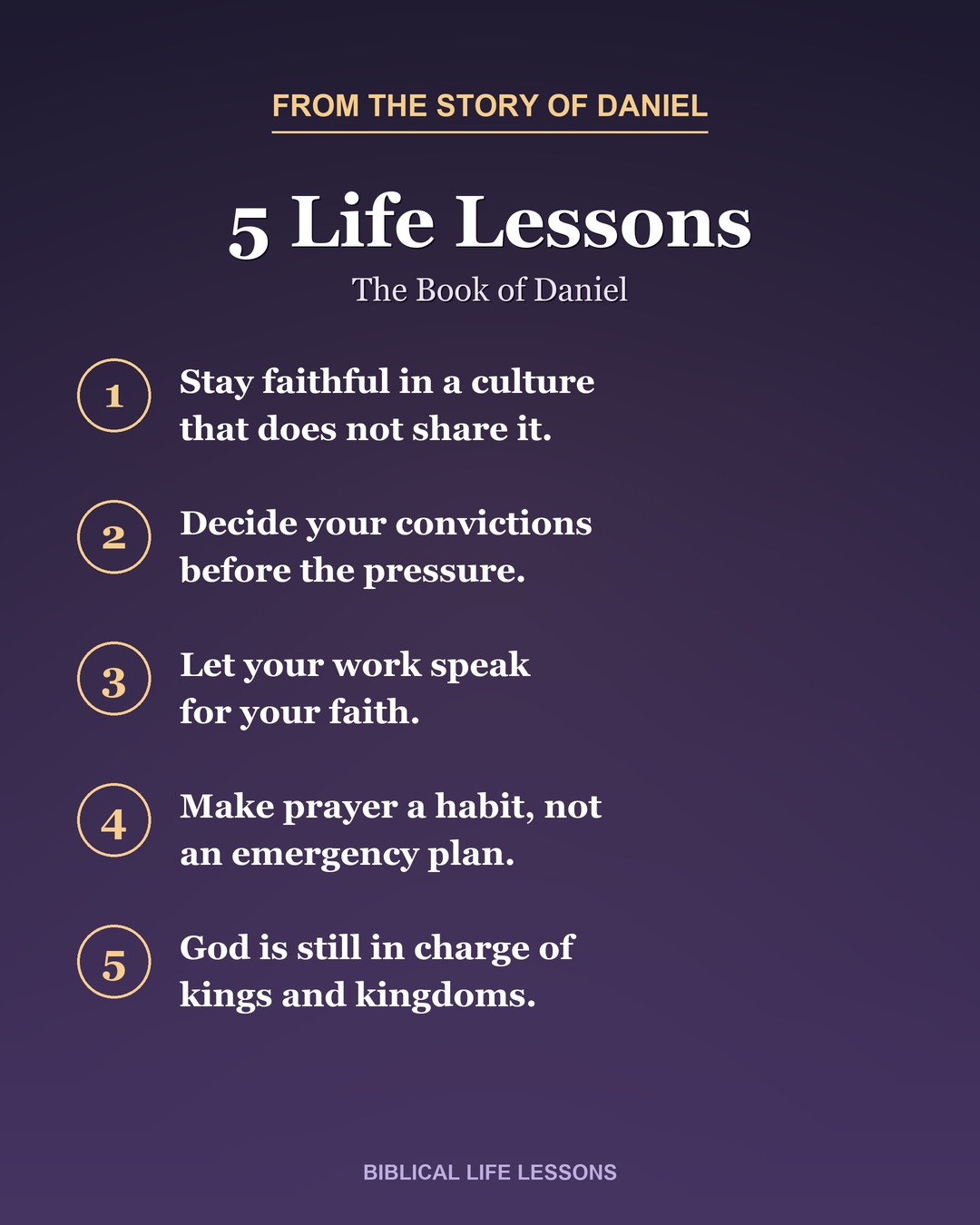
1. You can stay faithful in a culture that does not share your faith.
Daniel did not get to choose where he lived, what language he spoke, or what name he was called. He learned Babylon’s ways and served its kings well. But he never let Babylon have his heart. You may not be able to change your surroundings, but you can decide who you belong to in the middle of them.
2. Decide your convictions before the pressure comes.
Daniel “resolved” in advance. By the time the decree came about prayer, there was nothing left to decide. He simply did “just as he had done before.” The choices you settle in quiet seasons are the ones that will hold you up when the pressure is real.
3. Let your work speak for your faith.
Daniel’s enemies could find “no corruption in him.” He was trustworthy, diligent, and respected even by pagan kings. Honest, excellent work is one of the clearest ways to honor God in a place where people may never open a Bible.
4. Make prayer a habit, not an emergency plan.
When Daniel heard about the decree, he did not suddenly start praying. He kept praying, three times a day, as he always had. A lifetime of ordinary prayer is what made him ready for an extraordinary night. Start where you are, and keep a regular time with God.
5. God is still in charge of kings and kingdoms.
Babylon fell in one night. Proud kings were humbled. Through it all, Daniel’s confidence was in a God who “changes times and seasons” and “deposes kings and raises up others.” Whatever is happening in the world around you, the final kingdom belongs to God, and it will never be destroyed.
Frequently Asked Questions About Daniel
How old was Daniel in the lions’ den?
The Bible does not give his age. But Daniel was taken to Babylon as a young man around 605 BC, and the lions’ den happened after Babylon fell to the Medes and Persians in 539 BC. That means he was most likely in his eighties.
What did Daniel eat in Babylon?
Daniel and his friends asked for “nothing but vegetables to eat and water to drink” instead of the king’s food and wine (Daniel 1:12). This inspired what some people today call the “Daniel Fast.”
What was Daniel’s Babylonian name?
Daniel was given the name Belteshazzar (Daniel 1:7). His friends Hananiah, Mishael, and Azariah were renamed Shadrach, Meshach, and Abednego.
Was Daniel in the fiery furnace?
No. The fiery furnace story in Daniel 3 is about his three friends, Shadrach, Meshach, and Abednego. Daniel is not mentioned in that chapter.
What does “Mene, Mene, Tekel, Parsin” mean?
Daniel explained the words this way: God had numbered the days of Belshazzar’s reign and brought it to an end; the king had been weighed on the scales and found wanting; and his kingdom would be divided and given to the Medes and Persians (Daniel 5:26-28).
How many kings did Daniel serve?
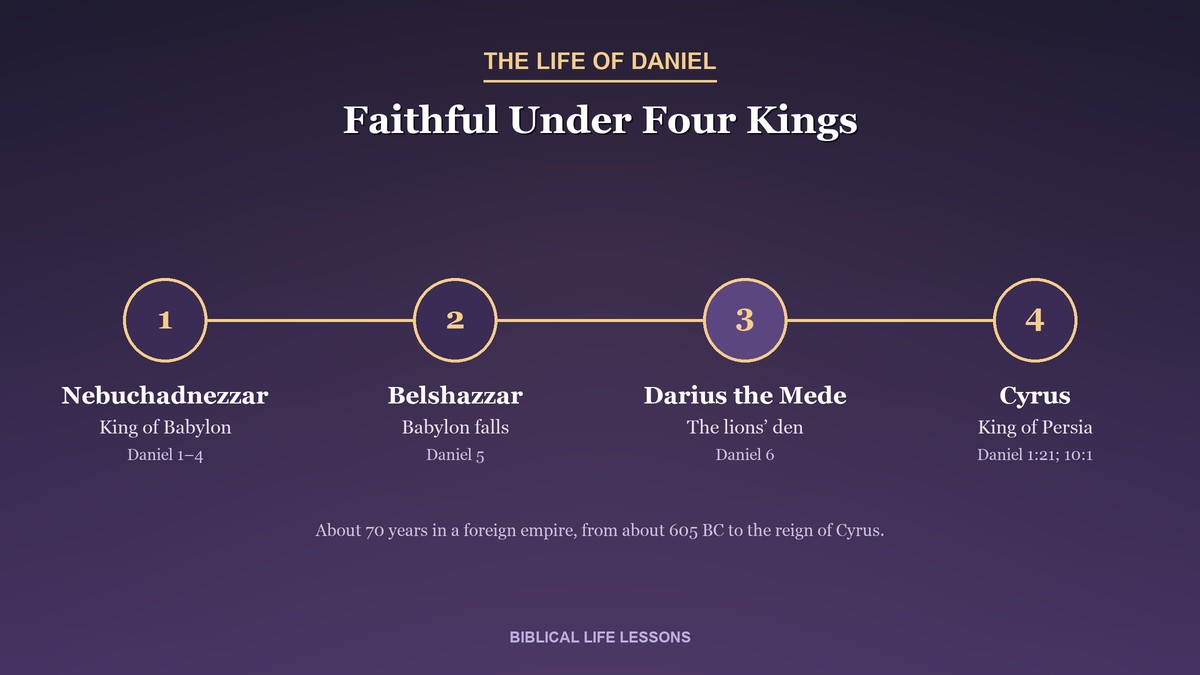
Daniel served under four kings named in his book: Nebuchadnezzar and Belshazzar of Babylon, Darius the Mede, and Cyrus of Persia. Daniel 1:21 says he remained in service “until the first year of King Cyrus.”
Is Daniel mentioned in the New Testament?
Yes. Jesus referred to “the prophet Daniel” in Matthew 24:15, and Hebrews 11:33 honors those who by faith “shut the mouths of lions.”
Related Reading
For a short devotional on Daniel’s courage under pressure, read How Did Daniel Stay Faithful When His Faith Became Illegal? For more on his three friends, see In the Midst of Flames: Lessons from Shadrach, Meshach, and Abednego. For the proud king Daniel served, read The King Who Bowed: Nebuchadnezzar’s Lesson in Surrender. For another young man who served faithfully in a foreign court and interpreted a king’s dreams, see Who Was Joseph in the Bible? For a woman who also risked everything in a Persian palace, read Who Was Esther in the Bible? For more courage from Scripture, see Standing Strong: Lessons in Courage from the Bible. For a wider guide to the men and women of Scripture, visit our Characters of the Bible pillar.
A Closing Prayer
Father, thank You for Daniel, and for his steady faithfulness in a place that did not know You. Help me to live the same way where You have placed me. Settle my convictions now, before the pressure comes. Let my work be honest and excellent, so that it points to You. Draw me into a habit of prayer that holds me up on ordinary days and on the hardest nights. When the world feels uncertain, remind me that You change times and seasons, and that Your kingdom will never be destroyed. Shut the mouths of the lions I am facing, and help me trust You through it all. In Jesus’ name, Amen.
Subscribe for Daily Email Devotionals
MEET FAITH FRIEND AI
Faith Friend is your friendly AI chatbot on BiblicalLifeLessons.com, here to help you explore the Bible, answer your faith-related questions, and guide you through life lessons based on God’s Word. Whether you’re seeking encouragement, understanding Scripture, or deepening your faith, Faith Friend is always ready to chat.