Who Was Samson in the Bible? The Complete Story of the Strongest Man in Scripture
Samson is the strongest man in the Bible, and one of its most troubling heroes. He tore apart a lion with his bare hands, struck down a thousand men with a donkey’s jawbone, and carried a city’s gates up a hill. Yet he could not master his own desires. His story ends with him blind, shackled, and grinding grain in an enemy prison. And it is there, at his very lowest, that he prays the most honest prayer of his life.
If you have searched for who Samson was in the Bible, or what his story teaches us today, this is a complete guide. We will walk through his miraculous birth, his Nazirite vow, the lion and the riddle, his battles with the Philistines, Delilah and the secret of his strength, his fall, his final prayer, and five practical life lessons his story still speaks into ours.
Who Was Samson in the Bible?
Samson was the last of the major judges of Israel, a son of Manoah from the tribe of Dan, born in the town of Zorah (Judges 13:2). He led Israel for twenty years during the time the Philistines ruled over them (Judges 15:20). His story is told in four chapters, Judges 13-16. His name is probably connected to the Hebrew word for “sun.”
“You will become pregnant and have a son whose head is never to be touched by a razor because the boy is to be a Nazirite, dedicated to God from the womb. He will take the lead in delivering Israel from the hands of the Philistines.” (Judges 13:5, NIV)
Three things stand out about him. He was set apart, called by God before he was born. He was gifted, empowered by the Spirit of the LORD with strength no one else had. And he was deeply flawed, ruled by anger and desire for most of his life. Few people in Scripture show so clearly the gap between what God gives us and what we do with it.
Israel in the Days of the Judges
Samson’s story opens with a familiar line: “Again the Israelites did evil in the eyes of the LORD, so the LORD delivered them into the hands of the Philistines for forty years” (Judges 13:1). The book of Judges follows a repeating cycle of sin, oppression, crying out, and rescue, and each time the pattern seems to grow darker. The book’s closing line sums up the era: “In those days Israel had no king; everyone did as they saw fit” (Judges 21:25).
The Philistines were a powerful people living along the southern coast of Canaan, in cities like Gaza and Ashkelon. By Samson’s day, Israel had grown so used to their rule that the people no longer seem to have cried out for deliverance at all. God raised up a deliverer anyway.
A Miraculous Birth (Judges 13)
Manoah’s wife, whose name the Bible never gives, was childless. The angel of the LORD appeared to her and told her she would have a son. Like Sarah, Rebekah, Rachel, and Hannah before her, she would receive a child only God could give.
When the angel returned, Manoah asked his name. “Why do you ask my name?” he replied. “It is beyond understanding” (Judges 13:18). Then, as Manoah offered a sacrifice, the angel went up to heaven in the flame. Manoah panicked: “We are doomed to die! We have seen God!” His wife calmly pointed out that if the LORD meant to kill them, He would not have accepted their offering or told them all this (Judges 13:22-23).
“The woman gave birth to a boy and named him Samson. He grew and the LORD blessed him, and the Spirit of the LORD began to stir him.” (Judges 13:24-25, NIV)
What Was the Nazirite Vow?
A Nazirite was a person specially set apart to God. According to Numbers 6, a Nazirite was to avoid wine and anything from the grapevine, never cut their hair, and stay away from dead bodies. The vow was usually taken for a limited time. Samson’s was different: God assigned it to him before birth, and it was meant to last his whole life.
This is the key to understanding him. Samson’s long hair was not a magic charm. It was the visible sign of a life dedicated to God. As his story unfolds, watch how he treats each part of that vow.
The Lion and the Riddle (Judges 14)
Samson’s first recorded words are a demand. He saw a Philistine woman in Timnah and told his parents, “Get her for me. She’s the right one for me” (Judges 14:3). His parents objected, but the text adds a surprising note: this “was from the LORD, who was seeking an occasion to confront the Philistines” (Judges 14:4). God was at work even through Samson’s stubborn choices, though that did not make those choices wise.
On the way to Timnah, a young lion came roaring at him. “The Spirit of the LORD came powerfully upon him so that he tore the lion apart with his bare hands as he might have torn a young goat” (Judges 14:6). Later he found bees and honey in the carcass, scooped some out, ate it, and gave some to his parents without telling them where it came from. A man vowed to keep away from dead bodies had just reached inside one for a snack.
At his wedding feast, he offered thirty Philistine companions a riddle with a wager of thirty sets of clothes: “Out of the eater, something to eat; out of the strong, something sweet” (Judges 14:14). They threatened his bride, who wept and pressed him for seven days until he told her the answer. When they solved it, Samson struck down thirty men in Ashkelon to pay the debt, and stormed home in anger. His bride was given to another man (Judges 14:19-20).
Foxes, Fire, and a Donkey’s Jawbone (Judges 15)
When Samson learned his wife had been given away, he caught three hundred foxes, tied them in pairs with torches between their tails, and released them into the Philistines’ grain fields, vineyards, and olive groves. The Philistines retaliated by burning his wife and her father to death. Samson answered by attacking them again. Each act of revenge only produced another.
Then the Philistines came looking for him in Judah. Rather than rally behind their deliverer, three thousand men of Judah went to hand him over: “Don’t you realize that the Philistines are rulers over us?” (Judges 15:11). Samson let them tie him with two new ropes. But when he reached Lehi, the Spirit of the LORD came on him, and the ropes fell away like charred flax.
“Finding a fresh jawbone of a donkey, he grabbed it and struck down a thousand men.” (Judges 15:15, NIV)
Afterward, exhausted and desperately thirsty, Samson called out to God for what appears to be the first time: “You have given your servant this great victory. Must I now die of thirst?” (Judges 15:18). God opened a hollow place in the ground and water came out. Samson’s strength returned. Even Israel’s strongest man could not survive a single day without God.
Samson and Delilah (Judges 16:1-20)
Judges 16 opens with Samson in Gaza, visiting a prostitute. When the men of the city lay in wait for him at the gate, he got up in the middle of the night, tore the city gates loose, posts and all, and carried them to the top of a hill. It was a stunning feat of strength, and it may have convinced him that his choices had no consequences.
Then “he fell in love with a woman in the Valley of Sorek whose name was Delilah” (Judges 16:4). Delilah is the only woman in Samson’s story whose name we are told. The Philistine rulers each offered her eleven hundred shekels of silver to discover the secret of his strength. Three times Samson gave her a false answer, and three times she tried it, then cried out that the Philistines were upon him.
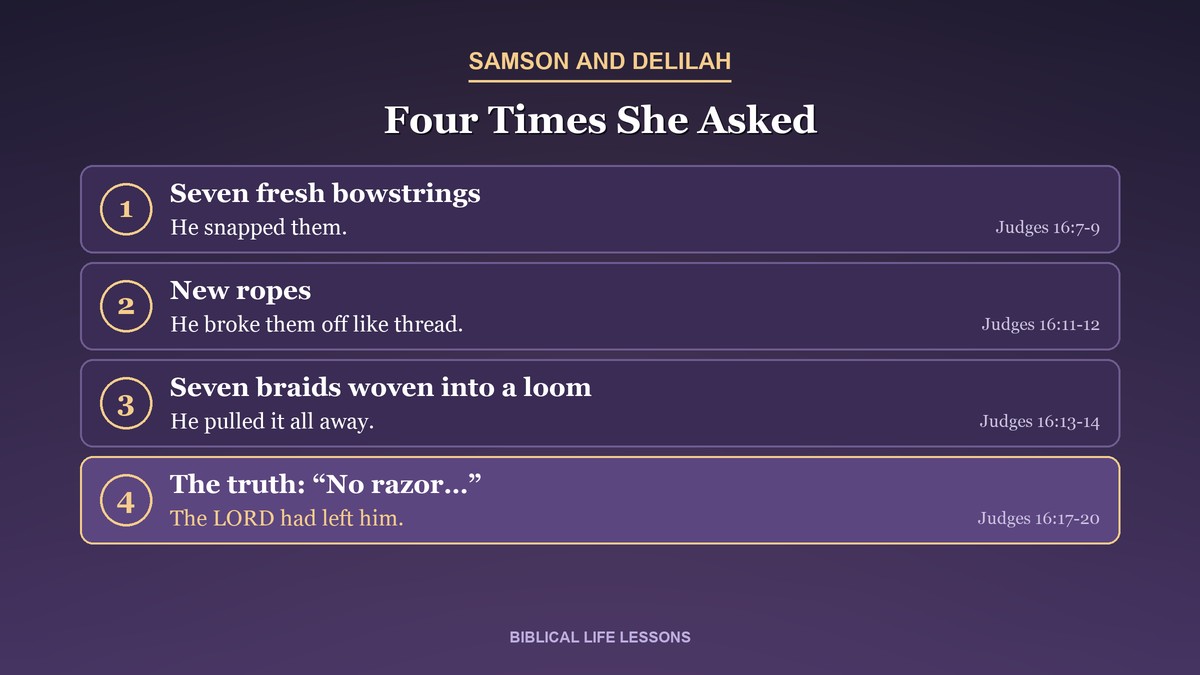
By this point the danger should have been obvious. Yet Delilah kept pressing: “How can you say, ‘I love you,’ when you won’t confide in me?” (Judges 16:15). Day after day she prodded him until “he was sick to death of it.” So he told her everything:
“No razor has ever been used on my head because I have been a Nazirite dedicated to God from my mother’s womb. If my head were shaved, my strength would leave me.” (Judges 16:17, NIV)
She lulled him to sleep on her lap and called for someone to shave off the seven braids of his hair. Then she cried out, “Samson, the Philistines are upon you!” He woke and thought he would shake himself free as before. Then comes one of the saddest lines in the Bible:
“But he did not know that the LORD had left him.” (Judges 16:20, NIV)
Blind and Grinding Grain (Judges 16:21-25)
The Philistines gouged out his eyes, took him down to Gaza, bound him in bronze shackles, and set him to grinding grain in the prison. The eyes that had led him astray were gone. The man who had carried away Gaza’s gates now ground grain inside its prison.
But the writer slips in one small sentence that changes everything:
“But the hair on his head began to grow again after it had been shaved.” (Judges 16:22, NIV)
The Philistines gathered in the temple of their god Dagon to celebrate: “Our god has delivered Samson, our enemy, into our hands” (Judges 16:23). In high spirits, they called for Samson to be brought out to entertain them. They had no idea they were watching the end of their own party take shape.
Samson’s Final Prayer and Death (Judges 16:26-31)
Samson asked the servant leading him by the hand to place him where he could feel the pillars supporting the temple. The building was packed, with about three thousand men and women on the roof alone. Then Samson prayed:
“Sovereign LORD, remember me. Please, God, strengthen me just once more, and let me with one blow get revenge on the Philistines for my two eyes.” (Judges 16:28, NIV)
Even now his motives were mixed, and his words mention his eyes rather than Israel’s freedom. But for the first time, Samson knew his strength did not belong to him. He braced himself against the two central pillars. “Let me die with the Philistines!” he said, and pushed with all his might. The temple came down on the rulers and everyone inside. “Thus he killed many more when he died than while he lived” (Judges 16:30).
His family came to carry his body home, and he was buried in the tomb of his father Manoah. God had promised that Samson would “take the lead” in delivering Israel, and that is exactly what he did. He began a work that would be carried on by Samuel and David.
Samson in the Hall of Faith
You might expect the New Testament to leave Samson out. Instead, Hebrews 11 names him among the heroes of faith, alongside Gideon, David, and Samuel (Hebrews 11:32). Together they are described as people “whose weakness was turned to strength” (Hebrews 11:34).
That does not excuse the way Samson lived. It does remind us that God’s list of faithful people is made up entirely of people who needed mercy. Samson’s life is not on the page because he was a good example. It is there because God is a faithful God.
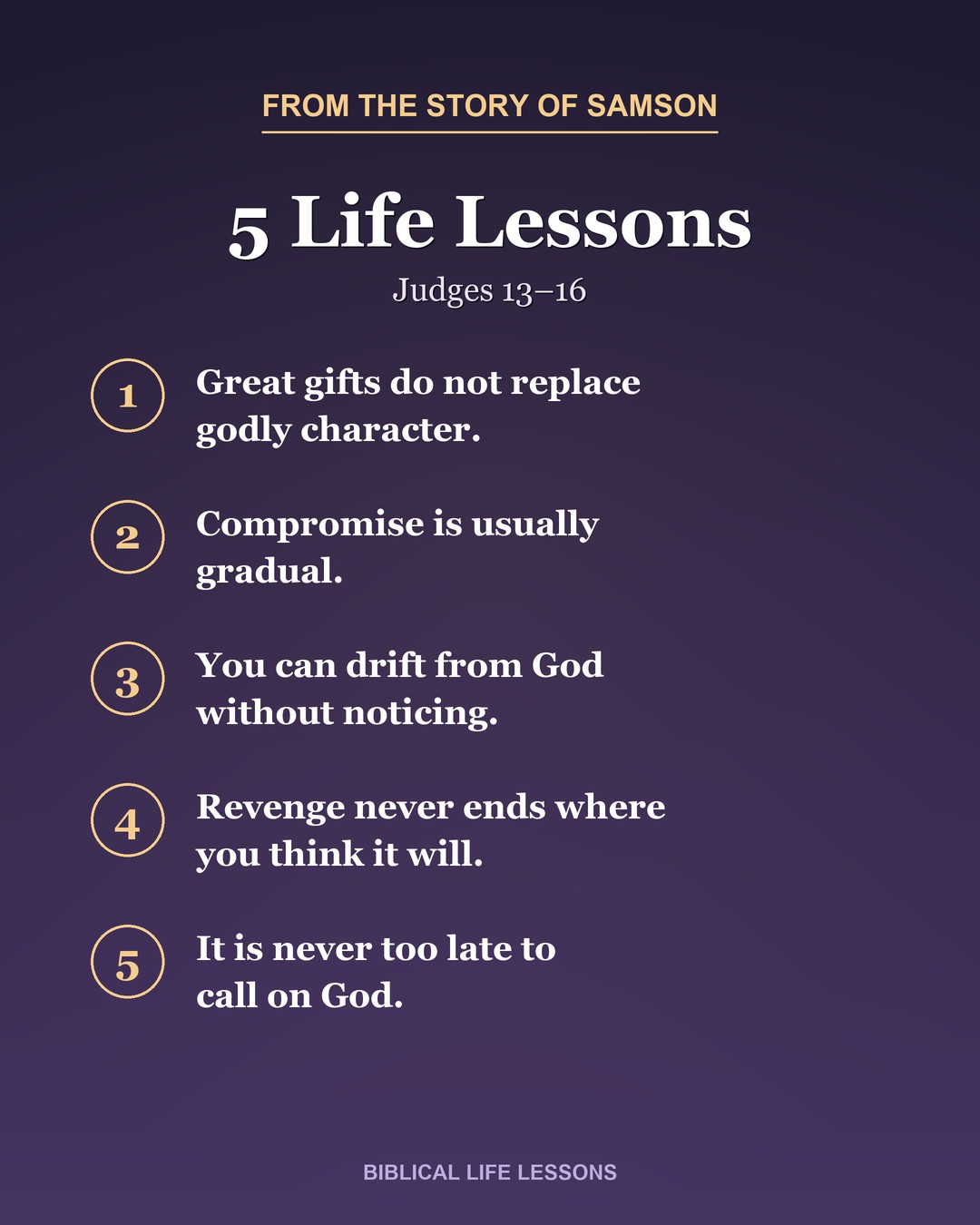
Five Life Lessons from Samson’s Story
1. Great gifts do not replace godly character.
Samson had more raw power than anyone in Israel and less self-control than almost anyone. Being gifted is not the same as being faithful. Talent, success, and even real spiritual fruit can hide a life that is quietly falling apart. Ask God to grow your character as carefully as you develop your gifts.
2. Compromise is usually gradual.
Samson did not lose everything in one night. He ate honey from a carcass, then held a feast, then visited Gaza, then played games with Delilah, and only then gave up his secret. Each step made the next one easier. The small compromise you are explaining away today may be the one that matters most. “Above all else, guard your heart, for everything you do flows from it” (Proverbs 4:23).
3. You can drift from God without noticing.
“He did not know that the LORD had left him.” Samson assumed tomorrow would be like yesterday because he had always escaped before. Past blessing is no proof of present closeness to God. Do not wait for a crisis to check where you stand with Him.
4. Revenge never ends where you think it will.
Samson’s story is a chain of retaliation: thirty men, three hundred foxes, a burned family, a thousand dead, and finally a collapsed temple that took his own life. Anger promised him satisfaction and delivered only more loss. If you are nursing a wrong, bring it to God before it starts to run your life.
5. It is never too late to call on God.
Samson’s hair began to grow again in prison, and his greatest moment of dependence on God came after his greatest failure. “Sovereign LORD, remember me” is a prayer anyone can pray, from any place, after any fall. Your failure does not have to be the last line of your story.
Frequently Asked Questions About Samson
Was Samson’s strength really in his hair?
Not exactly. His strength came from the Spirit of the LORD, who “came powerfully upon him” (Judges 14:6). His uncut hair was the sign of his Nazirite vow. When it was cut, the final part of that vow was broken, and the Bible says, “the LORD had left him” (Judges 16:20). The power was never in the hair itself. It was in the God he was dedicated to.
Who was Delilah in the Bible?
Delilah was a woman from the Valley of Sorek whom Samson loved. Philistine rulers paid her to discover the secret of his strength (Judges 16:4-5). Although she is often assumed to be a Philistine, the Bible does not state her nationality.
Did Delilah cut Samson’s hair?
Not according to the text. Judges 16:19 says she put him to sleep on her lap and “called for someone to shave off the seven braids of his hair.” Many paintings show Delilah holding the scissors, but the Bible says she called someone else to do it.
How did Samson die?
Samson died when he pushed down the two central pillars of the temple of Dagon in Gaza, bringing the building down on himself, the Philistine rulers, and the crowd (Judges 16:29-30).
How long did Samson lead Israel?
The Bible says Samson led Israel for twenty years “in the days of the Philistines” (Judges 15:20; 16:31).
Is Samson in the Hall of Faith?
Yes. Hebrews 11:32 mentions Samson by name along with Gideon, Barak, Jephthah, David, Samuel, and the prophets.
Where is Samson’s story in the Bible?
Samson’s story is told in Judges 13-16. It comes near the end of the book of Judges, just before the closing chapters that describe Israel’s moral collapse.
Related Reading
For another judge who felt anything but strong, see Who Was Gideon in the Bible? For the woman who led Israel with wisdom and courage in the same era, read Who Was Deborah in the Bible? For another mother who received a child dedicated to God from birth, see Who Was Hannah in the Bible? For a man God refused to give up on even after he ran, read Who Was Jonah in the Bible? For help resisting the pull that brought Samson down, see Overcoming Temptation: A Biblical Guide. For the truth that God’s power shows up in our weakness, read When I Am Weak, Then I Am Strong. For a wider guide to the men and women of Scripture, visit our Characters of the Bible pillar.
A Closing Prayer
Sovereign Lord, remember me. Thank You for Samson, and thank You that his failures were not the end of his story. Forgive me for the small compromises I have explained away. Keep me from trusting in my gifts or my past victories, and show me where I have drifted from You without noticing. Take the anger I have been holding and teach me to leave justice in Your hands. Where my life has fallen apart, let something new begin to grow again. Turn my weakness into strength, for my strength has only ever come from You. In Jesus’ name, Amen.
Subscribe for Daily Email Devotionals
MEET FAITH FRIEND AI
Faith Friend is your friendly AI chatbot on BiblicalLifeLessons.com, here to help you explore the Bible, answer your faith-related questions, and guide you through life lessons based on God’s Word. Whether you’re seeking encouragement, understanding Scripture, or deepening your faith, Faith Friend is always ready to chat.