What Hosea Teaches Us About God’s Relentless Love
Maybe you’ve wandered further than you ever meant to. It didn’t happen all at once—it rarely does. A skipped prayer here, a compromise there, a season of distance that quietly became a way of life. And now, when you think about coming back to God, there’s a voice that whispers you’ve used up your chances. That He’s tired of you. That whatever love He once had for you has been worn down by all the times you walked away. You wouldn’t say it out loud in church, but you carry it: the suspicion that you are more trouble than you are worth. If any part of you has ever wondered whether you’ve out-sinned God’s patience, please meet Hosea, who was told to love someone the way God loves us—and never stopped.
His marriage became a living picture of a love that refuses to let go.
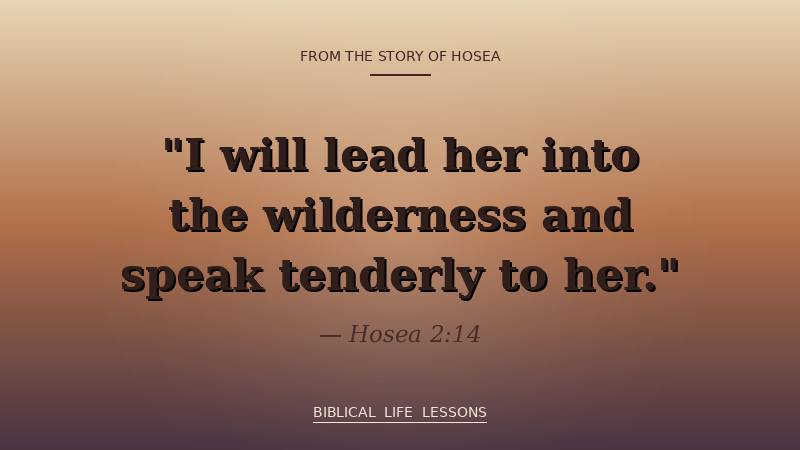
Scripture Focus: Hosea 2:14
“Therefore I am now going to allure her; I will lead her into the wilderness and speak tenderly to her.” (NIV)
Hosea was a prophet in the northern kingdom of Israel during the eighth century BC, a time of prosperity on the surface and rot underneath. Israel had chased other gods the way an unfaithful spouse chases other lovers. So God asked Hosea to do something almost unbearable: marry Gomer, a woman who would be unfaithful to him, and keep loving her through it. Their marriage became a sermon the whole nation could see. By chapter 2, Gomer has left. Israel has left. Every human instinct says the next word should be “divorce.” Instead, God says “therefore”—and what follows is not a sentence of abandonment but a plan of pursuit. He will go after her. He will lead her somewhere quiet. And He will speak, of all things, tenderly.
Three Things Hosea Teaches Us About God’s Relentless Love
1. God’s love pursues you at your worst, not your best.
Notice when God says “I am now going to allure her.” Not after Gomer cleaned herself up. Not after she proved she’d changed. The pursuit begins while she is still gone. That is the scandal at the heart of Hosea, and it is the scandal at the heart of the gospel: God does not wait at the edge of your failure with crossed arms, expecting you to crawl back and earn re-entry. He comes looking. Centuries later, Paul would put it plainly—while we were still sinners, Christ died for us. The distance you feel from God right now is not evidence that He has given up on you. It may be the very place He intends to meet you. You do not have to become lovable before God will love you. You have to stop running long enough to notice He has been following you the whole time.
A simple prayer: “Lord, I stopped running—come find me here.”
2. The wilderness is not your punishment—it may be His pursuit.
God says He will lead her “into the wilderness”—and speak tenderly to her there. That should stop us. The wilderness is the last place we expect tenderness. It is the season of loss, the stripped-down year, the silence after everything loud fell apart. We usually read those seasons as proof that God is angry with us. But in Hosea, the wilderness is where the noise of every rival lover finally dies down and Gomer can hear her husband’s voice again. Some of what you have interpreted as God’s absence may actually be His severe mercy—removing the things you were depending on instead of Him, so that His voice is the only one left in the room. If you are in a bare season right now, do not assume you have been discarded. Listen. Tender words are often spoken in empty places.
3. His love pays the price to bring you home.
In chapter 3, the story reaches its costliest moment. Gomer has fallen so far that she is up for sale, and God tells Hosea: “Go, show your love to your wife again.” So Hosea goes to the market and buys back his own wife—fifteen shekels of silver and some barley (Hosea 3:2). He pays for what was already his. Let that settle: love that pursues will eventually be love that pays. Hosea’s silver points forward to a hill outside Jerusalem, where God did not send a prophet to redeem His people but came Himself, and the price was not silver but blood. You were not welcomed back on a technicality. You were purchased—deliberately, at full cost, by Someone who knew exactly what He was buying and wanted you anyway. Whatever your failure has cost you, it did not exceed what He was willing to pay.
Practical Steps to Take Today
- Name the thing you’ve been hiding from God. Say it out loud in prayer today—not to inform Him, but to stop pretending with Him. Pursued people don’t need polished words.
- Read Hosea 2:14–23 slowly, twice. The first time, read it as Israel’s story. The second time, put your own name where Israel’s is and let the promises land on you.
- Reinterpret one wilderness in your life. Take a season you’ve labeled “God punishing me” and ask instead: what was He quieting so I could hear Him? Write down one thing that season taught you.
- Come back to one abandoned practice. Not all of them—one. The morning prayer, the open Bible, the church you drifted from. Returning starts with a single step in the opposite direction.
- Extend the love you’ve received. Think of one person you’ve written off as too far gone, and reach out this week. People loved like Gomer learn to love like Hosea.
Reflection Questions
- Where in your life have you been assuming God’s patience has run out—and what would change if you believed He was pursuing you there instead?
- Looking back on your hardest season, can you find any moment where God was speaking tenderly rather than punishing? What did He strip away, and what did He say?
- Hosea paid to redeem someone who had broken his heart. Who has God placed in your life that He may be asking you to keep loving past the point where it feels deserved?
A Closing Prayer
Father, I have been living as though Your love ran out somewhere behind me. I believed the whisper that said I had wandered too far, failed too often, stayed away too long. But Hosea tells me the truth about You: You pursue. You come after the one who left. You speak tenderly in the very wilderness I mistook for rejection. So here I am, Lord—not cleaned up, not impressive, just found. Thank You that You paid for me when I was at my lowest price. Teach me to stop running, to hear Your voice in the quiet places, and to love the people around me with even a fraction of the stubborn, costly love You have shown me. Bring me all the way home. In Jesus’ name, Amen.
Subscribe for Daily Email Devotionals
Subscribe for Daily Email Devotionals
MEET FAITH FRIEND AI
Faith Friend is your friendly AI chatbot on BiblicalLifeLessons.com, here to help you explore the Bible, answer your faith-related questions, and guide you through life lessons based on God’s Word. Whether you’re seeking encouragement, understanding Scripture, or deepening your faith, Faith Friend is always ready to chat.