Who Was Moses in the Bible? The Complete Story from the Nile to Mount Nebo
Moses is one of the most important people in the entire Bible. He was born under a death sentence, raised in Pharaoh’s palace, and spent forty years as a shepherd in the desert before God spoke to him from a burning bush. He confronted the most powerful king on earth, led a nation of slaves through the Red Sea, received the Ten Commandments, and guided a stubborn people through the wilderness for forty more years. Yet he began his calling by asking God to send someone else.
If you have searched for who Moses was in the Bible, or what his story teaches us today, this is a complete guide. We will walk through his birth, his years in Egypt and Midian, the burning bush, the plagues, the Passover and the Red Sea, Mount Sinai, the golden calf, the wilderness years, why he never entered the promised land, how his life points to Jesus, and five practical life lessons his story still speaks into ours.
Who Was Moses in the Bible?
Moses was a Hebrew prophet, leader, and lawgiver from the tribe of Levi. His parents were Amram and Jochebed, and his older siblings were Aaron and Miriam (Exodus 6:20; Numbers 26:59). God used him to lead the Israelites out of slavery in Egypt and to give them His law at Mount Sinai. His story fills the books of Exodus, Leviticus, Numbers, and Deuteronomy.
“Since then, no prophet has risen in Israel like Moses, whom the LORD knew face to face.” (Deuteronomy 34:10, NIV)
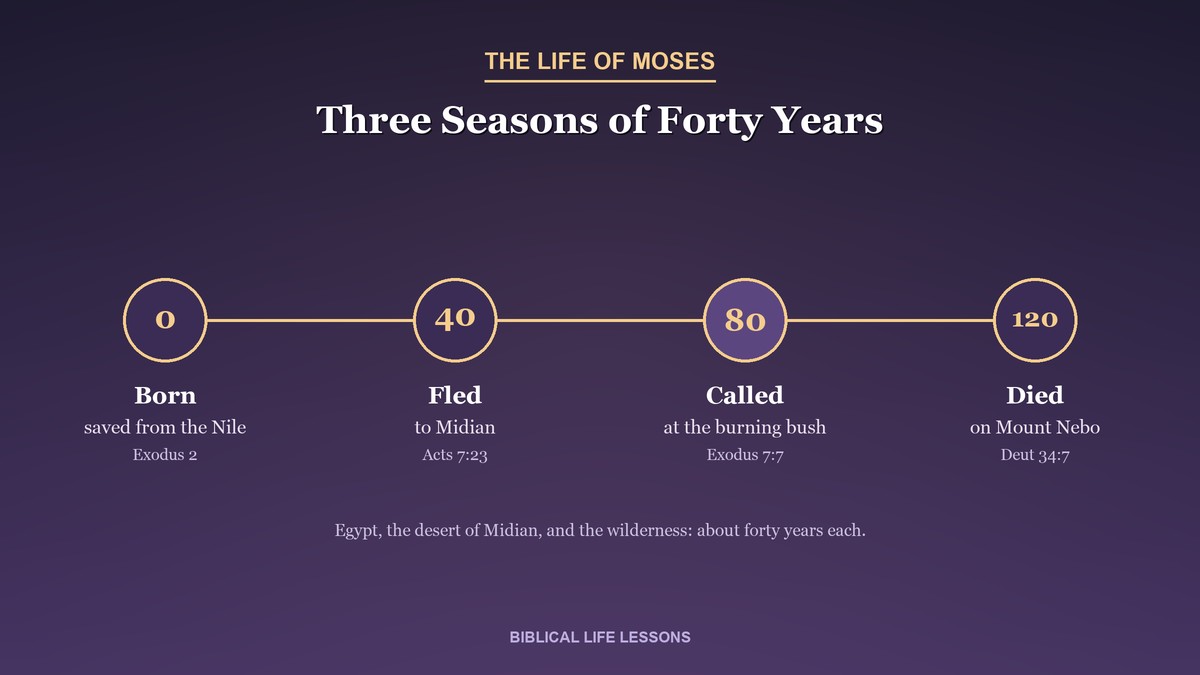
Three things stand out about him. He was reluctant, convinced he was the wrong person for the job. He was humble, described as “more humble than anyone else on the face of the earth” (Numbers 12:3). And he was close to God, who spoke with him “face to face, as one speaks to a friend” (Exodus 33:11). His life of 120 years falls into three seasons of about forty years each.
Born Under Pharaoh’s Decree (Exodus 1-2:10)
Generations after Joseph, “a new king, to whom Joseph meant nothing, came to power in Egypt” (Exodus 1:8). Afraid of how many Israelites there were, he made them slaves. When that did not slow their growth, he gave a terrible order: every Hebrew baby boy was to be thrown into the Nile (Exodus 1:22).
When Moses was born, his mother hid him for three months. When she could hide him no longer, she coated a papyrus basket with tar, placed him inside, and set it among the reeds along the Nile, while his sister watched from a distance. Pharaoh’s own daughter came down to bathe, found the crying baby, and felt sorry for him. His sister bravely offered to find a Hebrew nurse, and brought back the baby’s own mother.
When the child grew older, he was brought to Pharaoh’s daughter and became her son. “She named him Moses, saying, ‘I drew him out of the water'” (Exodus 2:10). The river that was meant to kill him became the place where God saved him.
From Prince to Fugitive (Exodus 2:11-25)
Moses grew up in the palace and “was educated in all the wisdom of the Egyptians” (Acts 7:22). But he never forgot who his people were. At about forty, he saw an Egyptian beating a Hebrew slave. He looked around, killed the Egyptian, and hid the body in the sand.
The next day, when he tried to stop two Hebrews from fighting, one of them shot back, “Who made you ruler and judge over us? Are you thinking of killing me as you killed the Egyptian?” (Exodus 2:14). Moses realized his secret was out. Pharaoh tried to kill him, and Moses fled to the land of Midian.
There he defended seven sisters at a well, was welcomed into the home of their father, a priest named Jethro (also called Reuel), and married one of them, Zipporah. He named his son Gershom, saying, “I have become a foreigner in a foreign land” (Exodus 2:22). The prince of Egypt spent the next forty years looking after another man’s sheep.
The Burning Bush (Exodus 3-4)
One day, near Horeb, the mountain of God, Moses saw something strange: a bush on fire that did not burn up. When he went over to look, God called to him from within the bush: “Take off your sandals, for the place where you are standing is holy ground” (Exodus 3:5).
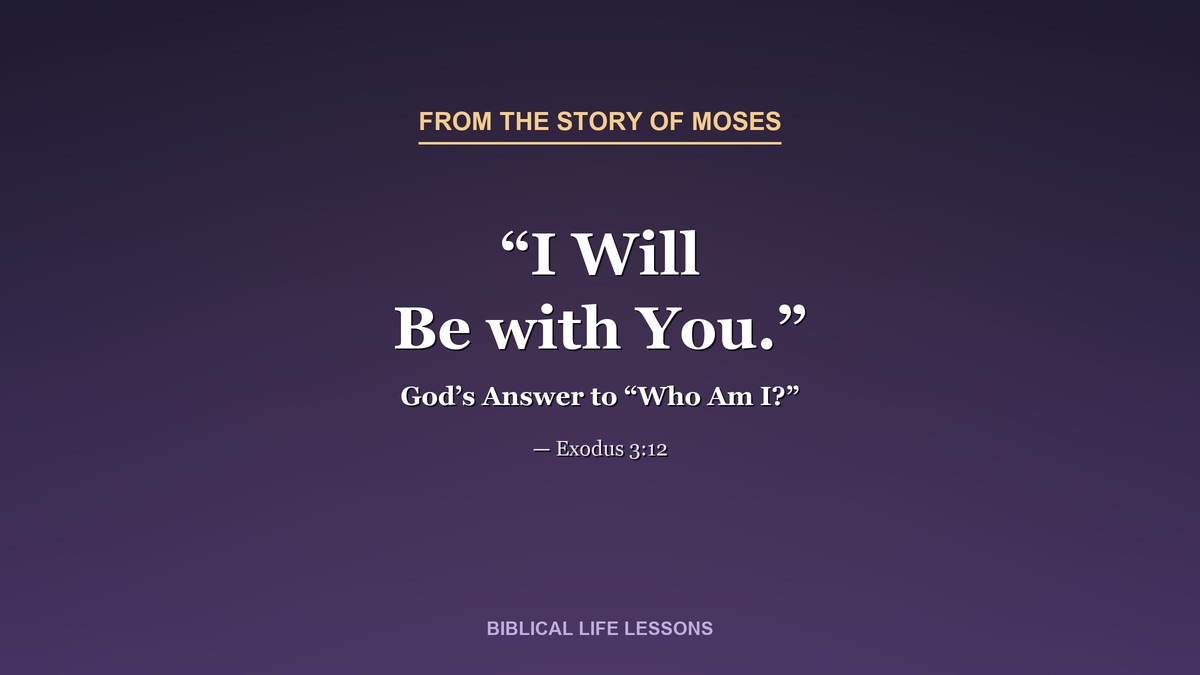
God told Moses He had seen the misery of His people and heard their cry, and He was sending Moses to Pharaoh to bring them out. Moses’ first answer was a question: “Who am I that I should go to Pharaoh?” (Exodus 3:11). God’s answer did not focus on Moses at all:
“And God said, ‘I will be with you.'” (Exodus 3:12, NIV)
Moses kept pushing back. What if they ask Your name? God answered, “I AM WHO I AM” (Exodus 3:14). What if they do not believe me? God gave him signs: a staff that turned into a snake, and a hand that turned leprous and was healed. What about my speech? “I am slow of speech and tongue” (Exodus 4:10). God replied, “Who gave human beings their mouths? … Now go; I will help you speak and will teach you what to say” (Exodus 4:11-12). Finally Moses said what he really meant: “Please send someone else” (Exodus 4:13). God sent his brother Aaron to go with him, but He did not let Moses off.
“Let My People Go” (Exodus 5-11)
Moses and Aaron went to Pharaoh with God’s message: “Let my people go” (Exodus 5:1). Pharaoh answered with contempt: “Who is the LORD, that I should obey him and let Israel go?” (Exodus 5:2). Then he made the Israelites’ work harder, forcing them to gather their own straw for bricks. The people blamed Moses, and Moses brought his discouragement straight to God.
What followed were the ten plagues: the Nile turned to blood, then frogs, gnats, flies, the death of livestock, boils, hail, locusts, and darkness. Again and again Pharaoh promised to let the people go, and again and again he hardened his heart. Each plague showed that the gods of Egypt had no power before the LORD.
The Passover and the Red Sea (Exodus 12-15)
The tenth plague was the most terrible: the death of every firstborn in Egypt. God told each Israelite family to sacrifice a lamb and put its blood on their doorframes. “When I see the blood, I will pass over you” (Exodus 12:13). That night, the Passover, Pharaoh finally let them go. Israel still remembers it every year.
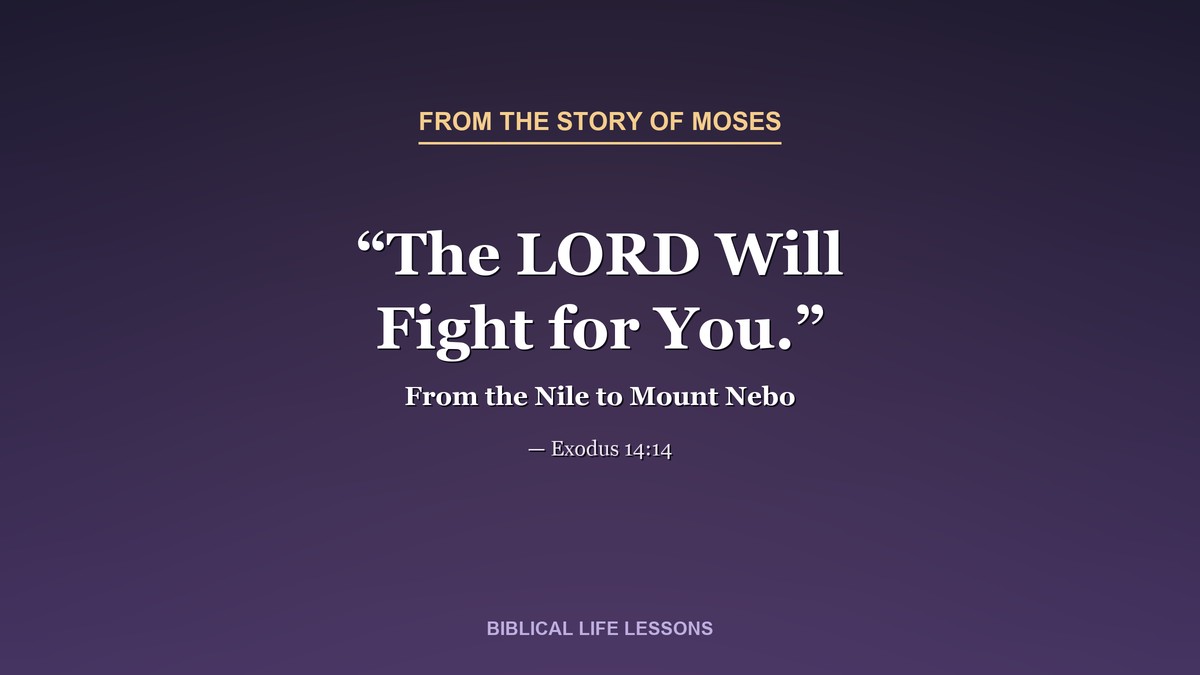
But Pharaoh changed his mind and sent his chariots after them. The Israelites found themselves trapped between the army and the sea, and they panicked. Moses answered:
“Do not be afraid. Stand firm and you will see the deliverance the LORD will bring you today. … The LORD will fight for you; you need only to be still.” (Exodus 14:13-14, NIV)
Moses stretched out his hand, and God drove the sea back with a strong east wind. The Israelites walked through on dry ground, with a wall of water on either side. When the Egyptians followed, the waters returned. On the far shore, Moses and Miriam led the people in a song of praise (Exodus 15).
Leading a Restless People (Exodus 15-18)
Freedom did not make the Israelites easy to lead. Within days they were complaining about bitter water, then about food. God provided sweet water, then manna from heaven each morning and quail in the evening, then water from a rock. When the Amalekites attacked, Israel won as long as Moses held up his hands. When he grew tired, Aaron and Hur held his arms up until sunset (Exodus 17:11-12).
Moses tried to settle every dispute among the people himself, from morning until evening. His father-in-law Jethro saw it and said plainly, “What you are doing is not good. … The work is too heavy for you; you cannot handle it alone” (Exodus 18:17-18). Moses listened, and appointed capable leaders to share the load.
Mount Sinai and the Golden Calf (Exodus 19-34)
At Mount Sinai, God came down in fire, smoke, and thunder, and gave His people the Ten Commandments and the rest of His law. Moses went up the mountain and stayed there forty days and forty nights.
While he was gone, the people grew impatient and persuaded Aaron to make a golden calf, and they worshiped it. When God said He would destroy them, Moses pleaded for them, even offering his own place in God’s book: “Please forgive their sin, but if not, then blot me out of the book you have written” (Exodus 32:32). Then he went down, saw the people dancing around the calf, and in anger threw down the stone tablets and broke them.
After this crisis, Moses asked for the one thing he could not do without: “If your Presence does not go with us, do not send us up from here” (Exodus 33:15). He even asked, “Now show me your glory” (Exodus 33:18). God passed by and proclaimed His name: “The LORD, the LORD, the compassionate and gracious God, slow to anger, abounding in love and faithfulness” (Exodus 34:6). When Moses came down with new tablets, his face was shining because he had spoken with the LORD.
Forty Years in the Wilderness (Numbers)
When Israel reached the edge of the promised land, Moses sent twelve spies to explore it. Ten came back terrified of the people living there; only Joshua and Caleb trusted God. The people refused to go in, and God declared that this generation would wander in the wilderness for forty years (Numbers 14).
Those years were full of complaints, rebellions, and even opposition from Moses’ own brother and sister. When snakes struck the people, God told Moses to make a bronze snake and lift it up on a pole, and anyone who looked at it lived (Numbers 21:8-9). Through it all, Moses kept carrying the people to God in prayer.
Why Moses Never Entered the Promised Land (Numbers 20; Deuteronomy 34)
Near the end of the journey, the people were again without water. God told Moses to speak to a rock, and water would come out. Instead, frustrated and angry, Moses said, “Listen, you rebels, must we bring you water out of this rock?” and struck it twice with his staff (Numbers 20:10-11). Water still came out. But God said, “Because you did not trust in me enough to honor me as holy in the sight of the Israelites, you will not bring this community into the land I give them” (Numbers 20:12).
Before he died, Moses gave a series of farewell speeches that make up the book of Deuteronomy, and commissioned Joshua to lead the people. Then he climbed Mount Nebo, and God showed him the whole promised land. “I have let you see it with your eyes, but you will not cross over into it” (Deuteronomy 34:4). Moses died there at 120 years old, “yet his eyes were not weak nor his strength gone” (Deuteronomy 34:7). God Himself buried him, and “to this day no one knows where his grave is” (Deuteronomy 34:6).
Centuries later, Moses did stand in the promised land. On the mountain where Jesus was transfigured, Moses and Elijah appeared and spoke with Him (Matthew 17:3).
How Moses Points to Jesus
Moses himself told Israel that God would one day raise up “a prophet like me” (Deuteronomy 18:15), and the New Testament sees that promise fulfilled in Jesus. Both were threatened as infants by a ruler who killed baby boys. Both stood between God and a sinful people. Jesus said that just as Moses lifted up the snake in the wilderness, “so the Son of Man must be lifted up, that everyone who believes may have eternal life in him” (John 3:14-15). And the Passover lamb pointed to Jesus, the Lamb of God whose blood rescues His people. As John puts it, “the law was given through Moses; grace and truth came through Jesus Christ” (John 1:17).
Five Life Lessons from Moses’ Story
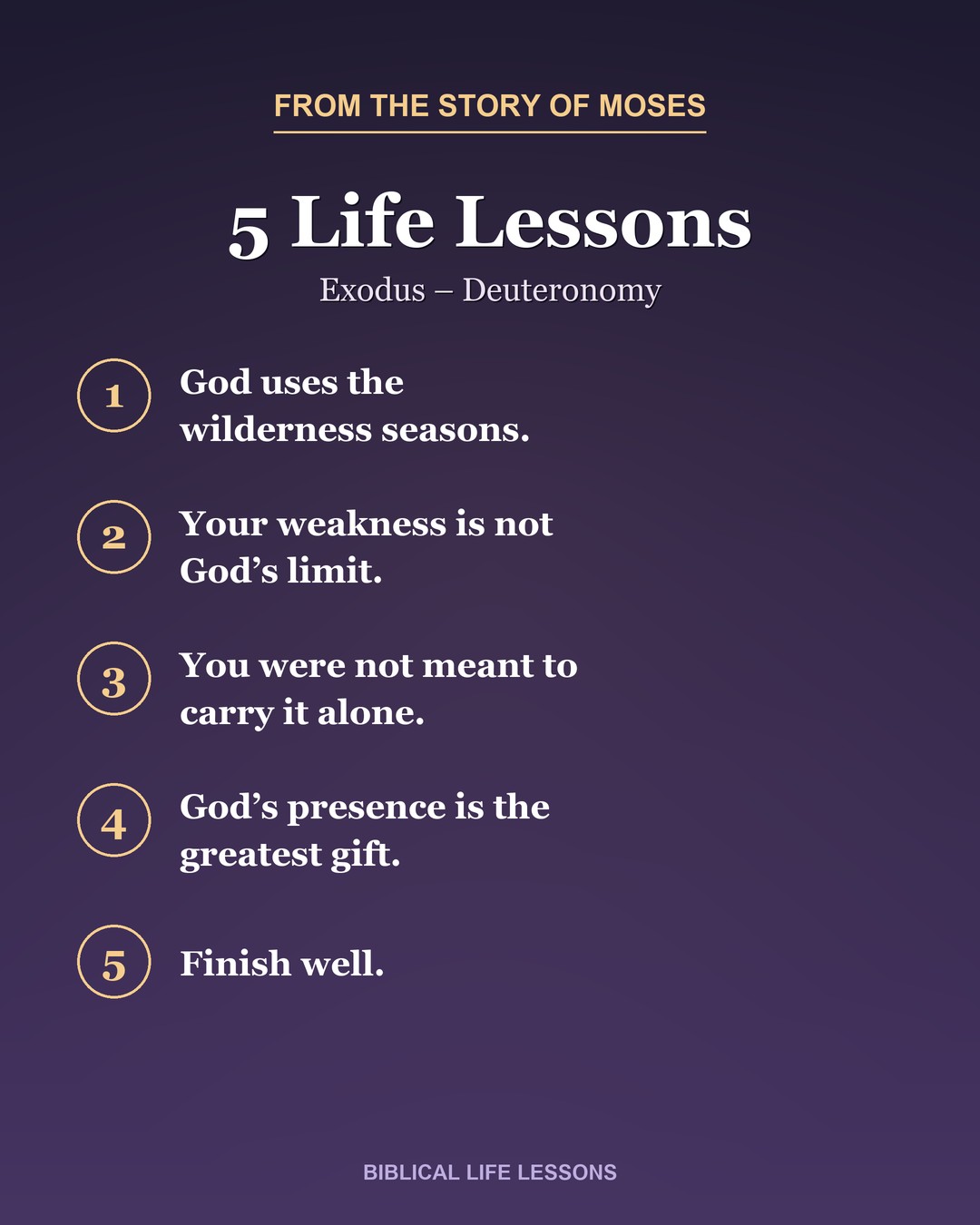
1. God uses the wilderness seasons.
Moses spent forty years in the desert tending sheep, and it probably felt like his life was over. In fact, God was preparing him to lead a nation through that very desert. A quiet, hidden season is not wasted when God is in it.
2. Your weakness is not God’s limit.
“Who am I?” Moses asked. God answered, “I will be with you.” Moses had real weaknesses, and God never pretended otherwise. But the call did not depend on Moses’ ability. It depended on God’s presence. Whatever you feel unqualified for, the question is not who you are, but who goes with you.
3. You were not meant to carry it alone.
Aaron and Hur held up Moses’ arms. Jethro told him the work was too heavy for one person. Even the greatest leader in Israel needed help, and he was wise enough to accept it. Let the people God has placed around you share the load.
4. God’s presence is the greatest gift.
Moses would rather stay in the desert with God than enter the promised land without Him: “If your Presence does not go with us, do not send us up from here.” The goal of the Christian life is not only to reach the right destination, but to walk with God all the way there.
5. Finish well.
One moment of anger at the end of a long and faithful life cost Moses the promised land. Obedience matters in every season, including the last one. Yet even then, God showed him the land, buried him with His own hands, and later brought him to stand beside Jesus. God’s grace has the final word.
Frequently Asked Questions About Moses
How old was Moses when he died?
Moses was 120 years old when he died on Mount Nebo (Deuteronomy 34:7). His life is often described in three seasons of about forty years: in Egypt, in Midian, and in the wilderness (Acts 7:23, 30; Exodus 7:7).
Why couldn’t Moses enter the promised land?
Because at Meribah he struck the rock instead of speaking to it as God commanded, and spoke in anger to the people. God said he had not trusted Him enough to honor Him as holy before the Israelites (Numbers 20:12).
Who were Moses’ parents and siblings?
His parents were Amram and Jochebed, from the tribe of Levi. His brother was Aaron, Israel’s first high priest, and his sister was Miriam, a prophet (Exodus 6:20; Numbers 26:59).
Who was Moses’ wife?
Moses married Zipporah, the daughter of Jethro, a priest of Midian (Exodus 2:21). Their sons were Gershom and Eliezer (Exodus 18:3-4).
What were the ten plagues of Egypt?
Water turned to blood, frogs, gnats, flies, the death of livestock, boils, hail, locusts, darkness, and the death of the firstborn (Exodus 7-12).
Where is Moses buried?
Moses was buried in a valley in Moab, opposite Beth Peor, but “to this day no one knows where his grave is” (Deuteronomy 34:6).
Did Moses write the first five books of the Bible?
Jewish and Christian tradition has long credited Moses with the first five books of the Bible, often called the Law of Moses or the Torah, and Jesus spoke of what “Moses wrote” (John 5:46). Some parts, such as the account of his own death, were clearly added by someone else.
Related Reading
For a short devotional on Moses’ calling, read What Moses Teaches Us About Saying Yes When You Feel Unqualified. For the moment it all began, see Moses and the Burning Bush. To meet the brother who stood beside him, read Who Was Aaron in the Bible? and for the sister who watched over him, see 5 Powerful Life Lessons from Miriam. For the night the sea opened, read The Red Sea Crossing: Trusting God in Impossible Situations. For the man who led Israel after him, see Who Was Joshua in the Bible? For a wider guide to the men and women of Scripture, visit our Characters of the Bible pillar.
A Closing Prayer
Father, thank You for Moses, and for the way You called a reluctant shepherd to set Your people free. When I ask, “Who am I?”, remind me that You have promised to be with me. Use my wilderness seasons to shape me, and give me the humility to accept help when the load is too heavy. More than any blessing, I want Your presence; do not send me anywhere without You. Help me to trust You and honor You to the very end. Thank You for Jesus, the true Passover Lamb, who leads me out of slavery into freedom. In His name, Amen.
Subscribe for Daily Email Devotionals
MEET FAITH FRIEND AI
Faith Friend is your friendly AI chatbot on BiblicalLifeLessons.com, here to help you explore the Bible, answer your faith-related questions, and guide you through life lessons based on God’s Word. Whether you’re seeking encouragement, understanding Scripture, or deepening your faith, Faith Friend is always ready to chat.