Who Was Gideon in the Bible? The Complete Story of the Reluctant Judge (Judges 6-8)
Gideon is one of the most relatable heroes in the Old Testament. When we first meet him, he is hiding — threshing wheat in a winepress so the enemy will not see him. He questions God, asks for sign after sign, and describes himself as the least person in the weakest clan in Israel. Yet God called him “mighty warrior,” and with just three hundred men, Gideon defeated an army that covered the valley like locusts.
If you have searched for who Gideon was in the Bible, or what his story teaches us today, this is a complete guide. We will walk through the oppression of the Midianites, Gideon’s surprising call, the altar he tore down at night, the famous fleece, God’s reduction of his army from 32,000 to 300, the battle with trumpets and torches, the sad ending of his story, and five practical life lessons his story still speaks into ours.
Prefer to watch? Here is Gideon’s story as a short animated devotional, with Scripture, reflection, and a closing prayer.
Who Was Gideon in the Bible?
Gideon was one of the judges of Israel — leaders God raised up to rescue His people in the centuries between Joshua and the kings. He was the son of Joash, from the clan of Abiezer in the tribe of Manasseh, and lived in the town of Ophrah. God used him to deliver Israel from seven years of Midianite oppression. His story is told in Judges 6-8.
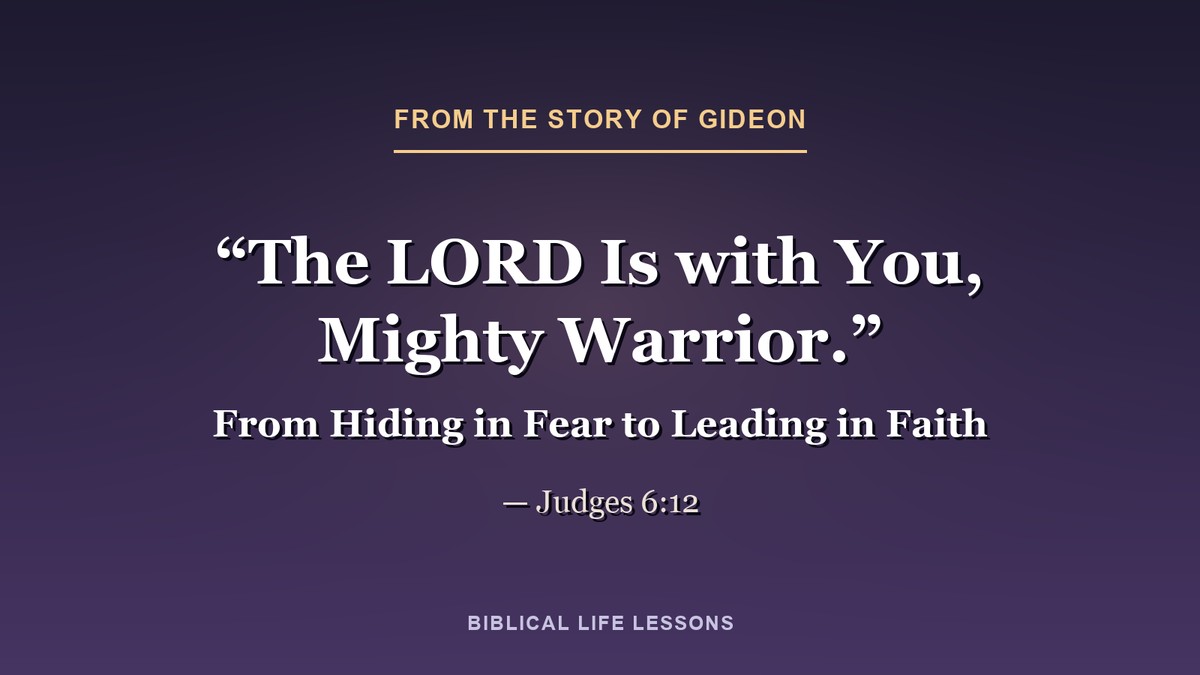
“When the angel of the LORD appeared to Gideon, he said, ‘The LORD is with you, mighty warrior.'” (Judges 6:12, NIV)
Three things stand out about him. He was afraid — he hid, worked at night, and asked for repeated signs. He was called — God saw a mighty warrior where Gideon saw only weakness. And he was used — not because of his strength, but because God chose to show His own power through someone weak.
The Background: Seven Years of Oppression (Judges 6:1-10)
The book of Judges follows a repeating cycle: Israel turns away from God, falls under enemy oppression, cries out for help, and God raises up a deliverer. Gideon’s story begins the same way. “The Israelites did evil in the eyes of the LORD, and for seven years he gave them into the hands of the Midianites” (Judges 6:1).
The oppression was crushing. The Midianites and their allies swept in every harvest season “like swarms of locusts,” with camels too many to count, destroying crops and livestock (Judges 6:5). The Israelites were driven to hide in mountain caves and strongholds. Finally, impoverished and desperate, they cried out to the LORD (Judges 6:6).
Before sending a deliverer, God sent a prophet to remind Israel why this was happening: He had rescued them from Egypt and told them not to worship the gods of the Amorites — “But you have not listened to me” (Judges 6:10).
“Mighty Warrior” in a Winepress (Judges 6:11-24)
Then the angel of the LORD came to Ophrah, where Gideon “was threshing wheat in a winepress to keep it from the Midianites” (Judges 6:11). Wheat was normally threshed in an open, windy place. Gideon was doing it in a pit, hidden from view. It is a picture of fear and survival. And it was there, in his hiding place, that God greeted him as “mighty warrior.”
Gideon’s response was honest — even blunt: “Pardon me, my lord, but if the LORD is with us, why has all this happened to us? Where are all his wonders that our ancestors told us about?” (Judges 6:13).
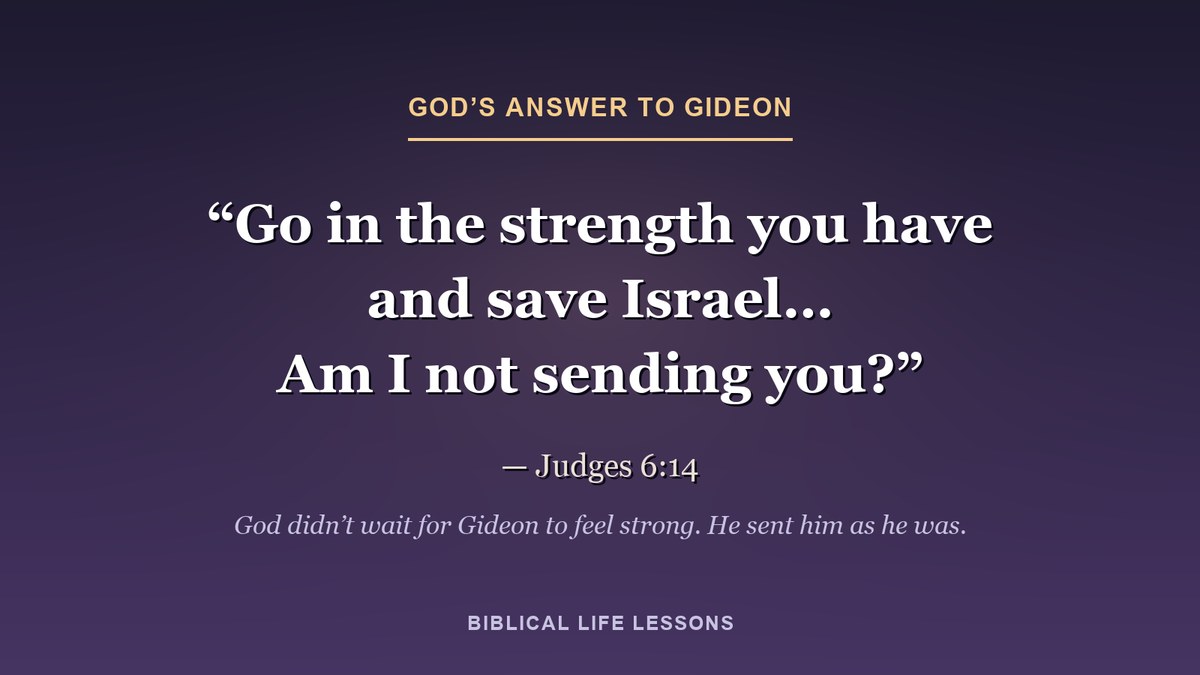
God did not argue. He simply sent him: “Go in the strength you have and save Israel out of Midian’s hand. Am I not sending you?” (Judges 6:14). Gideon protested again: “How can I save Israel? My clan is the weakest in Manasseh, and I am the least in my family” (Judges 6:15). And God answered with the promise that changes everything: “I will be with you, and you will strike down all the Midianites, leaving none alive” (Judges 6:16).
Gideon asked for a sign. He prepared an offering, and the angel touched it with the tip of his staff — fire flared from the rock and consumed it (Judges 6:21). Realizing he had seen the angel of the LORD, Gideon was terrified, but God said, “Peace! Do not be afraid. You are not going to die” (Judges 6:23). Gideon built an altar there and called it “The LORD Is Peace” (Judges 6:24).
Tearing Down Baal’s Altar (Judges 6:25-32)
Gideon’s first assignment was not on a battlefield. It was in his own family. God told him to tear down his father’s altar to Baal, cut down the Asherah pole beside it, and build a proper altar to the LORD. Gideon obeyed — but “because he was afraid of his family and the townspeople, he did it at night rather than in the daytime” (Judges 6:27).
The next morning, the townspeople discovered what had happened and demanded that Gideon be put to death. His father Joash defended him: “If Baal really is a god, he can defend himself when someone breaks down his altar” (Judges 6:31). Gideon was given a new name, Jerub-Baal, meaning “let Baal contend with him” (Judges 6:32).
Before Gideon could deliver Israel from Midian, he had to deal with the idols in his own backyard. And even his fearful, nighttime obedience was still obedience.
The Fleece (Judges 6:33-40)
When the Midianites and their allies gathered again in the Valley of Jezreel, “the Spirit of the LORD came on Gideon” (Judges 6:34). He blew a trumpet and called the tribes of Israel to follow him. Thousands came.
But Gideon still wanted to be sure. He laid a wool fleece on the threshing floor and asked God to make the fleece wet with dew while the ground stayed dry. The next morning, he wrung out a bowlful of water from the fleece (Judges 6:37-38). Then he asked again, the opposite way: “Do not be angry with me. Let me make just one more request” — this time, dry fleece and wet ground. And God did it (Judges 6:39-40).
The fleece is often used today as a model for making decisions, but it is worth noticing what was actually happening. God had already told Gideon what to do and promised to be with him. The fleece was not about discovering God’s will — it was about Gideon’s struggle to believe it. And God, in His patience, met him in his weakness.
From 32,000 to 300 (Judges 7:1-8)
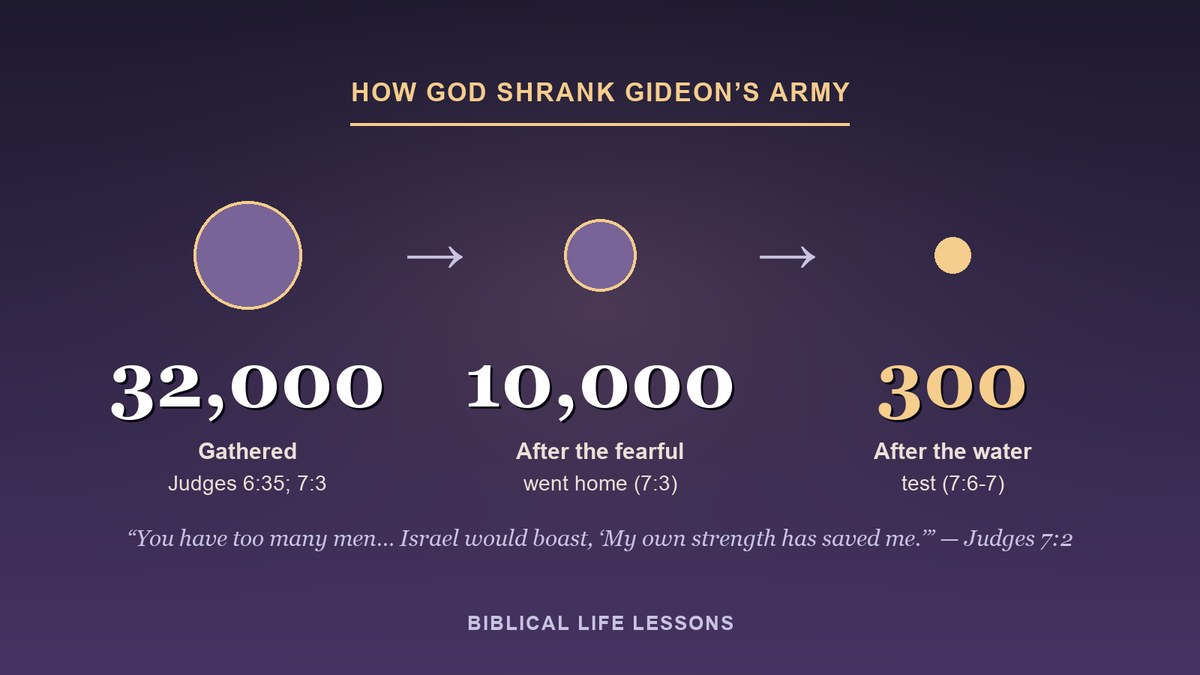
Gideon’s army numbered thirty-two thousand men. Then God said something surprising:
“The LORD said to Gideon, ‘You have too many men. I cannot deliver Midian into their hands, or Israel would boast against me, “My own strength has saved me.”‘” (Judges 7:2, NIV)
First, God told Gideon to send home anyone who was afraid. Twenty-two thousand men left, and ten thousand remained (Judges 7:3). Still too many. God told Gideon to bring the men down to the water. Those who lapped water from their hands were set apart from those who knelt to drink. Only three hundred lapped — and God said, “With the three hundred men that lapped I will save you and give the Midianites into your hands” (Judges 7:7).
Three hundred men against an army “thick as locusts” whose camels “could no more be counted than the sand on the seashore” (Judges 7:12). The point was unmistakable: when this victory came, no one would be able to credit Israel’s strength.
A Dream in the Enemy Camp (Judges 7:9-15)
The night before the battle, God gave Gideon one more reassurance — without being asked. “If you are afraid to attack, go down to the camp with your servant Purah and listen to what they are saying” (Judges 7:10-11).
Gideon crept to the edge of the Midianite camp and overheard a soldier describing a dream: a round loaf of barley bread tumbled into the camp and struck a tent so hard that it collapsed. His friend interpreted it immediately: “This can be nothing other than the sword of Gideon son of Joash… God has given the Midianites and the whole camp into his hands” (Judges 7:14).
The enemy was more afraid of Gideon than Gideon was of them. When he heard it, “he bowed down and worshiped” (Judges 7:15). Then he returned to camp and said, “Get up! The LORD has given the Midianite camp into your hands.”
Trumpets, Jars, and Torches (Judges 7:16-25)
Gideon divided his three hundred men into three companies. Each man carried a trumpet in one hand and an empty jar with a torch inside it in the other. In the middle of the night, they surrounded the camp. At Gideon’s signal, they blew their trumpets, smashed their jars, held up their blazing torches, and shouted, “A sword for the LORD and for Gideon!” (Judges 7:20).
The Midianite camp erupted into panic. In the darkness and confusion, “the LORD caused the men throughout the camp to turn on each other with their swords” (Judges 7:22). The enemy fled, and Israelites from several tribes joined the pursuit. Not one of Gideon’s three hundred had to fight the army head-on. God won the battle.
Victory — and a Troubling Ending (Judges 8)
Gideon pursued the fleeing Midianite kings, Zebah and Zalmunna, and captured them. When the men of Ephraim complained that they had not been called earlier, Gideon answered them gently and defused the conflict (Judges 8:1-3). But when the towns of Succoth and Peniel refused to give his exhausted men bread, he later punished them harshly (Judges 8:5-17). The humble man from the winepress was becoming someone different.
After the victory, the Israelites asked Gideon to rule over them and establish a dynasty. His answer sounded right: “I will not rule over you, nor will my son rule over you. The LORD will rule over you” (Judges 8:23). But then he asked each man for a gold earring from the plunder, and he used the gold to make an ephod — a priestly garment — which he placed in his hometown. Scripture’s verdict is sobering: “All Israel prostituted themselves by worshiping it there, and it became a snare to Gideon and his family” (Judges 8:27).
Israel had peace for forty years during Gideon’s lifetime (Judges 8:28). He had many wives and seventy sons, plus a son named Abimelek by a concubine in Shechem (Judges 8:30-31). After Gideon died, Israel quickly returned to worshiping Baal (Judges 8:33), and Abimelek murdered seventy of his brothers in a grab for power (Judges 9). The man who began by tearing down an idol ended by setting one up.
Even so, the New Testament remembers Gideon among the heroes of faith — named in Hebrews 11:32 alongside Barak, Samson, Jephthah, David, and Samuel — people who “through faith conquered kingdoms” and “whose weakness was turned to strength” (Hebrews 11:33-34).
Five Life Lessons from Gideon’s Story
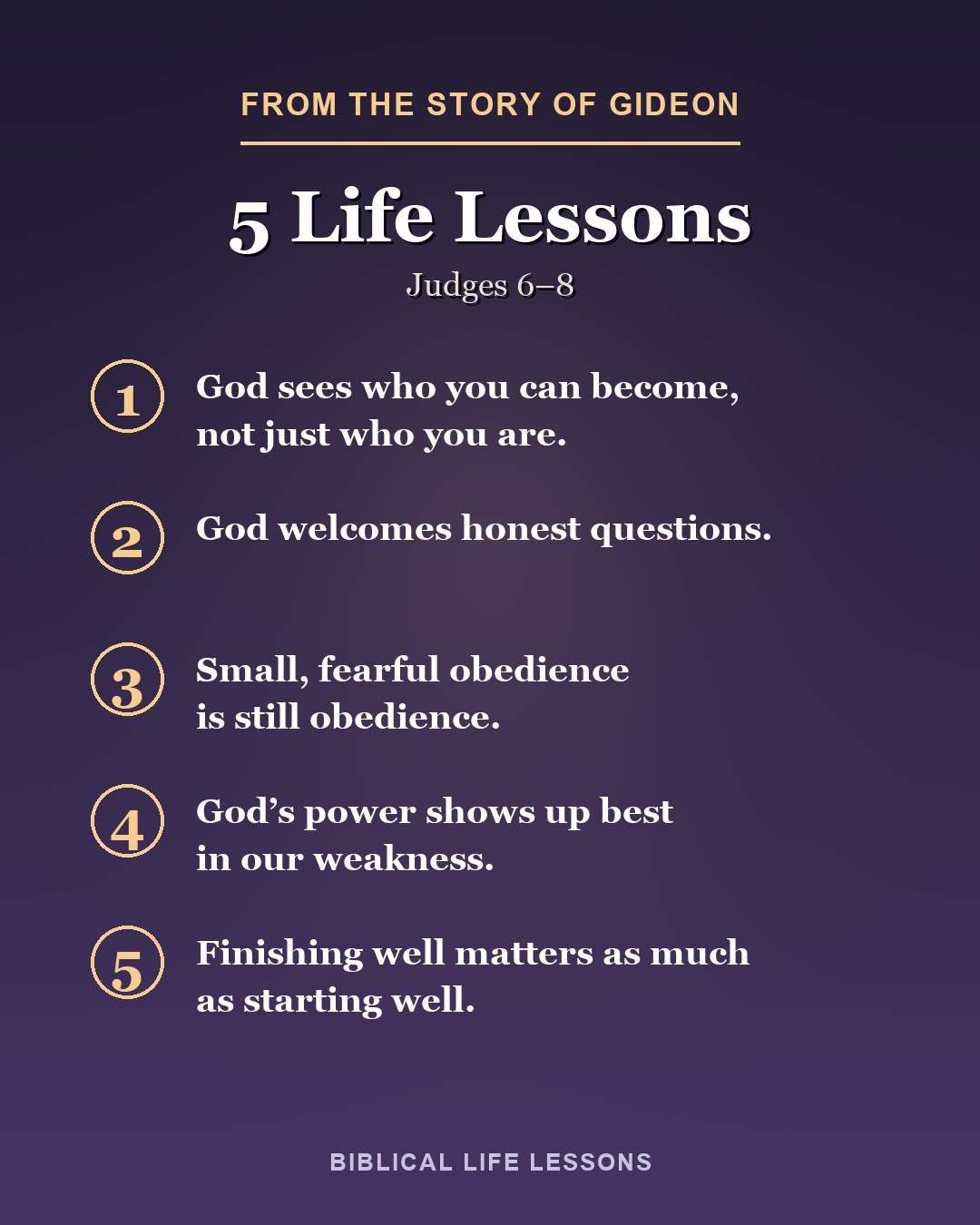
1. God sees who you can become, not just who you are.
Gideon was hiding in a winepress. God called him “mighty warrior.” God was not describing Gideon’s present but declaring His purpose. If you see yourself as weak, fearful, or insignificant, remember that God’s view of you is not limited by how you feel today. He calls people according to what His presence can make of them.
2. God welcomes honest questions.
“If the LORD is with us, why has all this happened to us?” Gideon did not hide his doubts. God did not rebuke him for asking — He answered with a calling and a promise: “I will be with you.” You can bring your honest questions about suffering and God’s silence to Him. He is big enough to handle them.
3. Small, fearful obedience is still obedience.
Gideon tore down Baal’s altar at night because he was afraid. It was not a bold, public stand. But he did it. God often begins with the small, private steps of obedience before He leads us into larger ones. Do not wait until you feel fearless to obey. Take the step in front of you, even if your knees are shaking.
4. God’s power shows up best in our weakness.
God cut Gideon’s army down to three hundred men so that no one could say, “My own strength has saved me.” He still works this way. The apostle Paul heard the Lord say, “My power is made perfect in weakness” (2 Corinthians 12:9). When you feel outnumbered and underqualified, you may be exactly where God can show what He can do.
5. Finishing well matters as much as starting well.
Gideon’s greatest danger was not the Midianite army — it was success. After the victory, pride, harshness, and a golden ephod led him and his family into a snare. Many people start well in faith and stumble later. Gideon’s story urges us to stay humble and keep worshiping God alone, especially after He has given us victory.
Frequently Asked Questions About Gideon
Who were the Midianites?
The Midianites were a nomadic people descended from Midian, a son of Abraham and Keturah (Genesis 25:1-2). In Gideon’s time, they joined with the Amalekites and other eastern peoples to raid Israel every harvest season for seven years (Judges 6:1-6).
What is the meaning of Gideon’s fleece?
Gideon asked God to confirm His promise by making a fleece wet while the ground stayed dry, and then the reverse (Judges 6:36-40). God had already told Gideon what to do, so the fleece reflected Gideon’s struggle to believe rather than a model for discovering God’s will. God graciously met his weakness.
Why did God reduce Gideon’s army to 300?
God said that with too many soldiers, “Israel would boast against me, ‘My own strength has saved me'” (Judges 7:2). By using only three hundred men, God made it clear that the victory came from Him.
What does the name Jerub-Baal mean?
Jerub-Baal means “let Baal contend with him.” Gideon received this name after he tore down his father’s altar to Baal, and his father challenged the townspeople to let Baal defend himself (Judges 6:31-32).
What was Gideon’s ephod?
After his victory, Gideon made an ephod — a priestly garment, possibly an object used to seek divine guidance — from the gold earrings taken as plunder. Israel began to worship it, and it became “a snare to Gideon and his family” (Judges 8:24-27).
How many sons did Gideon have?
Gideon had seventy sons by his many wives, plus a son named Abimelek by a concubine in Shechem (Judges 8:30-31). After Gideon’s death, Abimelek killed his brothers to seize power; only the youngest, Jotham, escaped (Judges 9:5).
Where is Gideon’s story in the Bible?
Gideon’s story is told in Judges 6-8, with the aftermath involving his son Abimelek in Judges 9. He is also mentioned in 1 Samuel 12:11 (as Jerub-Baal), Psalm 83:11, Isaiah 9:4 and 10:26 (“the day of Midian”), and Hebrews 11:32.
Related Reading
For a short devotional on Gideon, see What Gideon Teaches Us About Hearing God’s Voice Over Your Own. For more on how God works through ordinary, underqualified people, read God Doesn’t Call the Qualified, He Qualifies the Called and Broken to Shine: How God Uses Our Weakness. For the judge who led Israel a generation before Gideon, see Who Was Deborah in the Bible? For the leader who first brought Israel into the land, read Who Was Joshua in the Bible? And for a wider guide to the men and women of Scripture, visit our Characters of the Bible pillar.
A Closing Prayer
Father, thank You for Gideon. Thank You that You saw a mighty warrior in a frightened man hiding in a winepress. When I feel weak and unqualified, remind me that You are with me. Thank You for welcoming my honest questions. Give me courage to take small steps of obedience, even when I am afraid. Let Your strength be shown in my weakness, so that You get the glory. And keep me humble after every victory, so that I finish well, worshiping You alone. In Jesus’ name, Amen.
Subscribe for Daily Email Devotionals
MEET FAITH FRIEND AI
Faith Friend is your friendly AI chatbot on BiblicalLifeLessons.com, here to help you explore the Bible, answer your faith-related questions, and guide you through life lessons based on God’s Word. Whether you’re seeking encouragement, understanding Scripture, or deepening your faith, Faith Friend is always ready to chat.