Who Was Rebekah in the Bible? The Complete Story of Isaac’s Wife (Genesis 24-27)
Rebekah is one of the most consequential women in the entire Old Testament — a matriarch of Israel whose “yes” at a well changed the trajectory of God’s covenant story. She is Isaac’s wife, Jacob’s mother, the grandmother of the twelve tribes. Yet most people who know her name know only fragments: the servant, the water jar, the camels. The full arc of her life is far richer, more complicated, and more human than the Sunday-school version.
If you have searched for who Rebekah was in the Bible, or what her story teaches us today, this is a complete guide. We will walk through her family background, the extraordinary betrothal scene in Genesis 24, her long wait for children, the twins she carried, the deception involving Jacob and Esau, and five practical life lessons her story still speaks into ours.
Who Was Rebekah in the Bible?
Rebekah was the wife of Isaac, the daughter-in-law of Abraham and Sarah, and the mother of the twin brothers Esau and Jacob (who would later be renamed Israel). She is the second of the four great matriarchs of Israel — alongside Sarah, Rachel, and Leah — and her story spans nearly the entirety of Genesis 24-27, one of the longest continuous narratives given to any woman in Scripture.
“The servant said to her, ‘Please give me a little water from your jar.’ ‘Drink, my lord,’ she said, and quickly lowered the jar to her hands and gave him a drink. After she had given him a drink, she said, ‘I’ll draw water for your camels too, until they have had enough to drink.'” (Genesis 24:17-19, NIV)
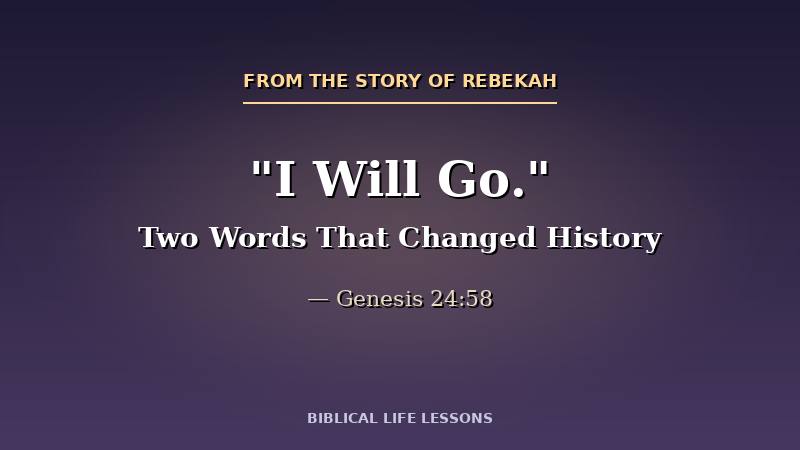
Three things stand out from her introduction. She was a young woman of extraordinary hospitality — offering to water ten thirsty camels is roughly 250 gallons of hauling by hand. She was discerning — she recognized the servant’s request as legitimate and responded generously. And she was willing — when asked days later if she would leave everything she had known to marry a man she had never met, she said in one word what changed history: “I will go” (Genesis 24:58).
The Family Background: Who Were Rebekah’s People?
Rebekah was the granddaughter of Nahor, Abraham’s brother, which made her Isaac’s second cousin. Her family lived in Paddan Aram (northern Mesopotamia), hundreds of miles from Canaan where Abraham and Isaac had settled. Her father was Bethuel and her brother was Laban — the same Laban who would later become Jacob’s uncle and famously difficult father-in-law.
This family lineage matters. Abraham had refused to let Isaac marry a Canaanite woman (Genesis 24:3) and sent his most trusted servant back to his homeland to find a wife from his own extended family. Rebekah was not just any bride. She was the specific woman God had preserved within the covenant family line for the specific son of promise. Her role in the story is theological, not incidental.
The Betrothal at the Well (Genesis 24)
Genesis 24 is the longest chapter in the entire book of Genesis — 67 verses devoted to a single event. That length is a signal. The story of how Rebekah became Isaac’s wife is not a footnote; it is one of the most theologically weighted narratives in the Torah.
Abraham sent his servant (traditionally identified as Eliezer) to find a wife for Isaac. The servant traveled with ten camels laden with gifts, arrived at a well outside the city of Nahor, and prayed a bold prayer: let the right woman be the one who offers water to me and to my camels. Before he had finished praying, Rebekah appeared. She offered him water. She offered to water his camels. She was, in real time, the answer to a prayer she did not know had been prayed.
The servant then went home with her, ate a meal with her family, and asked whether she could return with him to marry Isaac. Her family asked her the question no one had bothered to ask a woman before: “Will you go with this man?” (Genesis 24:58). She answered, “I will go.” Two Hebrew words. And with them, she left her country, her father’s household, everything she had ever known, to walk into a covenant story she could not yet see.
The Long Wait for Children
Rebekah’s story does not skip from wedding to happy family. Genesis 25:20-21 records that Isaac was forty when he married her and sixty when their twins were born — a twenty-year wait. Like Sarah before her, Rebekah struggled with infertility. Isaac prayed for her, and eventually she conceived — but the pregnancy itself was so difficult that she asked God, “Why is this happening to me?” (Genesis 25:22).
Her honest question is one of the most tender moments in all of Genesis. She did not pretend the difficulty away. She brought her confusion directly to God. And God answered her — with a prophecy that would shape everything that followed:
“Two nations are in your womb, and two peoples from within you will be separated; one people will be stronger than the other, and the older will serve the younger.” (Genesis 25:23, NIV)
Rebekah carried that word in her heart for the rest of her life. It would become the interpretive key to every hard decision she made about her sons.
Rebekah’s Sons: Esau and Jacob
The twins were opposites from the moment they were born. Esau came first — red, hairy, and physical, a hunter who lived for the outdoors. Jacob came second, gripping Esau’s heel — a quieter man who stayed among the tents. Isaac loved Esau; Rebekah loved Jacob (Genesis 25:28). That divided-parent dynamic sits at the center of every hard decision that follows.
But Rebekah did not favor Jacob arbitrarily. She had heard God’s word during her pregnancy: the older will serve the younger. She knew the covenant blessing was meant to pass to Jacob, not Esau. And when Isaac grew old and blind and prepared to bless Esau instead, Rebekah made a decision she believed was in keeping with the word she had received — even though the way she carried it out was deeply flawed.
The Deception of Isaac (Genesis 27)
Genesis 27 is uncomfortable reading. Isaac, near death, calls Esau to hunt game and bring it to him so he can give him the paternal blessing. Rebekah overhears. She quickly instructs Jacob to disguise himself with goat skins on his neck and hands (to mimic Esau’s hairiness) and to bring Isaac a meal she prepares from the flock. The deception works. Isaac blesses Jacob thinking he is Esau. When Esau returns and discovers what has happened, he weeps bitterly and vows to kill Jacob.
Rebekah’s motive was theologically defensible — the blessing needed to go to Jacob according to the word God had spoken. But her method was not. She used deceit. She weaponized her son. She damaged her marriage and her family. And in the end, she paid the highest cost: she had to send Jacob away for his safety, and Scripture never records that she saw him again. She did what she believed was right, but she did it in a way that fractured everything she loved.
This is one of the reasons Rebekah’s story is so honest. The Bible does not sanitize its matriarchs. She was faithful, courageous, and consequential — and she was also capable of terrible manipulation. Both are true. That honesty is what makes her real.
Five Life Lessons from Rebekah’s Story
1. God works through willing “yes” answers, not perfect resumes.
Rebekah did not have theology training, ministry experience, or any preparation for what God was asking her to do. She had a water jar and a willing heart. When the question came — “Will you go with this man?” — she said yes to something she could not yet see. Every consequential life in Scripture rides on a moment like that. If God is asking you to go somewhere you cannot yet see, you do not need more information first. You need a “yes.”
2. Your generosity in small moments prepares you for larger callings.
The reason God chose Rebekah was not visible to anyone in her family. It was visible at a well, when she offered water to a stranger and then went above and beyond by watering his ten camels. Nobody was watching. It was not a performance. It was who she was in the ordinary moment. Character formed in the small hours is what qualifies you for the moment God calls you into.
3. Bring your hardest questions directly to God.
Rebekah’s pregnancy was so painful she asked God, “Why is this happening to me?” She did not spiritualize her way around the question. She did not stuff it. She brought it. And God answered her — with a word that would guide the rest of her life. Whatever you are trying to explain away with pious language, please read Genesis 25:22 again. Rebekah asked the question, and God met her in it.
4. Being right about the outcome does not justify a wrong method.
Rebekah was right that Jacob was meant to receive the blessing — God had told her that during her pregnancy. But she was wrong to secure that outcome through deception. The rightness of the ends did not sanctify the wrongness of the means. Genesis 27 is a warning: when you believe you know what God wants, the temptation to help Him along by cutting corners is real. Do not take it. God does not need your manipulation to accomplish His purposes.
5. Favoritism fractures families.
Isaac loved Esau. Rebekah loved Jacob. And the family split down that fault line. Their sons paid for it. Their marriage strained under it. Rebekah lost her favored son to a distant land and, as far as Scripture records, never saw him again. If you are parenting, if you are leading a team, if you are shepherding a family in any form — the story of Rebekah is a plea: refuse to have a favorite. The cost is generational.
Frequently Asked Questions About Rebekah
Who was Rebekah’s husband?
Rebekah married Isaac, the son of Abraham and Sarah. Their marriage is described in Genesis 24 and lasted the remainder of her life. Isaac was forty years old when they married; Rebekah’s exact age is not given, but she is described as a young woman.
Who were Rebekah’s parents?
Rebekah’s father was Bethuel, and her grandfather was Nahor — Abraham’s brother. This made her Isaac’s second cousin. Her mother is not named in Scripture, but her nurse Deborah (a different Deborah from the judge) traveled with her from Paddan Aram and remained with her (Genesis 24:59; 35:8).
How many children did Rebekah have?
Rebekah had two children — twin sons named Esau and Jacob (Genesis 25:24-26). Jacob was later renamed Israel by God (Genesis 32:28) and became the father of the twelve tribes of Israel.
Why did Rebekah help Jacob deceive Isaac?
Rebekah had received a word from God during her pregnancy that “the older will serve the younger” (Genesis 25:23). She believed the covenant blessing was meant for Jacob, not Esau. When Isaac prepared to bless Esau instead, she orchestrated the deception in Genesis 27 to redirect the blessing. Her motive aligned with God’s stated purpose, but her method was manipulative and cost her dearly.
Where is Rebekah buried?
Rebekah was buried in the Cave of Machpelah in Hebron — the same burial site as Abraham and Sarah, and later Isaac, Jacob, and Leah (Genesis 49:31). This cave, purchased by Abraham in Genesis 23, remains identified today at the Tomb of the Patriarchs in Hebron.
Where is Rebekah’s story in the Bible?
Rebekah’s story is told primarily in Genesis 24 (her betrothal), Genesis 25 (her marriage, infertility, and the birth of Esau and Jacob), Genesis 26 (a brief episode in Gerar with Abimelech), and Genesis 27 (the deception of Isaac). She is also mentioned in Romans 9:10-13 as part of Paul’s theological argument about God’s electing purposes.
Related Reading
For a devotional walk through what Rebekah’s “I will go” teaches us about saying yes to God, see our companion devotional What Rebekah Teaches Us About Saying Yes to God Before You Can See the Outcome. For the matriarch whose story preceded hers, see What Sarah Teaches Us About Waiting When the Promise Feels Impossible. And for a wider guide to the men and women of Scripture, visit our Characters of the Bible pillar.
A Closing Prayer
Father, thank You for Rebekah. Thank You that You saw her at a well, that You honored her willing “yes,” and that You wove her into the covenant story You were writing. Give me her willingness to go when I cannot yet see. Give me her honesty in bringing hard questions directly to You. And save me from her mistake — the temptation to help You out by cutting corners when I think I know what You want. Keep me trusting Your purposes AND Your ways. In Jesus’ name, Amen.
Subscribe for Daily Email Devotionals
Subscribe for Daily Email Devotionals
MEET FAITH FRIEND AI
Faith Friend is your friendly AI chatbot on BiblicalLifeLessons.com, here to help you explore the Bible, answer your faith-related questions, and guide you through life lessons based on God’s Word. Whether you’re seeking encouragement, understanding Scripture, or deepening your faith, Faith Friend is always ready to chat.