Who Was Deborah in the Bible? The Complete Story of Israel’s Warrior Judge (Judges 4-5)
Deborah is one of the most extraordinary — and most overlooked — leaders in the entire Old Testament. A woman in a patriarchal age, a prophetess who spoke for God when Israel had almost forgotten how to listen, a judge who held court under a palm tree, and a military strategist whose voice broke the twenty-year grip of Canaanite oppression. Her story sits in the middle of one of the darkest periods in Israel’s history — and it is the story of what God does when a nation runs out of leaders and one woman refuses to stay quiet.
If you have searched for who Deborah was in the Bible, or what her story teaches us today, this is a complete guide. We will walk through the historical setting, her three overlapping roles (prophetess, judge, warrior), the battle against Sisera in Judges 4, the famous “Song of Deborah” in Judges 5, and five practical life lessons her life still speaks into ours.
Who Was Deborah in the Bible?
Deborah was the fourth judge of Israel, mentioned by name only in Judges 4-5 (though her legacy shaped generations afterward). Scripture introduces her with three titles that would have stopped an ancient audience cold:
“Now Deborah, a prophet, the wife of Lappidoth, was leading Israel at that time. She held court under the Palm of Deborah between Ramah and Bethel in the hill country of Ephraim, and the Israelites went up to her to have their disputes decided.” (Judges 4:4-5, NIV)
Three things stand out. She was a prophet — one of only five women in the Old Testament explicitly given that title (alongside Miriam, Huldah, Noadiah, and Isaiah’s wife). She was leading Israel — the Hebrew word used is the same verb applied to every other judge in the book. And she was married, which the text mentions almost in passing, as if to say: her role was not a substitute for her home; it was in addition to it.
The Historical Setting: Israel Under Oppression
To understand Deborah, you have to understand the era. The book of Judges opens with Joshua dead, the Israelites settled in Canaan, and a cycle beginning that would repeat six times: Israel forgets God → God allows an oppressor to rise → Israel cries out → God raises a judge → deliverance → forgetting again. By the time Deborah appears, Israel had been under the thumb of King Jabin of Hazor for twenty years. His army commander, Sisera, had 900 iron chariots — the tanks of the ancient world. Israel had no army capable of standing against them. The main roads were unusable. Trade had collapsed. Villagers hid in the hills. Judges 5:6 says, “The highways were abandoned; travelers took to winding paths.”
Into that hopelessness, Deborah rose.
Deborah’s Three Roles
1. Prophetess
Deborah heard from God and spoke on His behalf. In a period when Scripture says “the word of the Lord was rare” (1 Samuel 3:1, of the following generation), Deborah’s prophetic ministry was extraordinary. She did not merely predict the future — the Hebrew role of the prophet was to declare God’s active will into the present. When she summoned Barak in Judges 4:6-7, she opened with, “The Lord, the God of Israel, commands you…” — not I think, not maybe, but a direct word from God. Her authority came not from position but from proximity to the voice she was speaking for.
2. Judge
Deborah “held court under the Palm of Deborah between Ramah and Bethel.” The palm — which became known by her name — was her open-air courtroom. People walked from all over the hill country to bring her their disputes. In a lawless age, she was the go-to source of wise, godly arbitration. This is worth pausing on: the people themselves recognized her authority. She was not appointed by a king or elected by tribes. Her judgeship was validated by decades of accurate, God-honoring counsel that made her palm the moral center of a nation.
3. Warrior-Leader
Deborah’s most famous role is the one that changed history. God told her that Israel’s deliverer would be Barak, a commander from Kedesh in Naphtali. She summoned him and delivered God’s word: gather 10,000 men, march to Mount Tabor, and I will draw Sisera and his 900 chariots to you and give them into your hand (Judges 4:6-7). Barak’s response is remarkable: “If you go with me, I will go; but if you don’t go with me, I won’t go” (Judges 4:8). Deborah went. She marched with the army. She stood on the mountain. When the moment came, she gave the command: “Go! This is the day the Lord has given Sisera into your hands. Has not the Lord gone ahead of you?” (Judges 4:14).
The Battle Against Sisera (Judges 4)
Everything hinged on the terrain and the weather. Sisera’s chariots were unstoppable on flat ground — but at Mount Tabor, the land sloped, and a sudden downpour turned the Kishon River valley into mud. The 900 iron chariots became stuck. Israel’s foot soldiers, who had trained for close combat, overwhelmed Sisera’s forces. The Canaanite army was routed. Sisera himself fled on foot to what he thought was safety — the tent of Jael, a Kenite woman married to an ally of Jabin. She gave him milk. She let him sleep. And then she drove a tent peg through his temple (Judges 4:21). The prophesied outcome — that a woman would receive the glory of the day — was fulfilled.
The Song of Deborah (Judges 5)
Judges 5 is one of the oldest and most poetically stunning texts in the entire Old Testament — a victory hymn that Deborah and Barak sing together after the battle. Scholars date it to the actual time of the events (around 1200 BC), which makes it one of the very earliest pieces of Hebrew literature we possess. The song recounts the battle, names the tribes who came to fight and shames the tribes who stayed home, describes Jael’s act in vivid poetic detail, and imagines Sisera’s mother waiting at the window for a son who will never come home.
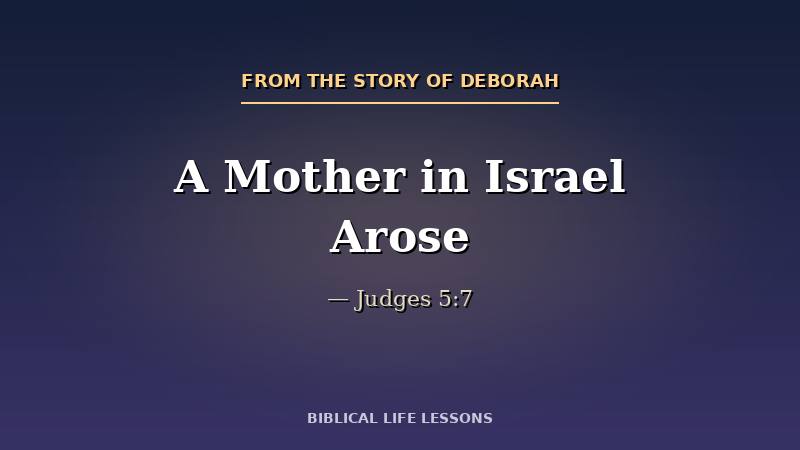
Most striking, Deborah calls herself, in verse 7, “a mother in Israel.” Not just a leader. Not just a judge. A mother. The image of maternal fierceness — protecting the vulnerable, refusing to let the enemy take another child, standing when others sat — sits at the heart of who Deborah understood herself to be. The chapter closes with the note that after the victory, “the land had peace forty years” (Judges 5:31). Deborah’s leadership bought Israel four decades of freedom.
Five Life Lessons from Deborah’s Story
1. God raises leaders where He needs them, not where the culture expects them.
Deborah led in a culture that did not expect a woman to. She did not seize the role — the people came to her under the palm because they recognized the authority in her voice. God is not bound by the categories a culture uses to decide who counts. If God has been prompting you to lead in a place where you are not the expected voice, please read Judges 4:4 again. He appoints whom He appoints.
2. Courage is contagious — but someone has to go first.
Barak refused to go without Deborah. Read that honestly. A hardened military commander needed a prophetess beside him to move. Deborah went. She did not sneer at Barak’s fear. She got up and walked into the danger with him. That is what a certain kind of leader does — not shame the timid, but stand beside them until they can stand alone. Who in your life needs you to go first?
3. The palm tree matters as much as the battlefield.
Deborah’s most sustained ministry was not the day of the battle. It was the years of sitting under her palm, listening to disputes and speaking God’s wisdom into ordinary lives. Battles are memorable; palm-tree seasons are formative. The unglamorous, daily faithfulness of showing up where God has planted you is the soil that produces the dramatic moment when it comes.
4. Shared credit is the mark of a secure leader.
Deborah told Barak that the glory of the day would go to a woman (Judges 4:9) — and it did, but not to her. Jael, an outsider, got the culminating moment. Deborah did not compete for it. In her song (Judges 5:24), she calls Jael “most blessed of women” and celebrates her. Insecure leaders hoard credit. Deborah handed it away. The land had forty years of peace because a leader was more interested in the outcome than in the applause.
5. A “mother in Israel” is not a small thing.
Deborah’s self-description in Judges 5:7 is one of the most powerful sentences in the chapter. She did not call herself a general, a prophet, or a judge — though she was all three. She called herself a mother. Motherhood, in Deborah’s sense, is fierce, protective, standing-in-the-gap presence. Whether you are a mother by biology or not, there is a version of that role God may be calling you into — for a family, a friend group, a workplace, a neighborhood, a church. Being the one who stands when others sit is a spiritual gift with an ancient name.
Frequently Asked Questions About Deborah
Was Deborah the only female judge?
Yes. Deborah is the only woman explicitly listed as a judge of Israel in the book of Judges. She is also one of only five named female prophets in the Old Testament.
Who was Deborah’s husband?
Judges 4:4 identifies her as “the wife of Lappidoth.” Nothing else is recorded about him. Some Jewish traditions suggest Lappidoth was another name for Barak (since the name means “flames” and Barak means “lightning”), but there is no scriptural evidence for this. Most scholars treat Lappidoth as a distinct, otherwise-unmentioned person.
Did Deborah fight in the battle herself?
She did not personally engage in combat. She accompanied Barak to Mount Tabor, delivered God’s word about the timing of the attack, and stood with the army as commander-alongside. The actual fighting was done by Barak’s 10,000 men, with Jael killing Sisera afterward.
How long did Israel have peace after Deborah?
Judges 5:31 records that “the land had peace forty years.” This is one of the longest peaceful periods in the entire book of Judges — a testimony to the depth of the deliverance and the strength of Deborah’s ongoing leadership.
Where is Deborah in the Bible?
Deborah’s story is told in Judges 4 (the narrative account of the battle) and Judges 5 (the poetic Song of Deborah). She is also briefly mentioned in Hebrews 11:32-34 among the great heroes of faith who “through faith conquered kingdoms” — though not by name, the reference is understood to include her.
Related Reading
For a devotional walk through what Deborah teaches us about leading when you feel outnumbered, see our companion devotional What Deborah Teaches Us About Courage When You Feel Outnumbered. For another woman whose faithful “yes” changed the trajectory of biblical history, see What Rahab Teaches Us About God Using the People With the Complicated Past. And for a wider guide to the men and women of Scripture, visit our Characters of the Bible pillar.
A Closing Prayer
Father, thank You for Deborah. Thank You that You raised a mother in Israel in a season when Israel had no leaders. Thank You that You do not choose based on the categories our culture uses to decide who counts. If You are calling me to lead in a place where I am not the expected voice, give me Deborah’s clarity, her courage, and her willingness to walk beside the ones who need someone to go first. Make me a palm-tree presence in the ordinary years, and a mountain-side voice when the day of battle comes. In Jesus’ name, Amen.
Subscribe for Daily Email Devotionals
Subscribe for Daily Email Devotionals
MEET FAITH FRIEND AI
Faith Friend is your friendly AI chatbot on BiblicalLifeLessons.com, here to help you explore the Bible, answer your faith-related questions, and guide you through life lessons based on God’s Word. Whether you’re seeking encouragement, understanding Scripture, or deepening your faith, Faith Friend is always ready to chat.