Matthew 7:7 Meaning: What Jesus Actually Said About Ask, Seek, and Knock
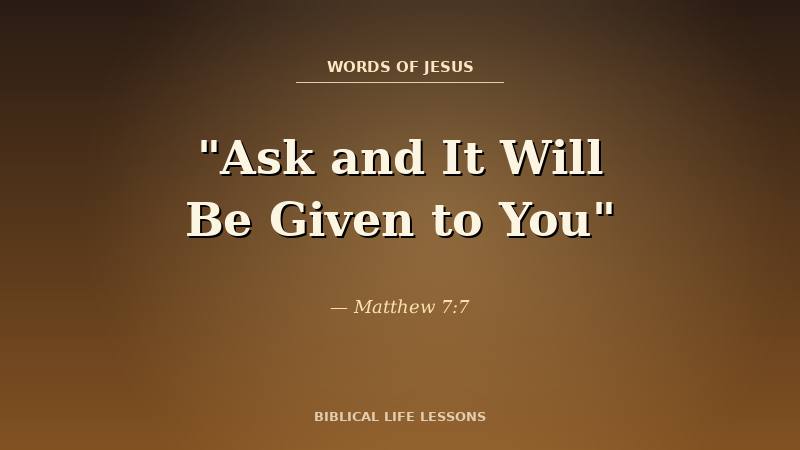
Matthew 7:7 might be the most quoted, most memorized, and most flattened verse in the Sermon on the Mount. Ask and it will be given to you; seek and you will find; knock and the door will be opened to you. It shows up on coffee mugs. It shows up on vision boards. It shows up in prosperity teaching as a formula: ask and you get. And a lot of us have prayed that formula, watched the door stay closed, and quietly concluded that either the verse is not true, or that we were doing it wrong.
The good news is that Matthew 7:7 does mean something extraordinary. But it means something much better — and more honest — than the flattened version most of us learned. This is a deep dive on what Jesus actually said in Matthew 7:7-11, the three action verbs He used, the surprising word in the Greek that changes everything, and the four-word promise underneath the whole passage.
Scripture Focus: Matthew 7:7-11
“Ask and it will be given to you; seek and you will find; knock and the door will be opened to you. For everyone who asks receives; the one who seeks finds; and to the one who knocks, the door will be opened.
“Which of you, if your son asks for bread, will give him a stone? Or if he asks for a fish, will give him a snake? If you, then, though you are evil, know how to give good gifts to your children, how much more will your Father in heaven give good gifts to those who ask him!” (NIV)
Notice something important right away: verses 7 and 8 do not stand alone. Jesus keeps talking. And where He goes next is not more instruction about how to get what you want. It is a portrait of the Father — the kind of Father you are actually talking to when you pray. If you read Matthew 7:7 without Matthew 7:9-11, you will almost always misunderstand it. Read together, the passage is not a formula. It is a revelation.
The Three Verbs: Ask, Seek, Knock
Jesus deliberately escalates the three verbs. They are not synonyms. Each one asks more of you than the last.
Ask
This is the verb of a child. Simple, direct, unashamed. You want something, you name it, you bring it. Asking is not the highest form of prayer, but it is the beginning of it. And it is worth pausing to notice: Jesus does not scold us for asking. He tells us to. If your prayer life has been quiet lately because you have been embarrassed to bring God what you actually want, please start here. He invited the ask.
Seek
Seeking is more than asking. Asking is a sentence; seeking is a search. When you seek, you get up and go look for what you have been asking about. You read the Scripture that touches your question. You seek counsel from the wise. You pay attention to what God is doing around you. Seeking is what asking becomes when you are willing to move.
Knock
Knocking is more than seeking. Knocking is standing at a specific door and refusing to give up until it is opened. Knocking is persistent. It is embodied. It is loud enough to be heard. You cannot knock quietly forever and pretend you were asking earnestly. Jesus is telling us: some doors only open to the person who is still standing there, still knocking, when the sun comes up.
The Greek Word That Changes Everything
In the original Greek, all three verbs in Matthew 7:7 are present continuous imperatives. A more literal translation would read: keep asking, and it will be given to you; keep seeking, and you will find; keep knocking, and the door will be opened. This is a critical detail. Jesus is not describing a one-time transaction. He is describing a posture. He is not saying, “Ask once and expect immediate delivery.” He is saying, “Make asking, seeking, and knocking the ongoing rhythm of your life with the Father.”
That matters because most of us have prayed the one-time version, given up when nothing happened, and concluded that the verse failed. The verse did not fail. We stopped knocking at verse 7 because we did not know Jesus was inviting us into a sustained conversation.
The Heart of the Passage: Matthew 7:9-11
This is where most sermons on Matthew 7:7 stop before they should. Read what comes next slowly. Jesus asks a question every parent understands: “Which of you, if your son asks for bread, will give him a stone? Or if he asks for a fish, will give him a snake?” No decent parent would substitute a rock for a meal. And then Jesus lands the sentence that Matthew 7:7 is really pointing to: “If you, then, though you are evil, know how to give good gifts to your children, how much more will your Father in heaven give good gifts to those who ask him!”
This is the four-word promise underneath the whole passage: God gives good gifts. Not always the specific outcome you asked for. Not always on your timeline. But always good. Matthew 7:7 is not a promise that you will get what you request. It is a promise that when you keep asking, seeking, and knocking, you will be met by a Father who is by nature a giver of good things — and that what He gives will be better, in the long run, than what you might have manufactured on your own.
What Matthew 7:7 Is Not Promising
Because the verse has been so widely misapplied, it helps to name what it is not saying.
- It is not a formula. The right words, the right amount of faith, the right posture — none of these will guarantee a specific outcome. Prayer is not a vending machine, and Jesus never suggested it was.
- It is not name-it-and-claim-it. Nowhere in Matthew 7:7-11 does Jesus say, “Ask for anything you want and you will receive it exactly as you asked.” He promises good gifts, which are His to define, not ours.
- It is not a rebuke for unanswered prayer. Some prayers get a merciful “no” — Paul’s thorn is one example (2 Corinthians 12:8-9). “No” is not evidence that you asked wrong. It is sometimes evidence that God is giving you a gift better than the one you asked for.
- It is not just about material things. The Greek phrase for “good gifts” in Luke’s parallel account (Luke 11:13) is even more specific — the ultimate “good gift” the Father wants to give is the Holy Spirit Himself. The deepest answer to Matthew 7:7 is more of God’s presence, not more of what you had already imagined for yourself.
What Matthew 7:7 Is Actually Promising
Read Matthew 7:7-11 together, and the promise becomes clear:
- God receives your asking. He is not annoyed by it. He invited it.
- He rewards sustained seeking, not one-time transactions. The verbs are present continuous. Keep going.
- He is a Father, not a machine. He responds personally, not mechanically, and He knows the difference between what you asked for and what you actually need.
- He gives good gifts. Sometimes the exact thing you asked for. Sometimes something better. Never a stone. Never a snake.
Practical Steps to Take Today
- Reopen the prayer you stopped praying. If there is a request you gave up on because “nothing happened,” read Matthew 7:7 in its present-continuous form. Keep asking. You did not fail. You just stopped one verse too early.
- Move from asking to seeking to knocking on one specific thing. Ask this week. Then take one action that turns the ask into a seek. Then take another that turns the seek into a knock. Notice how your prayer life changes when the verbs escalate.
- Pray for the Father, not just the gift. Luke’s parallel says the ultimate “good gift” is the Holy Spirit. Sometimes what we are asking for is a substitute for the God who wants to give Himself. Ask for Him, too.
- Refuse the vending-machine version. If you have been treating prayer like a formula and are quietly angry it has not worked, please put that version down. The real Matthew 7:7 is much better, and it does not depend on you saying the right words.
- Trust the “no” you have been resenting. If God has not given you what you asked for, He has not given you a stone. He has given you a different gift — one you may not see the shape of yet. Ask honestly what it might be.
Reflection Questions
- What is a prayer I stopped praying because “nothing happened” — and what would it look like to reopen it this week, in the present-continuous form Jesus actually used?
- Which of the three verbs — ask, seek, knock — do I most need to grow into right now, and what would the next specific action of that verb look like in one specific area of my life?
- If God’s promise in Matthew 7:11 is not “you will get exactly what you ask for” but “you will get good gifts from a good Father,” where in my life do I need to trust the goodness of the gift I have actually been given instead of resenting the one I asked for?
Related Reading
For a deeper look at what happens when God’s answer is “no,” see our devotional What Paul Teaches Us About the Prayer God Does Not Answer the Way You Want. And for a slower walk through God as our Shepherd, see What David Teaches Us About Letting God Shepherd Us Through the Valley.
A Closing Prayer
Father, thank You for Matthew 7:7. Thank You that You did not just invite me to ask — You invited me to keep asking, keep seeking, keep knocking. Forgive me for the times I gave up one verse too early. Forgive me for the times I treated You like a vending machine and got quietly angry when the formula did not work. Grow me into the present-continuous life of prayer You are calling me to. And when the gift You give is not the one I asked for, help me trust that it is still good — because You are still good, and You do not give Your children stones. In Jesus’ name, Amen.
Subscribe for Daily Email Devotionals
Subscribe for Daily Email Devotionals
MEET FAITH FRIEND AI
Faith Friend is your friendly AI chatbot on BiblicalLifeLessons.com, here to help you explore the Bible, answer your faith-related questions, and guide you through life lessons based on God’s Word. Whether you’re seeking encouragement, understanding Scripture, or deepening your faith, Faith Friend is always ready to chat.